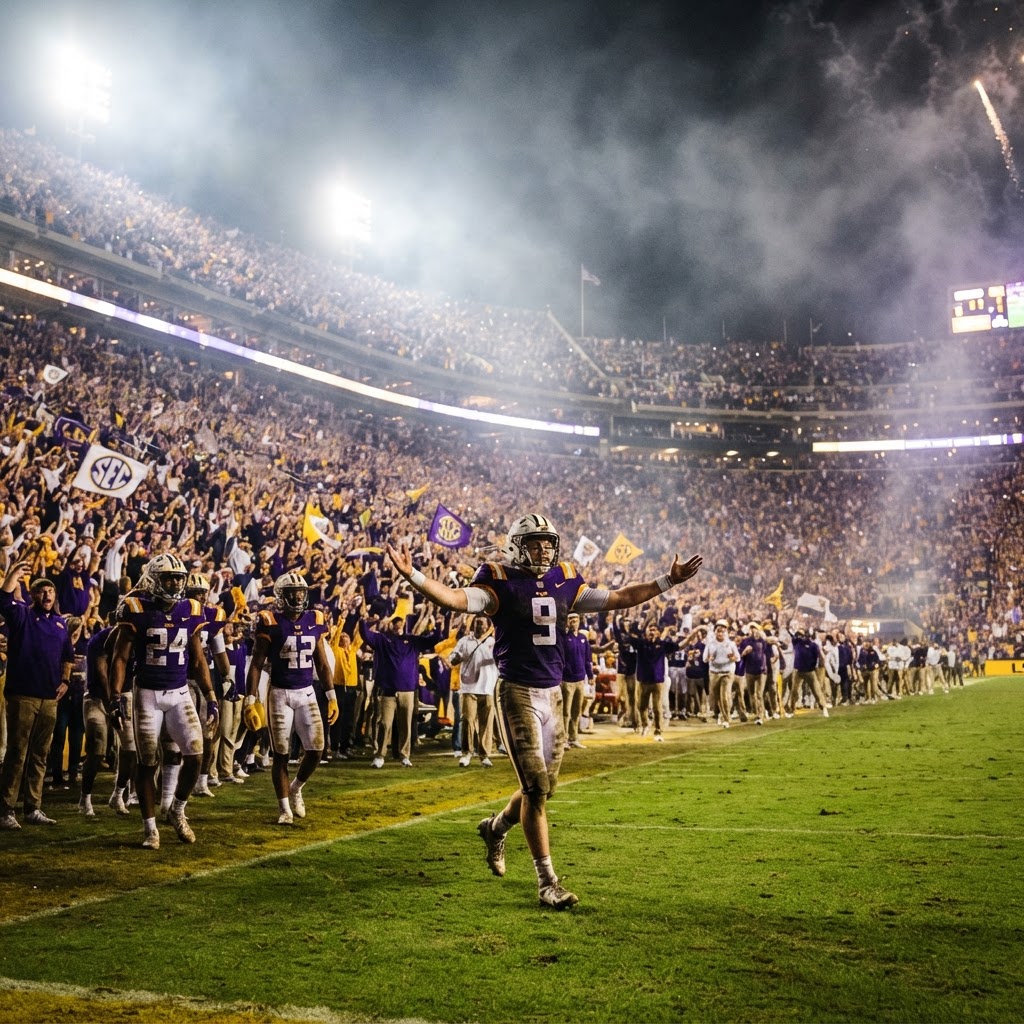
The SEC's Top-10 Takeover: Inside the Debate Over a Five-Bid (or Six-Bid) Playoff League
With 10 teams in the Week 5 AP Top 25 and both the No. 1 and No. 2 spots, the conference is forcing a national reckoning over just how many bids one league can — or should — take

A Conference Occupying Half the Top Ten
There is a version of this story that is simple: the SEC is good, again, still, always. But the Week 5 AP Top 25 did not just confirm the conference's usual depth — it rewrote the ceiling of what a modern super-conference can claim in a single poll. Texas sits at No. 1. Georgia sits at No. 2. Behind them, Alabama, Florida and Ole Miss round out a stretch that gives the SEC five of the nation's top 10 teams. That is not dominance at the margins. That is half the sport's upper crust wearing the same conference patch.
Zoom out further and the number gets almost absurd: 10 SEC programs in the 25-team poll, a full 40 percent of the national ranking belonging to one league. LSU at No. 11. Mississippi State at No. 16. Tennessee at No. 17. Kentucky at No. 24. Missouri at No. 25. Those are not token mid-major flourishes padding a weak bottom — those are programs with real playoff and New Year's Six resumes, stacked on top of a conference that already claims the sport's top two teams.
That volume is why the conversation has shifted from "is the SEC good" to "how many bids does the SEC deserve," and the answers being floated — five, maybe six — have ignited a debate that says as much about the structure of the expanded Playoff as it does about any single team. CBS Sports has reported projections with the SEC locking in at least five bracket spots. ESPN's Heather Dinich went further on The Paul Finebaum Show, floating six. The question this piece has to answer is not whether the SEC is loaded. It obviously is. The question is whether that poll says what everyone assumes it says.
What the Numbers Actually Say
Start with the top of the poll, because it is the cleanest data point available. Texas is No. 1. Georgia is No. 2. That is not a conference making noise in the back half of the rankings — that is a conference holding the two most valuable pieces of real estate in the sport, the spots that come with first-round byes and the most forgiving path through an expanded bracket. When a league has both the top overall seed and the No. 2 team nationally, the burden of proof for "this is a legitimately dominant year" is already satisfied before anyone gets to the other eight teams.
From there, the shape of the SEC's ranking is almost architectural. Alabama at No. 7, Florida at No. 8, and Ole Miss at No. 9 form a three-team wall that keeps the conference inside the top 10 from the very top of the poll through the ninth spot. Then LSU slides in at No. 11, just outside the top 10 but squarely inside anyone's projected at-large field. That is six teams, Texas through LSU, all sitting in territory where a Playoff bid is the expectation rather than the hope.
The back half is where the debate actually lives. Mississippi State at No. 16, Tennessee at No. 17, Kentucky at No. 24 and Missouri at No. 25 are the four teams doing the heavy lifting in the "10 teams in the poll" headline, and they are also the four teams most responsible for every argument about whether the SEC's numbers are inflated by its own depth rather than deflated by any lack of it. Ten teams ranked is a fact. Ten teams deserving Playoff bids is a separate claim, and it is the one actually under debate.
The Opponents Behind the Résumés
Rankings mean little without opponents attached to them, and this is where the SEC's September has been genuinely instructive. Texas's marquee win over Ohio State is the single most discussed result of the young season — a victory SEC Network analysts Dari Nowkhah, Alyssa Lang, Benjamin Watson and Chris Doering pointed to directly when explaining why the league's strength at the top is not theoretical. Beating Ohio State is not a soft nonconference checkbox. It is the kind of result that reorders a conference's entire national perception in a single Saturday.
Georgia's case is built the same way, just with a different kind of statement. The 41-13 blowout of Oklahoma in Athens on September 26 was not a nervy escape — it was a rout, and it came with a signature performance from wide receiver Talyn Taylor, who caught four passes for 110 yards and a 35-yard touchdown, a 27.5-yards-per-catch average that speaks to explosive-play ability rather than simple volume. Oklahoma is not a bottom-feeder opponent. Dismantling that program by 28 points is precisely the kind of result that silences questions about whether a team's ranking is earned or inherited.
Alabama's ascent into the top 10 carries its own supporting evidence. Quarterback Keelon Russell went 21-of-27 for 365 yards and four touchdowns against South Carolina in Week 4, the kind of efficient, explosive quarterback performance that tends to separate contenders from pretenders in close November games. LSU's 35-6 demolition of Texas A&M, fueled by Jackson Harris's 163 receiving yards and two touchdowns on just six catches, adds another data point to the same pattern: this is not a conference accumulating wins against overmatched opponents. These are decisive, explosive results against programs with real national standing.
Ceilings, Not Just Floors
The more interesting question for October is not who gets in, but who can actually win it. Texas and Georgia occupying the top two spots nationally means both programs are being treated, correctly, as true championship-ceiling teams rather than simply Playoff-ceiling teams. There is a meaningful difference. A team can be good enough to make a 12-team bracket and still be nowhere near good enough to survive three rounds of it. Texas and Georgia, by virtue of sitting at Nos. 1 and 2, are the two programs nobody is making that distinction about.
Alabama's ceiling argument is more quarterback-dependent, and that is precisely the point of highlighting Russell's 365-yard, four-touchdown outing. A offense that can produce that against South Carolina has the explosive upside to matter in January, not just November. Florida and Ole Miss, rounding out the top-10 contingent, carry the kind of resume that makes them dangerous rather than simply tournament-eligible — teams capable of being the bracket's most disruptive out if matched correctly.
The more honest ceiling conversation belongs to the bottom half of the SEC's ranked teams. Mississippi State at No. 16 improved its position specifically by beating Missouri, 31-24, overcoming a 156-yard, two-touchdown performance from Mizzou receiver Cayden Lee in the process — a result that simultaneously boosted Mississippi State's case and did real damage to Missouri's own ranking, which still sits at No. 25 despite Lee's production. Tennessee and Kentucky occupy a tier where a Playoff bid is plausible but a deep run is not the expectation. That gap between "ranked" and "dangerous" is exactly what fuels skepticism about a six-bid projection.
The Coaching and Roster Thread
Behind every one of these results is a program-building story that explains why the depth is not an accident. Texas's win over Ohio State did not happen in a vacuum — it is the product of a roster now operating at the standard the SEC Network panel described when crediting the league's top-end strength. Georgia's blowout of Oklahoma showcased a skill-position weapon in Talyn Taylor whose big-play profile — 27.5 yards per catch on just four targets — suggests a roster capable of manufacturing explosive plays against elite competition, not just compiling yardage against lesser opponents.
Alabama's story is the clearest quarterback-development arc in the league's top 10. Keelon Russell's 21-of-27, 365-yard, four-touchdown performance against South Carolina is the kind of efficiency marker that programs build championship pushes around, and it is a central reason analysts have been comfortable placing Alabama in the top 10 rather than treating its ranking as a reputation-based placeholder. LSU's identity this season runs through its passing game as well, with Jackson Harris's 163-yard, two-touchdown outing against Texas A&M providing the explosive receiving production that elevates a blowout win into a genuine résumé centerpiece.
Mississippi State's climb to No. 16 is a reminder that the SEC's depth is not just about its traditional powers. Beating Missouri on the road against a quarterback-to-receiver connection as productive as Cayden Lee's 156-yard, two-touchdown showing is meaningful regardless of where Mississippi State ultimately lands in the Playoff conversation. It is precisely these mid-table, program-building results that inflate the SEC's total ranked-team count — and precisely why that count alone cannot be the only evidence offered for a five- or six-bid projection.
The National Reaction — and Its Limits
The debate did not stay confined to poll analysts and bracket projectors. Heather Dinich's projection of up to six SEC teams making the Playoff field, delivered on The Paul Finebaum Show, became the lightning rod for the entire conversation — a number aggressive enough to force every other outlet to stake out a position in response. CBS Sports's own reporting landed on a more conservative but still extraordinary projection: at least five SEC bids, a number that would represent nearly half of an expanded field claimed by a single conference.
SEC Network's own panel — Dari Nowkhah, Alyssa Lang, Benjamin Watson and Chris Doering — framed the conversation in terms of top-end strength rather than pure volume, specifically citing Texas's win over Ohio State as the signature result validating the league's standing. That is a notably different argument than Dinich's six-bid projection; it is a case built on quality at the summit rather than quantity across the board, and the distinction matters enormously to how seriously each projection should be taken.
What's clear is that the debate itself has become the story, independent of its eventual resolution. A conference putting 40 percent of the AP Top 25 on the board, while simultaneously holding the two highest rankings in the country, was always going to generate exactly this kind of reaction — equal parts legitimate recognition and reflexive suspicion that a poll this lopsided must be inflating itself. Both instincts are reasonable. Neither one, on its own, settles anything.
What Happens Next
The resolution to this debate will not come from preseason-adjacent poll positioning — it will come from what these teams do to each other. With five SEC teams in the national top 10 and five more packed into the back half of the poll, head-to-head November collisions are inevitable, and they will do more to validate or deflate the five-and-six-bid projections than any analyst panel possibly could. A Texas-Georgia rematch scenario, or any scenario where top-10 SEC teams play each other, will immediately start subtracting from whichever bid-count projection is currently in vogue.
The teams in the back half of the ranking carry the heaviest burden of proof. Mississippi State, Tennessee, Kentucky and Missouri all need their next several weeks to look like Mississippi State's win over Missouri — competitive, decisive, and against opponents the committee will respect — rather than accumulation against the schedule's softer stretches. If even two of those four teams fade from the rankings over the next month, the "10 ranked teams" headline evaporates and the realistic bid count shrinks with it.
Equally, the top five have their own test coming: strength of schedule is about to get unforgiving for everyone, and results like Georgia's 41-13 statement over Oklahoma or Alabama's Russell-led outburst against South Carolina will need SEC-caliber sequels, not just nonconference or crossover validation. The sport will know far more about whether six bids is realistic, or even five, by the time November's SEC-on-SEC schedule has run its course.
The Bottom Line
The numbers are not exaggerated: Texas and Georgia at Nos. 1 and 2, five SEC teams in the top 10, and 10 total programs in the AP Top 25 are facts, not spin, and they are backed by real results — Texas over Ohio State, Georgia's 41-13 dismantling of Oklahoma, Alabama's 365-yard Russell outburst, LSU's 35-6 rout of Texas A&M. That is a conference with legitimate championship-ceiling teams at the top and genuine depth running all the way to No. 25. The five-bid projection from CBS Sports is not reckless; it is supported by exactly the kind of résumé evidence this piece has walked through.
The six-bid projection is the more fragile claim, resting on the back half of the poll holding its position through a brutal conference schedule that has not yet been played. Mississippi State, Tennessee, Kentucky and Missouri earned their rankings, but "ranked in Week 5" and "Playoff-worthy in Week 15" are different standards, and the gap between them is where this entire national debate will ultimately be settled.
Published 18 days ago
Staff
Staff writer for SEC Saturday Wire covering college sports.
Process Notes & Methodology
Treat the SEC's historic 10-team, top-two-ranked Week 5 showing as a genuine journalistic puzzle: separate the undeniable (Texas/Georgia at 1-2, five in the top 10, 10 total ranked) from the contested (whether that supports five or six Playoff bids). Structure the piece to move from raw numbers to opponent quality to ceiling analysis to the coaching/player evidence behind the rankings, then to the actual national reaction (Dinich/Finebaum, CBS, SEC Network panel) before projecting forward to the November schedule that will resolve the debate.
Opened with the simple framing device (a conference occupying half the top ten) to establish scale immediately, then escalated to the 40% statistic, then pivoted the lede's third paragraph directly into the central tension of the piece — five bids vs. six bids — so the reader knows exactly what's being argued before the body sections begin.
Built six distinct analytical threads as required: a numbers-literal breakdown of the poll tiers, an opponent-quality section built around the Ohio State, Oklahoma, South Carolina, and Texas A&M results, a ceiling-vs-floor distinction between the top-10 teams and the back-half-ranked teams, a coaching/roster section tying specific player stats (Taylor, Russell, Harris, Lee) to program trajectories, a national-reaction section contrasting Dinich's six-bid projection against CBS's five-bid number and the SEC Network panel's quality-based argument, and a forward-looking section on how the unplayed November SEC schedule will actually adjudicate the debate. Every statistic, score, and name used is drawn directly from the provided ground truth with no invention.
Closed by explicitly validating the five-bid case as evidentiary while treating the six-bid case as the more speculative, schedule-dependent claim — giving the piece a clear, defensible verdict rather than a vague both-sides shrug, while reiterating the specific stats that earned each tier of teams their ranking.
See something wrong? Fix it.
We're the first crowdsourced college football site. Submit corrections — our editors review every one.