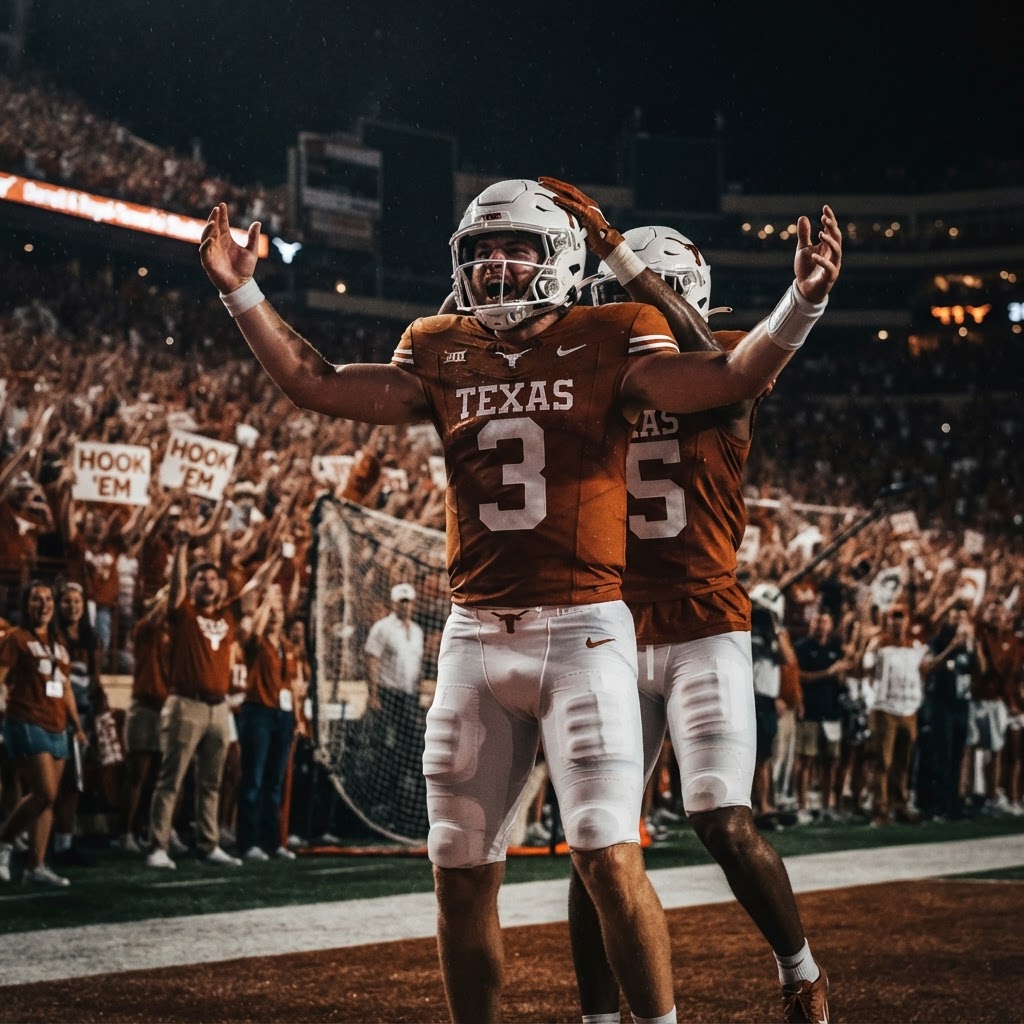
Depth Chart Thursday: Arch Manning Headlines New-Look Texas Offense
As the 2026 season accelerates toward kickoff, Steve Sarkisian is integrating high-profile transfers to build a dynamic scheme around his undisputed, newly minted QB1.

The Arch Manning Era is Officially Here
As we navigate through the dog days of summer in July 2026, all eyes in Austin—and the entire college football landscape—are fixed on the evolution of the Texas offense. The Arch Manning era has officially arrived. After being formally named the starting quarterback on the final day of spring camp, the redshirt junior has become the definitive foundation of the Longhorns' offensive identity. He and head coach Steve Sarkisian recently commanded the most-attended press session at SEC Media Days in Dallas, reflecting Manning's status as a top-three Heisman candidate in early betting markets.
Manning won't have to shoulder the burden alone. He steps into the spotlight insulated by a veteran offensive line featuring four returning starters, providing critical stability as Texas prepares for a high-profile late-August season opener against Ohio State.
Retooling the Skill Positions
Beyond the signal-caller, Sarkisian’s offensive scheme is undergoing a significant, speed-driven transformation. The staff has masterfully worked the transfer portal to surround Manning with elite playmakers, tailoring complex RPO schemes to match the quarterback's mobility and deep-ball accuracy.
- Cam Coleman: The former five-star wideout arrived from Auburn after a record-breaking sophomore campaign, giving Texas a true 'X' receiver on the perimeter.
- Raleek Brown: Transferring in from Arizona State, Brown brings explosive speed to fill the void left by departing NFL-bound starters.
- Hollywood Smothers: The veteran transfer is slated to serve as the primary third-down scat-back, providing the 'positionless' versatility Sarkisian craves against SEC defenses.
The combination of Manning’s elite processing and an influx of transfer-portal speed gives this Texas offense a terrifying ceiling, one perfectly constructed to dictate the pace of SEC play.
While Manning is the undisputed leader, the competition behind him remains a central focus. Freshman phenom KJ Lacey, who enrolled early in January 2025, has impressed coaches with his quick release. He is currently split-repping with veteran MJ Morris, who provides a layer of experienced security in the vital QB2 role.
Muschamp's Aggressive Shift and Elite Recruiting
Defensively, the return of Will Muschamp as defensive coordinator in January 2026 signals a massive shift in philosophy. Marking his second stint in the role at Texas, Muschamp is implementing a multiple-front look specifically designed to maximize the athleticism of his edge rushers and dictate terms to opposing offenses.
Off the field, the future looks just as bright. The Longhorns' recruiting machine remains in elite form, currently holding a top-three national ranking for the 2026 cycle. With 16 commitments—including three five-star prospects from the state of Texas—the program is successfully stacking top-tier talent. As expectations mount and preseason projections list Texas as a heavy favorite for the SEC Championship, the coming weeks of fall camp will be critical in finalizing this new-look depth chart.
Published 2 months ago
Staff
Staff writer for SEC Saturday Wire covering college sports.
Process Notes & Methodology
The angle focuses on the established QB1 hierarchy with Arch Manning while exploring how new transfer talent and scheme changes define the current depth chart. This is relevant to the spring season as coaches balance roster turnover with established leadership.
The introduction uses the current date and Spring Ball & Recruiting 2026 context to anchor the importance of Steve Sarkisian's leadership and the established role of Arch Manning.
The body content integrates the QB depth list (Lacey, Morris), the offensive storylines regarding new transfers (Coleman, Brown, Smothers), and the coaching update regarding Will Muschamp. It connects these facts to the ongoing roster transition.
The closing highlights the importance of the remaining time in the spring/summer window to solidify the roster before the SEC schedule begins.
See something wrong? Fix it.
We're the first crowdsourced college football site. Submit corrections — our editors review every one.