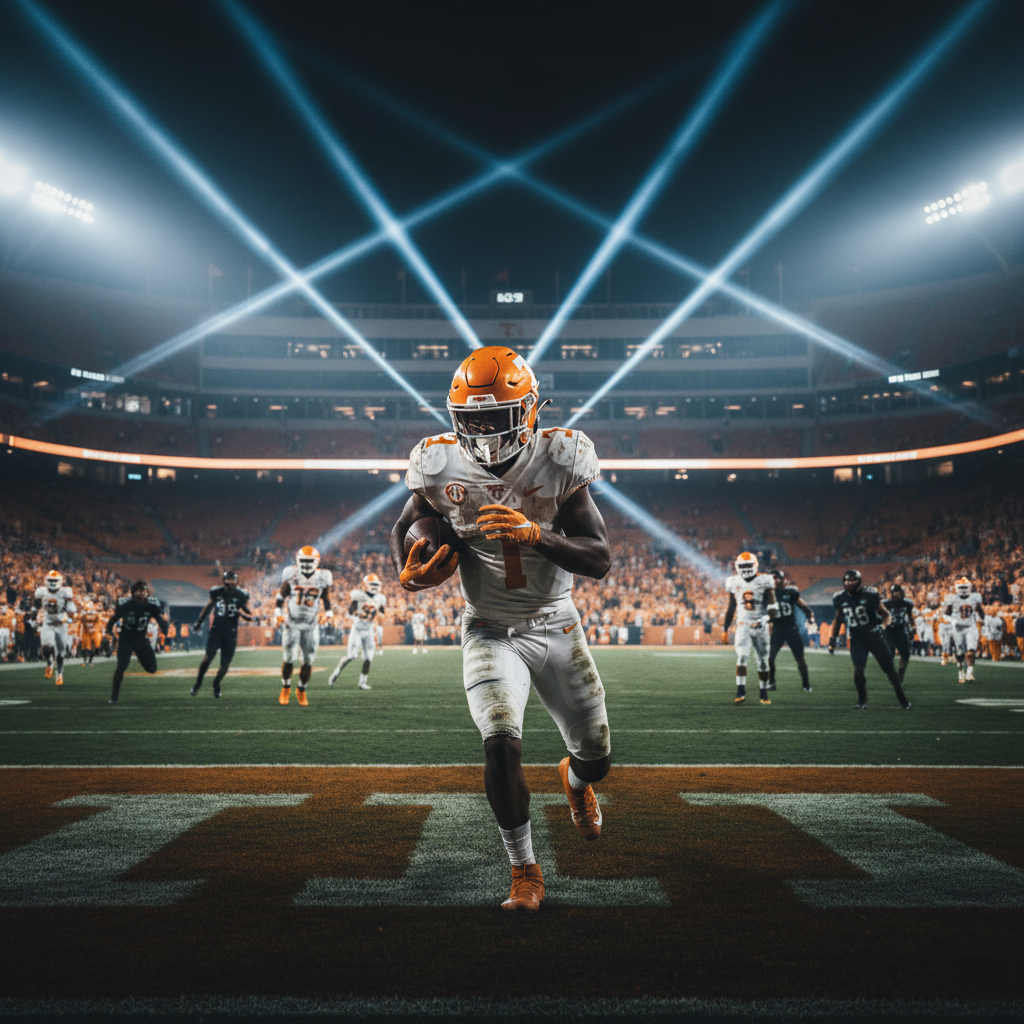
Depth Chart Thursday: Tracking Tennessee's Post-Spring Position Battles
With the Orange & White Game in the rearview, we break down the Volunteers' crucial quarterback duel and a revamped defense under Jim Knowles.

Depth Chart Thursday: Tracking Tennessee's Post-Spring Position Battles
As the Spring Ball & Recruiting 2026 season marches through late May, the Tennessee Volunteers are actively taking stock of their roster. Following a tough 30-28 loss to Illinois in the Music City Bowl to close out last season, head coach Josh Heupel is looking to retool his squad. With the April 11 Orange & White Game providing nearly 48,000 fans a glimpse of the 2026 team in Neyland Stadium, this week's Depth Chart Thursday examines where the most critical position battles stand.
The Offensive Engine: Who is QB1?
The most pressing question on Rocky Top revolves around the quarterback position. The starting role is currently completely up in the air as offensive coordinator Joey Halzle oversees a high-stakes battle. Underclassman George MacIntyre and highly touted true freshman Faizon Brandon are trading reps, with Colorado transfer Ryan Staub adding experienced depth to the mix. Heupel has kept his cards close to his vest, meaning this competition will almost certainly stretch deep into fall camp.
Whoever wins the job will have the luxury of an incredibly experienced supporting cast. Running back DeSean Bishop enters 2026 with sky-high expectations, largely due to the formidable returning offensive line paving his way. Anchored by David Sanders Jr. at offensive tackle and interior veterans Wendell Moe Jr., Sam Pendleton, and Jesse Perry, the trenches should be a major strength. Additionally, returning wide receivers Mike Matthews and Braylon Staley are locked in as the primary targets for whichever quarterback ultimately wins the job.
Rebuilding the Defensive Trenches and Secondary
On the other side of the ball, the arrival of new defensive coordinator Jim Knowles signals a philosophical shift for the Volunteers as he installs his signature system. Knowles inherited a defense that saw massive attrition to the NFL Draft, particularly along the defensive line and secondary. Edge rusher Joshua Josephs and defensive lineman Tyre West heard their names called in the middle and late rounds, while Bryson Eason and Dominic Bailey signed as undrafted free agents. To fill these voids, Tennessee hit the portal hard, bringing in Xavier Gilliam from Penn State and Jordan Norman from Tulane. Notably absent from spring practice was highly-touted transfer edge Chaz Coleman, whose off-field situation currently leaves his depth chart status in limbo.
The secondary is undergoing a similar facelift following the departures of drafted cornerbacks Colton Hood (New York Giants) and Jermod McCoy (Las Vegas Raiders), as well as Jalen McMurray (Tennessee Titans). Knowles will heavily rely on a trio of incoming transfers—Kayin Lee (Auburn), Qua Moss (Kansas State), and safety Dejuan Lane (Penn State)—to lock down starting roles in the defensive backfield. Fortunately, the linebacking corps remains stable, with Arion Carter and Amare Campbell returning to anchor the middle of the defense.
Looking Ahead
While the offensive line and linebackers offer known commodities, the ceiling for the 2026 Volunteers ultimately hinges on the resolution of the quarterback battle and how quickly the transfer portal additions can assimilate into Jim Knowles' defensive scheme. As the summer recruiting cycle heats up, these depth chart battles will be the focal point of Tennessee's preparation for the fall.
Published 5 months ago
Staff
Staff writer for SEC Saturday Wire covering college sports.
Process Notes & Methodology
The article provides a comprehensive depth chart breakdown for the Tennessee Volunteers during the Spring Ball & Recruiting 2026 window. It addresses the overarching theme of position battles by dissecting the roster turnover and analyzing where the current competition stands following spring practice.
The introduction hooks the reader by establishing the timeline (May 2026) and setting the stage with the April 11th Orange & White Game. It also anchors the piece around the team's motivation to bounce back from the specific 30-28 Music City Bowl loss to Illinois.
The body is constructed directly from the provided team context, contrasting the unsettled QB battle (MacIntyre vs. Brandon vs. Staub) with the veteran offensive line and DeSean Bishop. Defensively, it maps the massive NFL departures (Josephs, West, Hood, McCoy) against the new incoming transfers (Gilliam, Norman, Lee) while acknowledging Jim Knowles' arrival and Chaz Coleman's uncertain status.
The conclusion briefly summarizes the stakes of the depth chart battles. It pivots forward to the rest of the Spring Ball & Recruiting season, emphasizing that the resolution of the QB battle and the defense's adaptation to Knowles' system will dictate the team's ceiling in the fall.
See something wrong? Fix it.
We're the first crowdsourced college football site. Submit corrections — our editors review every one.