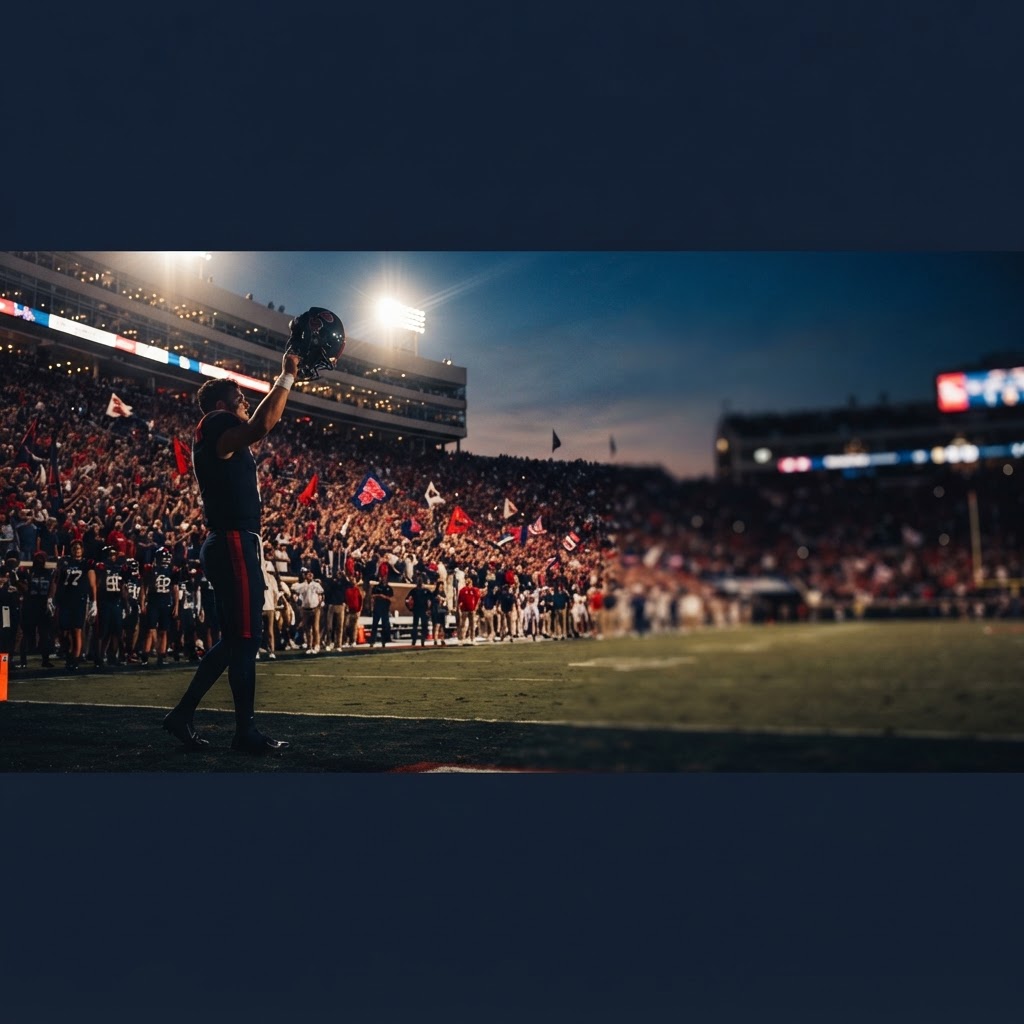
Ole Miss Has the Best Wins in College Football and the Fourth-Best Ranking
The Rebels are the only team in the country with two wins over ranked opponents. The AP poll has them fourth — and the CFP committee inherits that framing.

Three Wins, Two Ranked, One Question the AP Can't Answer
Ole Miss is 3-0. That part is simple. What makes the Rebels the most interesting data point in the sport right now is not the record itself but what is stacked underneath it, because through three weekends of the 2026 season Ole Miss is the only team in the country holding wins over two currently ranked opponents. That is not a talking point manufactured in Oxford. It is the arithmetic of the schedule they have already played.
The Rebels opened by beating No. 24 Louisville 41-38 in the inaugural Music City Kickoff in Nashville, a game decided by Lucas Carneiro's 48-yard field goal as the clock hit zero. Two weeks later they beat No. 7 LSU 32-24 in Oxford in Lane Kiffin's return, a game they led 17-0 and then 24-7 before surviving a fourth-quarter push. Neutral site against a ranked team, then home against a top-10 team. Three games in, no losses, and a resume with actual names on it.
And the AP Top 25 has them fourth. Behind Texas, Georgia, and Notre Dame. The poll is not wrong in any scandalous sense — those are three very good teams — but it is revealing, because the thing Ole Miss has done better than anyone in America is precisely the thing the AP poll is not built to measure. Which raises the question worth asking in September rather than November: if the human poll does not follow strength of schedule, why would anyone assume the College Football Playoff committee will?
What Strength of Schedule Actually Looks Like Right Now
Put the top four side by side and the difference is not subtle. Texas is No. 1 and earned it with a comeback win over Ohio State, then followed it with a 30-6 handling of UTSA. Georgia is No. 2 at 3-0, its most recent result a 45-17 win at Arkansas. Notre Dame is No. 3 at 3-0, coming off a 27-10 win over Michigan State in which the Irish defense did most of the heavy lifting after halftime.
Those are legitimate resumes. Only one of them includes a win over a team ranked in the current top 10, and it is not the one ranked first, second, or third. Ole Miss owns that win. Ole Miss also owns the neutral-site win over a ranked Louisville team that most of the sport spent the offseason underrating. Nobody else in the country has two.
The counterargument is that margin matters, and it does — a 45-17 road win looks more authoritative than a walk-off field goal. But margin measures how a team handled the opponent in front of it. Strength of schedule measures whether that opponent was worth handling. A 38-point win over an unranked team and a three-point win over a ranked one are not the same achievement dressed differently, and treating the former as more impressive is how a poll ends up rewarding scheduling rather than football.
The Poll Voted on Ole Miss Before It Watched Ole Miss
Here is the part that should bother anyone who takes the rankings seriously as a measurement rather than a mood. Ole Miss entered the LSU game ranked No. 8 by the AP. The Rebels were 2-0 at that point with a win over a ranked Louisville team already in hand, and the voting body had them eighth, behind teams whose best win was a body-bag game. The eighth-ranked team beat the seventh-ranked team in that spot, and the movement it produced was four spots.
That is what a poll built on preseason perception looks like in practice. The order gets set in August based on returning production, recruiting rankings, brand, and coaching name recognition, and then results are applied as small corrections on top of it rather than as the foundation underneath it. Ole Miss did not climb from eighth to fourth because voters recalculated the resume from scratch. They climbed because the poll nudges.
The independent power rankings tell you how differently this looks when someone starts from zero. Wolf Sports moved Ole Miss to No. 2 in its Week 4 rankings, ahead of Georgia and Notre Dame, and wrote that a real case exists to put the Rebels at No. 1 — while explicitly noting that having been ranked only eighth before the LSU game "felt off" and would likely keep them outside the top three in the eyes of AP voters. ESPN's power rankings, meanwhile, landed on No. 4, the same as the poll. Reasonable people are reaching different conclusions, and the spread between No. 2 and No. 4 is not a rounding error — it is the difference between a bye and a first-round game if it holds.
Why the CFP Committee Is Not the Fix
The standard reassurance is that none of this matters because the AP poll has no formal role in selection. True. The committee builds its own rankings, meets in person, and is instructed to weigh strength of schedule, head-to-head results, and results against common opponents. On paper that is exactly the correction Ole Miss needs.
In practice, the committee is a room full of people who watch the same broadcasts, read the same coverage, and absorb the same weekly narratives as everyone else, and those narratives are seeded in August by the polls the committee supposedly ignores. A team that spends September ranked eighth is discussed as the eighth-best team. When the committee's first rankings arrive, that framing is not erased — it is the water everyone has been swimming in for two months.
The committee also has a structural excuse the AP does not: it only ranks teams it has seen play a full season's worth of games, which means the early resume advantage Ole Miss holds today gets diluted by everything that happens between now and November. Being the only team with two ranked wins in September is worth something only if it is still true in December. Which is a fair standard. It is just not the standard being applied to the teams ranked ahead of them right now, and that asymmetry is the whole complaint: schedule strength is treated as a tiebreaker at the end and ignored as a credential at the start.
The Nine-Game Schedule Changes the Math for Everyone
All of this lands in the first season in which every SEC school plays nine conference games, a format the conference announced in August 2025 and implemented for 2026. That is not a cosmetic change. It removes a non-conference tune-up from sixteen schedules and replaces it with a league game, which means every SEC team's strength of schedule rises and every SEC team's margin for error shrinks at the same time.
The SEC currently has ten teams in the AP Top 25. Ten. In a nine-game conference format, that density guarantees that a meaningful share of those ten will finish with losses they would not have absorbed under the old eight-game model. Those losses will not be evidence of decline. They will be evidence of the schedule. And the ranking systems that do not properly price strength of schedule will read them as decline anyway.
Ole Miss is the test case. The Rebels go to No. 21 Florida on September 26, then face Missouri, then travel to Texas, then host Georgia, then go to Oklahoma. That is a stretch that would break most teams' playoff odds regardless of talent. If they emerge from it at 7-2 or 8-1, the honest reading is that they played a harder nine-week stretch than most one-loss teams played all year. The question is whether anyone with a vote reads it that way.
The Bottom Line
Ole Miss has the best collection of wins in college football and the fourth-best ranking, and both of those statements are defensible at the same time because the poll is not answering the question the resume poses. The Rebels are not owed the No. 1 spot. They are owed a ranking that reflects that they have already beaten a top-10 team and a ranked top-25 team while the teams above them have, between them, one comparable win.
The honest concession is that Ole Miss has not yet proven it can survive the schedule still in front of it. Florida on the road, then Texas, then Georgia, then Oklahoma — any of those can end the conversation. Nothing about a 3-0 start guarantees a November. But the argument here was never that the Rebels are the best team in the country. It is that the system currently ranking them fourth did not arrive at fourth by evaluating what they have done, and a committee that inherits that framing in November is unlikely to relitigate it from scratch. The Rebels' best defense against a poll that does not follow strength of schedule is to keep beating ranked teams until following it becomes unavoidable.
Process Notes & Methodology
Every score, rank, and record in this piece was verified against primary reporting before publication. Final scores and individual statistics come from ESPN game recaps and Associated Press game coverage. Rankings are the AP Top 25 released September 20, 2026. Independent power rankings are cited by name and outlet rather than referred to generically. The nine-game conference schedule detail is sourced to the SEC's own December 2025 schedule release, which states 2026 is the first season in which every school plays nine conference games.
Corrections note: an earlier version of this article reported the Ole Miss–LSU final as 41-38 and stated Ole Miss had risen to No. 3. Both were wrong. The LSU game finished 32-24; the 41-38 score belongs to the Rebels' Music City Kickoff win over Louisville on September 6. Ole Miss is No. 4 in the AP Top 25. That version also stated LSU quarterback Sam Leavitt was doubtful and that LSU played through quarterback uncertainty; Leavitt started and played, throwing for 153 yards and a touchdown and rushing for 63 yards and a score. Those claims have been removed.
Sources: ESPN — Ole Miss 32-24 LSU recap · ESPN — Ole Miss 41-38 Louisville recap · NCAA — Week 4 AP Top 25 · Wolf Sports — Week 4 Power Rankings · ESPN — Week 3 Power Rankings · Ole Miss Athletics — 2026 Schedule · SEC — 2026 Football Schedule Release
Published 8 days ago
Staff
Staff writer for SEC Saturday Wire covering college sports.
Process Notes & Methodology
Rewritten from scratch after a fact check found a fabricated 41-38 final (that score belongs to the Louisville opener), a phantom No. 3 ranking, and a false Sam Leavitt injury premise. New angle: Ole Miss owns the best set of wins in the sport (only team with two wins over currently ranked opponents) while sitting fourth in the AP, and if the human poll does not price strength of schedule, the CFP committee that inherits its framing is unlikely to either.
Opens on the verified resume — 3-0, 41-38 over No. 24 Louisville at the Music City Kickoff on a walk-off 48-yard field goal, 32-24 over No. 7 LSU in Oxford — then poses the AP-vs-CFP question rather than asserting a ranking.
Compares the top four resumes directly (Texas over Ohio State then 30-6 over UTSA, Georgia 45-17 at Arkansas, Notre Dame 27-10 over Michigan State), documents that Ole Miss was ranked eighth entering the LSU game and moved only four spots after winning, names the independent systems by outlet (Wolf Sports No. 2, ESPN No. 4), and ties the nine-game SEC schedule to league-wide strength-of-schedule inflation with ten SEC teams ranked.
The Bottom Line concedes Ole Miss has not survived the remaining gauntlet (Florida, Missouri, Texas, Georgia, Oklahoma) and does not claim they are the best team — only that fourth was not reached by evaluating the resume. Process Notes carry all sources plus an explicit corrections paragraph naming every error in the prior version.
See something wrong? Fix it.
We're the first crowdsourced college football site. Submit corrections — our editors review every one.