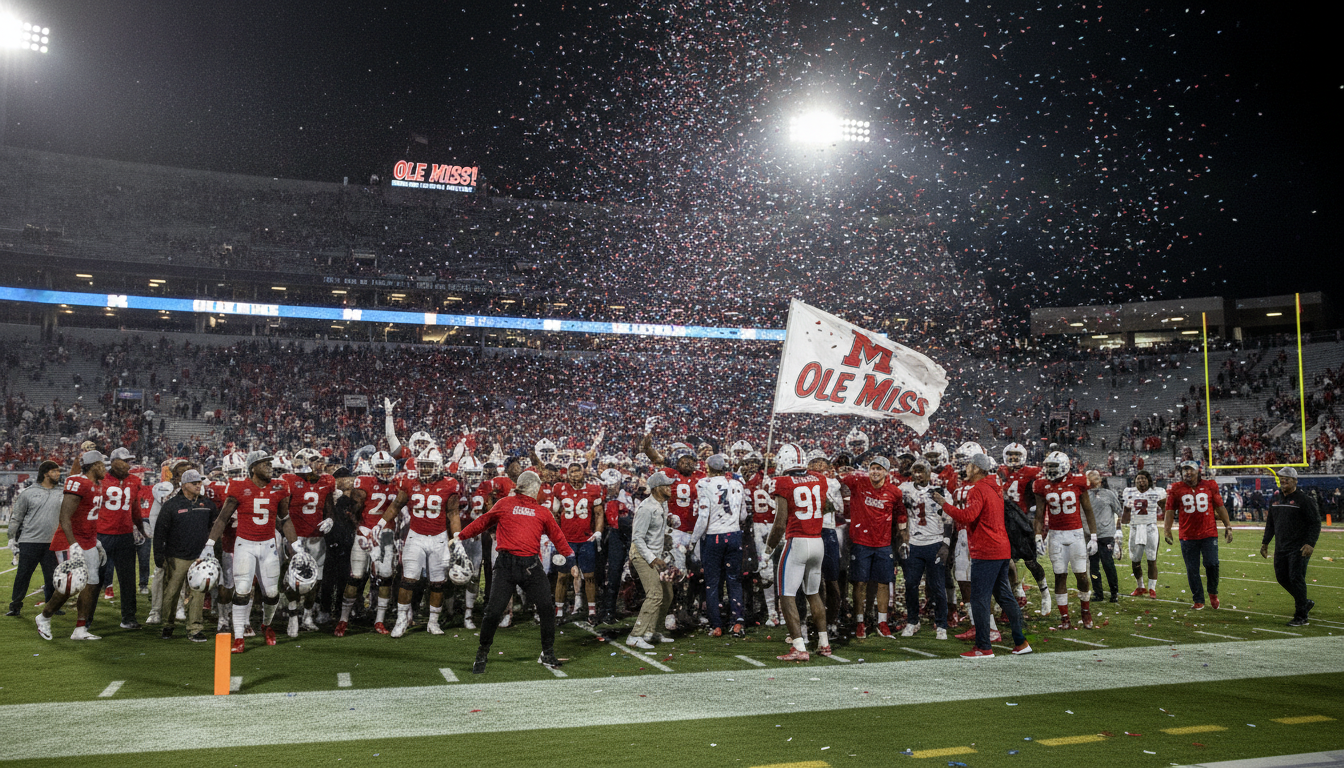
Gators Run Over Ole Miss: Florida's Ground Game Dominates Rebels in Gainesville
A promising first half for Ole Miss unraveled completely after the break as the Gators' rushing attack steamrolled Pete Golding's defense en route to a decisive 52-28 victory.

Final: Ole Miss Rebels 28, Florida 52
What started as a defensively challenging but still competitive affair for Ole Miss quickly devolved into a second-half rout, as the Florida Gators’ relentless ground game steamrolled the Rebels’ defense to secure a 52-28 victory. Despite offensive struggles and an already leaky run defense in the first half, Ole Miss managed to keep the deficit to a manageable 17-6 at halftime. However, a pivotal moment arrived earlier in the second quarter when safety Joenel Aguero was ejected for targeting, further depleting an already injury-riddled secondary and signaling deeper trouble ahead for Pete Golding's unit.
The floodgates opened after the break. Florida’s offense proved to be a scoring machine, converting an astonishing five consecutive possessions into touchdowns. The Gators' one-two punch of Jadan Baugh and Duke Clark, who each surpassed 100 rushing yards, consistently gashed the Ole Miss front. Key plays like Clark's 45-yard touchdown run in the third quarter and a 1-yard plunge by quarterback Aaron Philo underscored Florida's complete control of the line of scrimmage. A momentum-shifting sack/fumble by Jayden Woods further punctuated the Gators’ second-half dominance, stifling any Rebel hopes of a comeback.
While Trinidad Chambliss valiantly tried to keep Ole Miss in contention with an 8-yard and a 10-yard touchdown run in the third quarter, and later a 2-yard touchdown pass to Deuce Alexander in the fourth, the offensive efforts were merely a ripple against a tidal wave. Florida's sustained ground attack, totaling 302 yards and six rushing touchdowns, coupled with their quarterback Aaron Philo's efficient game management, ensured the Gators pulled away decisively, leaving Ole Miss to ponder a comprehensive defensive failure.
What Went Right
- Trinidad Chambliss’s Dual-Threat Performance: Even in a losing effort, quarterback Trinidad Chambliss showed flashes of resilience and playmaking, accounting for two rushing touchdowns and throwing for another. He finished with 298 passing yards on 25 of 34 attempts, demonstrating an ability to move the ball even when facing a steep deficit.
- Deuce Alexander’s Receiving Output: Wide receiver Deuce Alexander was a consistent bright spot in the passing game, hauling in 7 receptions for 134 yards and a touchdown. His ability to create separation and make contested catches provided a much-needed target for Chambliss.
- Second-Half Offensive Production: Despite the defensive collapse, the Ole Miss offense managed to score 22 points in the second half, showing an unwillingness to simply roll over. This offensive output, particularly the three second-half touchdowns, highlights the unit's ability to execute even under immense pressure.
What Went Wrong
- Catastrophic Run Defense: The Ole Miss run defense was utterly annihilated, surrendering 302 rushing yards and six touchdowns. Jadan Baugh and Duke Clark ran wild, frequently finding wide-open lanes, which points to significant issues in gap integrity, tackling, and overall defensive scheme against the run.
- Critical Targeting Ejection: The ejection of safety Joenel Aguero for targeting in the second quarter was a significant blow. Already dealing with multiple injuries in the secondary, losing a key defensive player further weakened a unit that subsequently struggled immensely, particularly as Florida continued to pound the ball and create play-action opportunities.
- Second-Half Turnovers: Ole Miss committed two crucial turnovers in the second half, both of which stifled potential scoring drives and directly contributed to Florida’s growing momentum and point differential. These unforced errors compounded the defensive struggles and made any comeback attempt nearly impossible.
- Special Teams Coverage Issues: Special teams, particularly kickoff coverage, was problematic. Giving Florida favorable field position consistently put the already struggling defense in difficult situations and allowed the Gators to maintain control of the game's flow.
Stock Up / Stock Down
- Stock Up: Trinidad Chambliss – Despite the loss, Chambliss showed grit and proved he can put up numbers under duress, both with his arm and his legs.
- Stock Up: Deuce Alexander – Alexander continues to emerge as a reliable and explosive receiving threat, racking up impressive yardage and a score.
- Stock Down: Ole Miss Run Defense – Giving up over 300 yards and six touchdowns on the ground is unacceptable and exposed a critical vulnerability.
- Stock Down: Secondary Depth – The ejection of Joenel Aguero highlighted and exacerbated existing depth concerns in the defensive backfield, which Florida exploited.
- Stock Down: Special Teams Coverage – Allowing short fields on kickoffs repeatedly puts the defense at a disadvantage and needs immediate attention.
What It Means for Vanderbilt (Ole Miss)
This crushing defeat against Florida is more than just a notch in the loss column; it's a stark revelation of fundamental flaws that Pete Golding and his staff must address immediately. The utter inability to stop the run game, coupled with critical turnovers and depth issues in key defensive positions, paints a concerning picture for Ole Miss's SEC aspirations. While Chambliss and Alexander showed offensive potential, it was entirely overshadowed by the defensive shortcomings, which allowed Florida to control the game from the trenches.
As the Rebels prepare to return home to face Vanderbilt, the focus must be entirely on regrouping defensively. This isn't just about scheme adjustments; it's about re-establishing confidence, improving tackling fundamentals, and shoring up gap assignments. Vanderbilt, while not a top-tier opponent, still presents an SEC challenge where Ole Miss cannot afford another defensive lapse. This game offers a crucial opportunity for the Rebels to show they can learn from their mistakes and demonstrate resilience, or risk further spiraling in a competitive conference. Golding's ability to motivate his team and plug these significant holes will be tested mightily in the coming week.
Published 22 days ago
Staff
Staff writer for SEC Saturday Wire covering college sports.
Process Notes & Methodology
The overarching theme is Ole Miss's defensive collapse, specifically against the run, which completely undermined any offensive efforts and led to a dominant Florida victory. The review emphasizes the second-half unraveling.
The lede opens on the defining moment of the game: the complete unraveling of Ole Miss in the second half, fueled by Florida's dominant rushing attack and exacerbated by critical defensive issues, including an ejection.
The body paragraphs heavily rely on specific game facts: Florida's 302 rushing yards and six touchdowns, the individual performances of Jadan Baugh and Duke Clark, the key plays (Aguero ejection, Woods' sack/fumble, Clark's 45-yard TD run), and Ole Miss's second-half turnovers. For 'What Went Right,' it highlights Trinidad Chambliss's dual-threat stats and Deuce Alexander's receiving yards, anchoring them to specific numbers. 'What Went Wrong' directly addresses the run defense, Aguero's ejection, turnovers, and special teams issues from the ground truth.
The closing section pivots to the immediate implications for Ole Miss, specifically focusing on the urgent need to address defensive deficiencies before their next game against Vanderbilt, emphasizing that the team's resilience and Golding's leadership will be tested.
See something wrong? Fix it.
We're the first crowdsourced college football site. Submit corrections — our editors review every one.