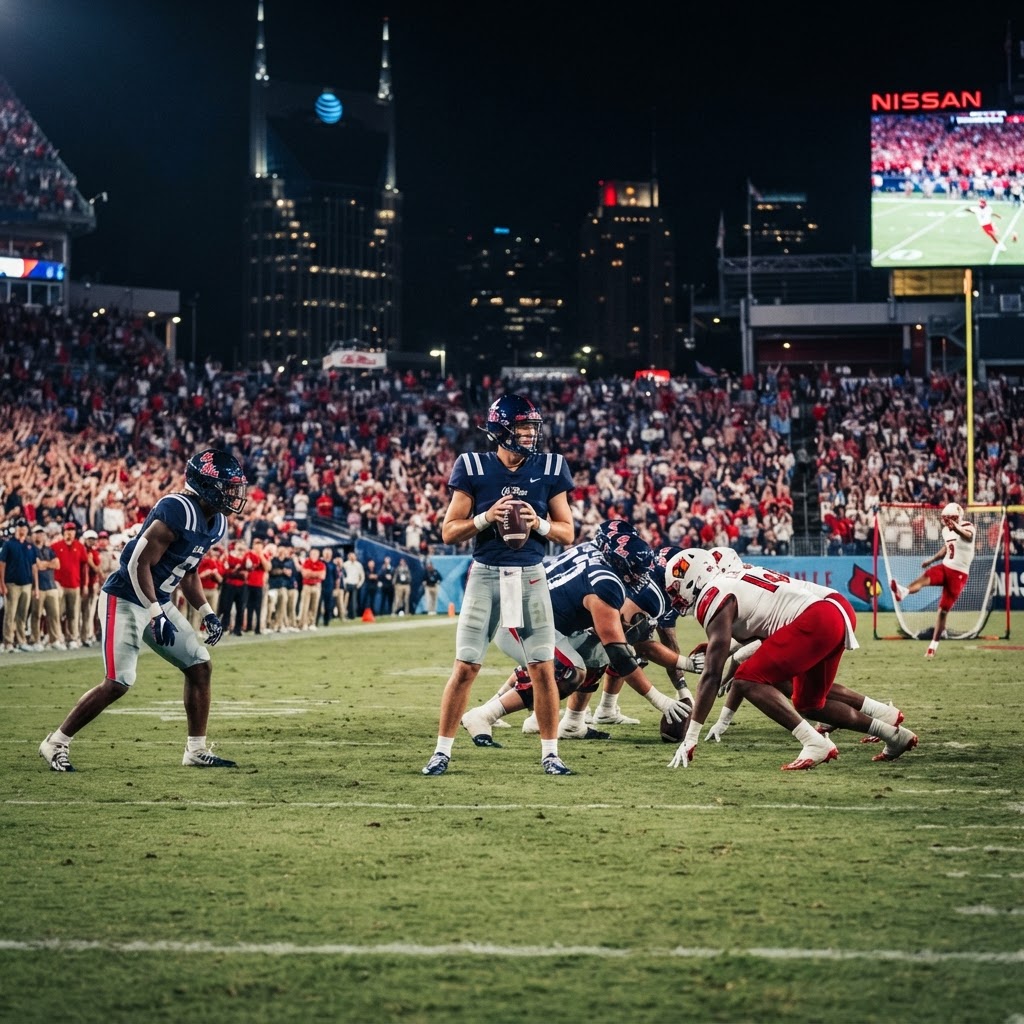
The Line Is Too Low: Ole Miss Beats Louisville by Two Scores Sunday Night
The market sees a tight opener. It is undervaluing college football’s best backfield, an elite kicking edge and a Rebel defense built to pressure Louisville’s new pieces.

Prediction: Ole Miss 38, Louisville 24.
Ole Miss is favored by 6.5 points Sunday night in Nashville. That number is too low.
Louisville is dangerous enough to make the opener entertaining. The Cardinals have a legitimate runner in Isaac Brown, an accomplished coach in Jeff Brohm and enough talent to punish a favorite that arrives unfocused. But this matchup is not a referendum on whether Louisville is good. It is a question of which team is more prepared to win a major game right now.
The answer is Ole Miss, and the separation should become obvious over four quarters.
The best quarterback in college football is already battle-tested
Trinidad Chambliss enters the season as more than a compelling story. He is the best quarterback in college football until someone takes that distinction from him.
Chambliss proved he can command the biggest stage during Ole Miss' run to the College Football Playoff semifinal. In the Sugar Bowl win over Georgia, he threw for 362 yards and two touchdowns while completing a bowl-record 13 consecutive passes. He does not have to discover how he responds to pressure, a close fourth quarter or a defense with NFL athletes. He has already supplied those answers.
Louisville will counter with Ohio State transfer Lincoln Kienholz, a talented athlete with only 21 career completions. He will also operate without the Cardinals' top four receivers from last season and behind an offensive line replacing nearly its entire starting group. That is a demanding way to make a high-profile debut.
Louisville is asking new pieces to become a finished offense under the Sunday-night lights. Ole Miss is handing the ball back to a quarterback who has already won beneath brighter ones.
That contrast matters more than preseason possibility. Chambliss can diagnose, extend and finish drives from the opening possession. Louisville may need a half—or longer—to find out what it can trust.
Kewan Lacy gives Ole Miss control of the game
Kewan Lacy is the best running back in the country entering this matchup. The national conversation may include other gifted backs, but few combine his production, explosiveness and proven fit with an elite quarterback as convincingly.
Chambliss and Lacy force a defense to defend the entire width and depth of the field. Load the box and Chambliss gets favorable coverage. Keep safeties deep and Lacy turns efficient runs into a long evening. Their continuity gives offensive coordinator John David Baker options that Louisville simply cannot replicate with a new quarterback and remade receiving corps.
The Cardinals' own running game can create problems. Brown is a genuine breakaway threat, and Louisville scored on 90 percent of its red-zone trips last season. But the Cardinals cannot afford to become one-dimensional. If Ole Miss establishes a lead and forces Kienholz to win obvious passing downs, the Rebels will dictate the terms.
This is not last year's defensive question mark
The easy case against Ole Miss is to point at defensive inconsistency and assume Louisville will run through it. That reading ignores both how the Rebels finished and what Pete Golding has changed.
Ole Miss finished last season with the nation's No. 15 defense, then attacked its remaining weaknesses. The secondary was rebuilt with seven additions led by Florida transfer Sharif Denson. The front gained more options, including Makhi Frazier, JT Lindsey and Joshua Dye. Golding, now entering his first full season as head coach, has a roster shaped to play his preferred brand of aggressive defense rather than merely survive it.
Louisville's rebuilt offensive line is the pressure point. New blockers communicating against Golding's fronts, while protecting an inexperienced quarterback throwing to new primary targets, is a far more serious concern than the market is pricing. Brown will break runs. The Cardinals may score early. Sustaining that success for four quarters is another matter.
Ole Miss owns the hidden-yardage advantage
Close opening games often turn on the possession that reaches the opponent's 35-yard line and stalls. Ole Miss owns one of the nation's strongest answers in Lucas Carneiro.
Carneiro was a Lou Groza Award semifinalist last season. In the Sugar Bowl, he drilled a record 56-yarder and later won the game with a 47-yard field goal in the final seconds. His range changes fourth-down decisions, rewards stalled drives and forces Louisville to produce touchdowns just to keep pace.
That advantage is easy to overlook when setting a point spread. It is also exactly why Ole Miss can turn a competitive game into a two-score finish. The Rebels do not need every drive to reach the end zone. They only need Chambliss and Lacy to cross midfield.
Why the 6.5-point line is wrong
The spread appears to give Louisville credit for its ceiling while discounting how much of that ceiling depends on immediate cohesion. The Cardinals are ranked, well coached and capable of making noise in the ACC. They are also introducing a quarterback with minimal game experience, replacing their four leading receivers and rebuilding the line against a top-10 opponent.
Ole Miss brings back the sport's best quarterback-running back tandem, one of its most trustworthy kickers and a defense strengthened precisely where it needed help. It has the better answer at the most important position, the better offensive foundation and the better margin for error.
Louisville's running game keeps the Cardinals alive into the second half. Then Chambliss creates one explosive drive, Lacy closes another, and Carneiro turns one imperfect possession into points. Golding's defense gets to Kienholz once the scoreboard makes the Cardinals predictable.
The market calls that a one-score game. By midnight in Nashville, Ole Miss will have won it by two.
Published about 2 months ago
Staff
Staff writer for SEC Saturday Wire covering college sports.
Process Notes & Methodology
A strongly Ole Miss-favored opinion arguing that the betting market undervalues proven elite talent and overvalues Louisville's theoretical ceiling. The analysis centers on four matchup edges: quarterback, running back, improved defense and kicking.
The opening states the pick and frames the 6.5-point spread as the central argument.
The body contrasts Chambliss' playoff experience with Kienholz's 21 career completions, explains how Lacy controls defensive structure, documents Ole Miss' defensive additions and establishes Carneiro's range as a hidden scoring edge.
The close projects how a competitive first half becomes a 38-24 Ole Miss win through offensive continuity, defensive pressure and special teams.
See something wrong? Fix it.
We're the first crowdsourced college football site. Submit corrections — our editors review every one.