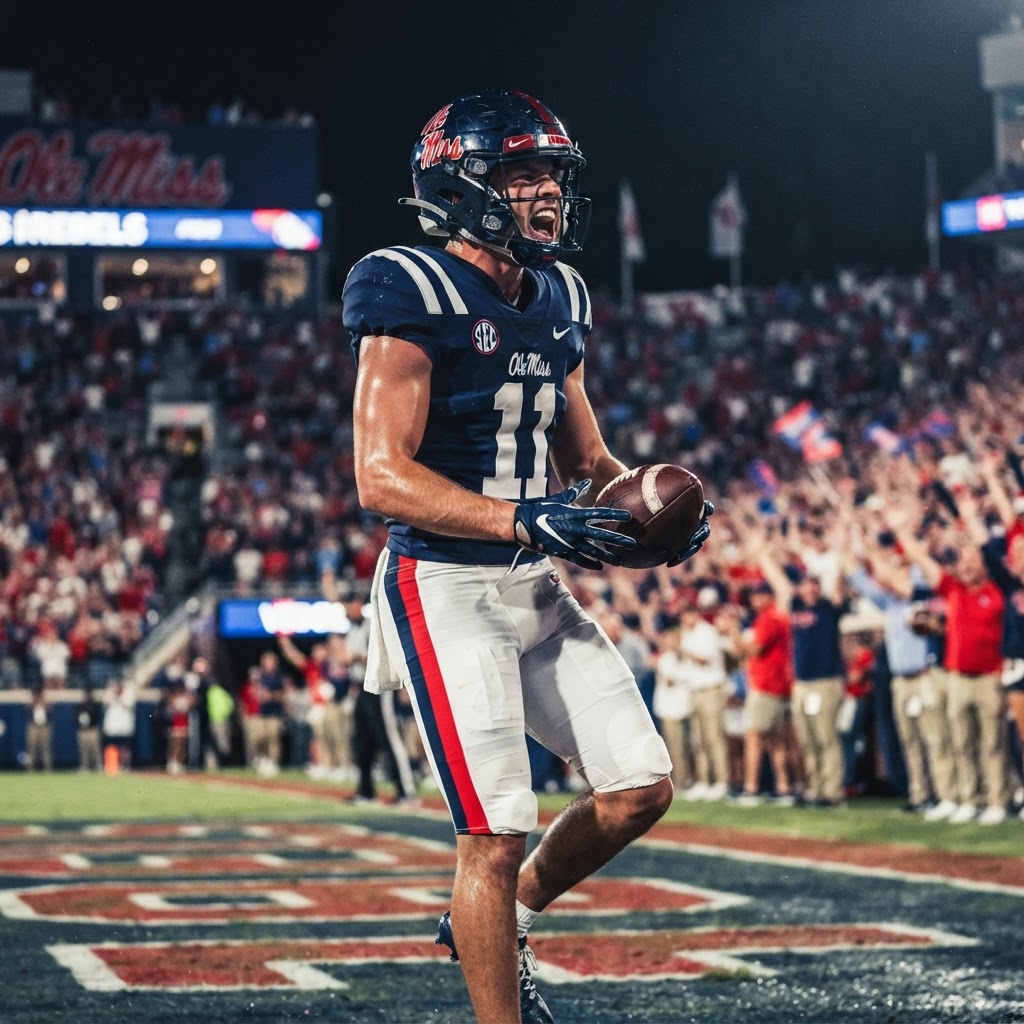
A Crucible in the Clay: Pete Golding's Blueprint and the Summer That Will Define Ole Miss
Amid the sweltering Mississippi heat, a reshaped program leans on a Heisman-contending quarterback, a philosophical shift in recruiting, and a relentless conditioning program to cement its playoff pedigree.

The Crucible of July
OXFORD, Miss. — The July heat in northern Mississippi does not merely arrive; it settles. It sits thick and suffocating, wrapping around the Manning Center like a wet wool blanket. Inside the Ole Miss weight room, however, the temperature is measured not in degrees, but in decibels and dropped iron. It is the crucible of the offseason, the grueling stretch of summer conditioning where the ghosts of January are either exorcised or empowered. As the dog days of summer take hold of the campus, the intensity matching the pressure of the upcoming campaign is palpable. For these Rebels, the specter of a hard-fought 27-31 loss to Miami in the Fiesta Bowl lingers—an ache that has been meticulously harvested and transformed into high-octane fuel.
The 2026 Spring Ball and Recruiting season has given way to the unforgiving grind of July. In the center of the facility stands head coach Pete Golding, a man fully immersed in the monumental task of overseeing his first complete summer of training. Having previously served as defensive coordinator and then the interim head coach who expertly navigated the team through a magical 13-2 season and a College Football Playoff semifinal appearance in 2025, Golding is now the undisputed maestro. He is pushing his squad to build the physical and mental foundation necessary to remain a permanent fixture in the expanded 12-team playoff conversation.
The Architect Steps Forward
Taking the reins from a high-profile predecessor is rarely simple, but doing so after the chaotic departure of Lane Kiffin to SEC West rival LSU requires a steady hand and a spine of steel. Golding has provided exactly that. He has fostered an environment that ignores external noise, even as the university's administration pursues potential legal action to recover unpaid buyouts from former players who followed Kiffin to Baton Rouge. Inside the facility, the focus is entirely internal. The transition from an offensive-minded maverick to a defensive tactician has fundamentally altered the DNA of the program, shifting the core philosophy from schematic flash to overwhelming physical force.
When a program transitions from an offensive maverick to a defensive tactician, the growing pains are usually structural. But Ole Miss did not rebuild; they simply recalibrated the engine, shifting the torque from flash to force.
Golding's vision is rooted in grit, discipline, and absolute accountability. He has surrounded himself with trusted lieutenants, including offensive coordinator John David Baker and defensive coordinator Bryan Brown, to ensure the transition is seamless. Together, they are redefining what it means to wear the Ole Miss uniform, demanding a level of physicality that ensures both returning veterans and highly touted newcomers are prepared for the unrelenting weekly warfare of the Southeastern Conference.
A Five-Hour Radius and the Law of the Trenches
Nowhere is Golding's philosophical pivot more apparent than in the recruiting department. While the previous regime became synonymous with an aggressive, almost total reliance on the transfer portal, Golding has charted a more traditional, sustainable course. His strategy prioritizes elite high school talent within a strict 'five-hour radius' of Oxford. It is a calculated gamble to reclaim the region's top prep prospects, and the dividends are already materializing.
On July 9, 2026, the Rebels secured a commitment from three-star tight end Colton Johnson out of Baxter, Tennessee. Johnson's pledge brought the 2027 recruiting class to a robust 22 total commitments. The group currently ranks No. 14 nationally and features a startlingly high concentration of blue-chip offensive and defensive linemen. It is a direct reflection of Golding's oft-repeated mantra that 'big men run this league.' By prioritizing the trenches in the high school ranks, Ole Miss is building a robust developmental pipeline designed to weather the attrition of an SEC schedule, rather than patching holes year after year with one-and-done mercenaries.
Plugging Gaps with Portal Precision
While the long-term vision is rooted in prep recruiting, Golding and his staff are not ignoring the immediate reality of the modern game. The portal remains a vital tool for roster optimization, but it is now being utilized with surgical precision rather than wholesale reliance. The Fiesta Bowl loss to Miami exposed critical defensive depth issues, a vulnerability the coaching staff spent the spring aggressively addressing.
The Rebels have integrated key transfers intended to shore up specific deficiencies. Georgia transfer Joenel Aguero has already established himself as a primary vocal leader in the secondary. The hard-hitting defensive back is currently projected to start at the crucial 'STAR' hybrid position, offering the versatility needed to counter the SEC's multifaceted offenses. On the other side of the ball, the staff secured Carius Curne, a towering transfer from LSU who is the overwhelming frontrunner to anchor the offensive line at left tackle. Alongside talented incoming transfers like Jalyn Crawford, Edwin Joseph, and Sharif Denson, Curne and Aguero represent a targeted injection of experience designed to elevate the floor of an already elite roster.
The Face of the Franchise
At the center of this summer mission, lifting weights with the intensity of a walk-on but commanding the room with the gravity of a superstar, is quarterback Trinidad Chambliss. His return to Oxford for the 2026 season was not without drama; it required a high-profile legal battle with the NCAA regarding his eligibility, which culminated earlier this spring in a preliminary injunction ruling in his favor. Now fully cleared, Chambliss is operating with a visible edge. He has been a vocal, demanding presence in the facility, ensuring the offense executes with precision during player-led 7-on-7 drills.
The national expectations hovering over Chambliss's final collegiate season are staggering. Recently named a Maxwell Award candidate, the dynamic signal-caller enters the summer with +900 odds to win the Heisman Trophy, the second-best odds in the nation behind only Notre Dame's CJ Carr. But Chambliss does not carry the spotlight alone. He shares the offensive backfield with superstar running back Kewan Lacy, whose explosive 2025 campaign earned him the ultimate pop-culture validation: being named the cover athlete for the EA SPORTS™ College Football 27 video game. Alongside returning defensive standout Suntarine Perkins and veteran defensive tackle William Echoles, this core group possesses the battle-tested maturity required for a championship run.
The broader college football world will soon get a glimpse of this leadership dynamic. On July 14, the university officially announced that Chambliss, Lacy, and Echoles will represent the team at SEC Media Days in Tampa, Florida. When they take the podium on Wednesday, July 22, they will do so as the undisputed faces of a program that expects nothing less than a return to the playoff.
Nashville Awaits
As July bleeds into August, the grueling conditioning sessions will give way to the strategic chess match of fall camp. Every sprint, every power clean, and every film session is geared toward a singular, highly anticipated moment. The Rebels will kick off their 2026 season under the bright lights of a Sunday night, taking on the Louisville Cardinals on September 6 in Nashville. With a 6:30 p.m. CT kickoff broadcast nationally on ABC, the game represents an immediate litmus test for Golding's fully realized vision.
Preseason buzz places Ole Miss firmly inside the top 10, recognizing them as legitimate contenders to repeat their playoff success. The expanded 12-team format offers a wider margin for error, but for Pete Golding and his battle-tested roster, simply making the field is no longer the objective. They are forging a new identity in the sweltering Mississippi heat—one built on physical dominance, structural integrity, and unyielding discipline. When they finally take the field in Nashville, they intend to prove that last season's playoff run was not a mere aberration, but the dawn of a new dynasty in Oxford.
Published 3 months ago
Staff
Staff writer for SEC Saturday Wire covering college sports.
Process Notes & Methodology
The article uses the 'Workout Wednesday' theme to frame the current team culture under a new head coach. It highlights the transition from last season's playoff run to the rigorous preparation required for the current year.
The opening hooks the reader by connecting the current date of July 15 and the summer heat to the team's ongoing physical training under Pete Golding.
I integrated the coaching change, the Fiesta Bowl outcome, recent transfer arrivals to bolster the roster depth, and the Heisman expectations surrounding Trinidad Chambliss to flesh out the team's current status.
The conclusion shifts focus from the current training grind to the broader goal of sustaining playoff contender status, setting the stage for the upcoming season.
See something wrong? Fix it.
We're the first crowdsourced college football site. Submit corrections — our editors review every one.