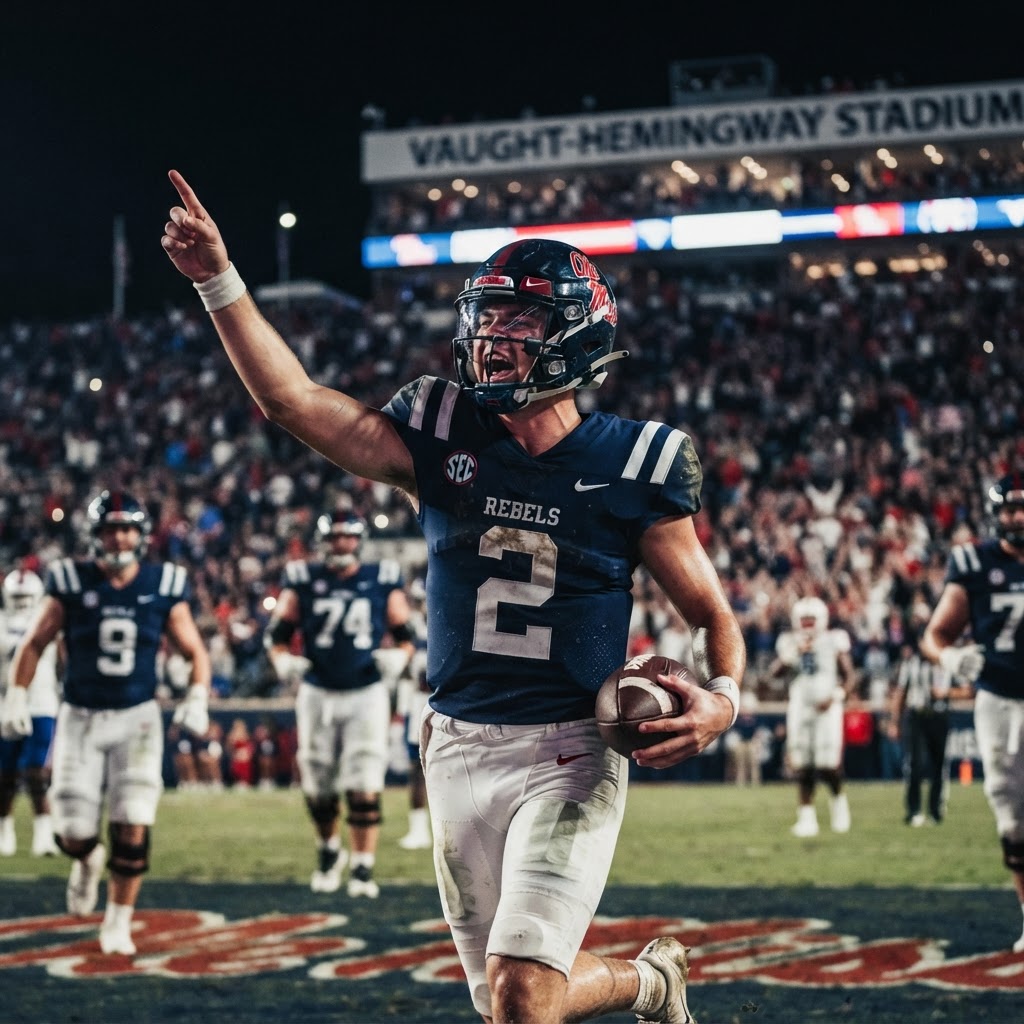
Beyond the Interim: Pete Golding's Brutal Blueprint and the New Era of Ole Miss Football
Armed with the reigning Doak Walker winner, a battle-tested quarterback, and a physical scheme pivot, the Rebels are engineered to survive the SEC's grueling 16-game gauntlet.

The mid-July heat has settled over Oxford with its usual oppressive weight, baking the practice fields outside the Olivia and Archie Manning Athletics Performance Center. Yet, the pressure surrounding the Ole Miss Rebels this summer has little to do with the Mississippi climate.
As of July 14, 2026, a defining shift in the power dynamics of the Southeastern Conference is nearly complete. When Lane Kiffin abruptly departed for LSU just before the 2025 College Football Playoff, he left behind a championship-caliber roster and a gaping leadership void. The shockwaves threatened to derail a historic season, but instead of fracturing, the locker room galvanized.
Into that crucible stepped Pete Golding.
Named Ole Miss' permanent head coach before the playoff began, Golding immediately faced the kind of pressure most first-year coaches never experience. He guided the Rebels past Tulane in the opening round, delivered a historic, blood-and-guts Sugar Bowl victory over the Georgia Bulldogs and ultimately saw the season end against Miami in the Fiesta Bowl national semifinal.
Golding proved he could navigate the storm.
Now, entering his first full season at the helm, he is tasked with not merely sustaining the momentum of the post-Kiffin era, but fundamentally evolving it. Expectations in Oxford remain sky-high, with multiple preseason projections placing the Rebels among the nation's top 15 teams.
Golding's blueprint for meeting those expectations relies heavily on strategic transfer-portal acquisitions, relentless physical development and elite continuity at college football's most critical positions.
The Vanguard Heads to Tampa
The ceremonial dawn of the 2026 season arrives Thursday, July 23, when Golding represents Ole Miss on the main stage at SEC Media Days in Tampa, Florida.
He will not walk into that spotlight alone.
Flanking the head coach will be three vital player representatives who embody the hardened, championship aspirations of this roster: star quarterback Trinidad Chambliss, elite running back Kewan Lacy and standout defensive tackle Will Echoles.
Bringing Echoles to Tampa is a pointed statement by Golding. It signals that the heart of this football team still beats in the trenches. Echoles is a disruptive force on the interior defensive line and one of the veteran leaders of a defense Golding helped meticulously construct.
Beside him, Chambliss' presence represents a victory in its own right.
After the NCAA denied his eligibility waiver and subsequent internal appeal, Chambliss took his case to court. A Mississippi judge granted him a preliminary injunction allowing him to compete, and the Mississippi Supreme Court later declined the NCAA's attempt to appeal that ruling.
The underlying lawsuit has not been fully resolved, but Chambliss is cleared to play an additional season.
His return cannot be overstated.
In the unforgiving crucible of the SEC, a battle-tested quarterback who can read complex coverages, manipulate the pocket and execute in high-leverage moments is the ultimate luxury. Chambliss provides exactly that steadying hand.
The Gravitational Pull of Kewan Lacy
If Chambliss is the anchor, Kewan Lacy is the wrecking ball.
Lacy returns to the Ole Miss backfield after earning recognition as a finalist for the 2025 Doak Walker Award. His phenomenal season—1,567 rushing yards and 24 touchdowns—cemented him as one of the most terrifying offensive weapons in the sport while establishing new Ole Miss single-season records in both categories.
Defenses spent the entirety of 2025 keying on him, stacking the box and daring the Rebels to beat them through the air. Yet Lacy continually shattered their defensive geometry with a punishing blend of speed, vision and power.
Alongside returning defensive standouts such as Echoles and linebacker Suntarine Perkins, the Rebels possess a star-studded nucleus. These seasoned veterans have endured the playoff pressure cooker, giving Golding a foundation capable of trading blows with any heavyweight in the country.
But to maximize Lacy's immense talent, the offensive philosophy must continue to evolve.
A Paradigm Shift in the Play-Calling
While the offensive firepower remains unquestioned, the leadership of that offense has changed.
Following Kiffin's departure to Baton Rouge, offensive coordinator Charlie Weis Jr. followed him to LSU. In response, Golding brought John David Baker back to Oxford after Baker spent two seasons running the offense at East Carolina.
Baker was not promoted from Ole Miss' 2025 staff, but he is no stranger to the program. His return provides familiarity and continuity rather than a complete schematic demolition.
Under Baker, the Rebels are expected to place a greater emphasis on physicality, the running game and controlling the line of scrimmage while retaining many of the concepts familiar to returning players.
The previous regime built its reputation by spreading the field, isolating defenders in space and operating at a breathless tempo. Baker's offense is expected to retain that flexibility while leaning more aggressively on Lacy and a fortified offensive line when the situation demands it.
It is an evolution designed to give Ole Miss the ability to outpace opponents in a track meet or bludgeon them in an alley fight.
In the grueling context of the expanded playoff era, offensive finesse remains valuable, but physical durability is a necessity. A national championship contender could be asked to play 16 or even 17 games, depending on its conference championship and playoff path.
Ole Miss is attempting to build an offense capable of surviving that marathon.
To execute that vision, the offensive line requires immense size and power. That is why the Rebels aggressively pursued formidable trench additions such as Carius Curne, Enoch Wangoy and Tommy Kinsler IV.
They are not merely depth pieces. They are potential building blocks for the physical identity Baker and Golding want to establish.
The Portal Blueprint: Reloading the Arsenal
To supplement his returning stars and facilitate the offensive transition, Golding and his staff have been ruthlessly efficient in the transfer portal.
The result is a class ranked No. 2 nationally by 247Sports—a massive influx of talent tailored to plug the gaps left by departing veterans.
The perimeter required immediate attention following the exits of standout wide receivers De'Zhaun Stribling and Harrison Wallace III. Stribling was selected in the second round of the 2026 NFL Draft, while Wallace signed with the Arizona Cardinals as an undrafted free agent.
Ole Miss responded by securing a dangerous trio of pass-catchers: Johntay Cook II, Horatio Fields and Darrell Gill Jr.
Cook brings explosive, game-breaking ability, while Fields and Gill provide the size, catch radius and route-running versatility necessary to prevent defenses from crowding the box against Lacy.
Returning receiver Deuce Alexander will also factor into the redesigned aerial attack, giving Chambliss another dynamic option on the outside.
The program used the portal to strengthen its backfield depth as well. Deuce Knight arrives from Auburn to provide immense talent and valuable insurance behind Chambliss, while Makhi Frazier transfers from Michigan State to help spell Lacy and preserve the rushing attack's punishing rhythm.
Defensively, Golding fortified both the front seven and the secondary.
Defensive end Jordan Renaud, linebacker Keaton Thomas, defensive tackle Jehiem Oatis and safety Edwin Joseph headline a group of additions intended to give defensive coordinator Bryan Brown the rotational depth necessary to keep his unit fresh deep into the fourth quarter.
Building Armor for a Championship Marathon
Beyond strategic acquisitions, Golding's overarching philosophy heading into fall camp has centered on structural durability.
Ole Miss adopted a phased, OTA-style approach during spring practice, with the coaching staff repeatedly emphasizing physical development, greater depth, clearly defined roles and the addition of the right kind of bulk throughout the roster.
The goal is simple: ensure the Rebels possess the physical mass and reliable depth required to withstand a marathon season.
That philosophy extends to the high school recruiting trail, where Ole Miss is laying the foundation for long-term sustainability.
On July 9, the Rebels landed their 22nd commitment for the 2027 recruiting cycle when three-star tight end Colton Johnson announced his pledge to Ole Miss.
Johnson, rated among the nation's top tight-end prospects, fits Baker's vision of a versatile offensive player capable of contributing as both a receiver and a blocker.
The continued recruiting momentum suggests Golding's vision is resonating not only with transfer-portal veterans but also with the next generation of high school talent.
The Brutal 2026 Gauntlet Awaits
As the program moves beyond its historic playoff run—from the opening-round victory over Tulane to the dramatic Sugar Bowl triumph over Georgia and the Fiesta Bowl semifinal against Miami—the path back to the mountaintop is fraught with peril.
The 2026 schedule presents a terrifying gauntlet of SEC powerhouses, including matchups against Georgia, Texas and Oklahoma.
Then there is LSU.
The emotionally charged meeting with Kiffin's Tigers will carry implications far beyond the standings. It will serve as the most visible referendum yet on the two programs' dramatically altered futures.
Navigating the schedule will require every ounce of the veteran leadership provided by Chambliss, the dominant rushing of Lacy and the defensive ferocity of Echoles and Perkins.
This Recruiting Tuesday, the message emanating from the Manning Athletics Performance Center is unambiguous.
The post-Kiffin era is not a rebuilding phase.
Through strategic portal acquisitions, elite returning talent, increased physicality and a modernized approach to SEC survival, Pete Golding has constructed a roster capable of enduring the deepest waters of the sport.
When Golding takes the podium in Tampa next week, he will not be speaking as a placeholder or an emergency replacement.
He will be outlining the blueprint of a national championship contender—tested by chaos, strengthened in the trenches and fundamentally ready for war.
Process Notes & Methodology
The article explores how Pete Golding is using the transfer portal to stabilize the roster during his first full season. It highlights the importance of balancing returning veteran talent with key incoming transfers to meet championship expectations.
The hook establishes the current calendar window (Spring Ball & Recruiting 2026) and frames Golding's leadership as the central narrative.
The body integrates the stability provided by QB1 Trinidad Chambliss with the depth added by recent transfers like Johntay Cook and Carius Curne. It connects these personnel moves directly to the pressure of the upcoming SEC schedule.
The closing pivots to the future, framing the program's strategy as a direct response to the previous season's finish and the need for immediate, high-level impact from new additions.
See something wrong? Fix it.
We're the first crowdsourced college football site. Submit corrections — our editors review every one.