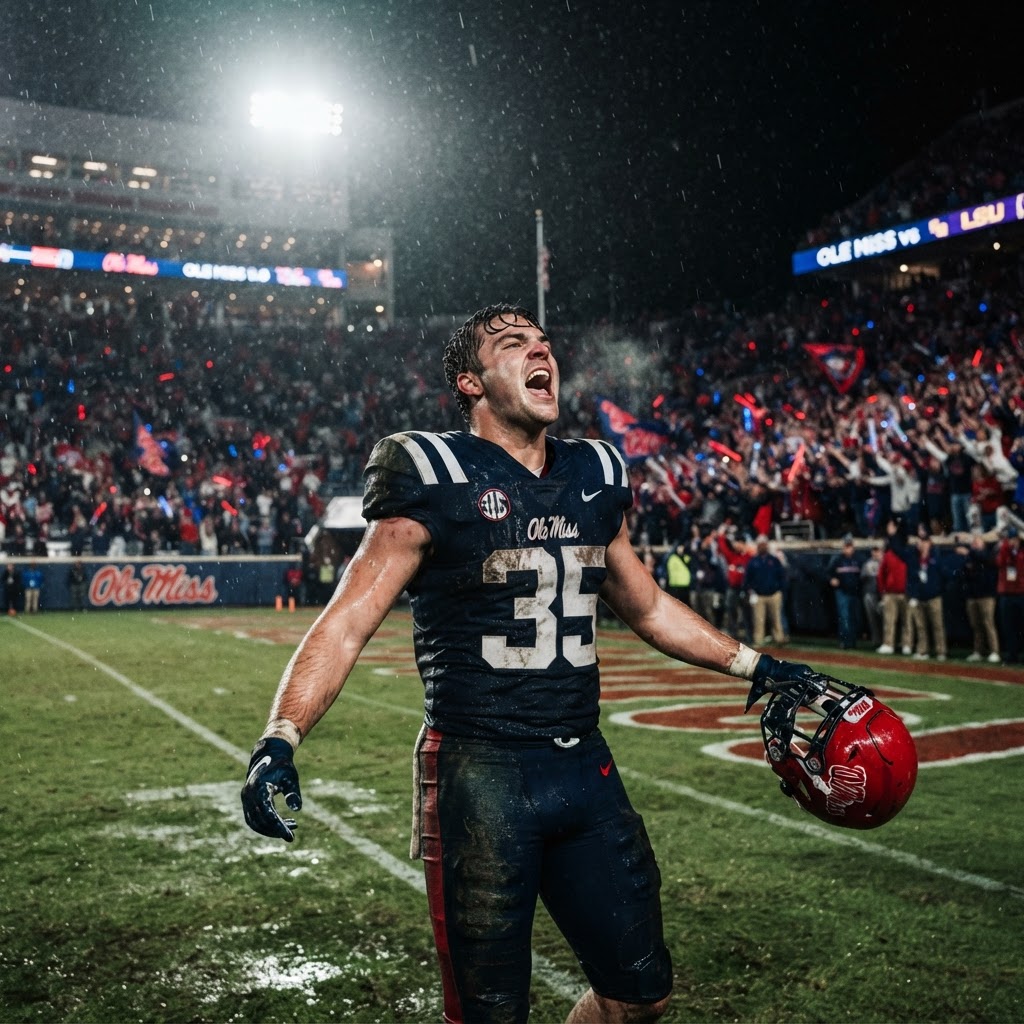
Forged in the Fire: How Pete Golding Is Building Ole Miss for a Post-Kiffin SEC Reality
Backed by a court ruling that currently clears his star quarterback to play, an All-American running back, a nationally ranked recruiting class, and a rebuilt defense, Pete Golding enters his first regular season in Oxford determined to prove last winter's playoff run was only the beginning.

Instead of hating, submit your corrections ;)
Oxford in July remains a relentless pressure cooker. The humidity settles over northern Mississippi like a weighted blanket, while Ole Miss works through the conditioning, installation and roster development that will carry the program into fall camp.
The pressure surrounding the Rebels is just as heavy.
The Lane Kiffin era—defined by tempo, offensive fireworks and aggressive transfer-portal roster construction—is officially in the rearview mirror. In its place stands a program that does not intend to abandon everything Kiffin built, but must now prove it can survive without the coach who made Ole Miss nationally relevant.
That responsibility belongs to Pete Golding.
Golding was officially named the 40th head coach in Ole Miss history on November 30, 2025, following Kiffin's departure for LSU. He was not an interim placeholder. Ole Miss immediately handed him permanent control of the program and entrusted him with leading the Rebels into the College Football Playoff.
What followed would have been difficult to predict even inside the most optimistic corners of Oxford.
Golding guided Ole Miss past Tulane in the opening round of the playoff and then oversaw a dramatic 39-34 victory over Georgia in the Sugar Bowl, sending the Rebels to the CFP semifinals. The run ended with a 31-27 loss to Miami in the Fiesta Bowl, but Ole Miss still completed the first 13-win season in program history.
Golding did more than hold the roster together. He demonstrated that he could lead it through the most important postseason run Ole Miss has ever experienced.
Now comes the harder assignment: building a program that can return.
The Courtroom Victory That Preserved the Season
While Golding's promotion stabilized the coaching situation, the most important development of the offseason occurred inside a Mississippi courtroom.
Starting quarterback Trinidad Chambliss spent months fighting for another season of eligibility after the NCAA denied his request for a medical redshirt connected to respiratory problems that prevented him from playing at Ferris State in 2022.
On February 12, Mississippi Judge Robert Whitwell granted Chambliss a preliminary injunction, allowing him to compete for Ole Miss during the 2026 season while the underlying legal case continues. The Mississippi Supreme Court later denied the NCAA's request to appeal that ruling.
The litigation is not technically over, but the injunction remains in place and Chambliss enters the summer cleared to play.
That distinction matters. Ole Miss did not receive a routine sixth-year waiver from the NCAA. Chambliss won temporary protection from the courts after the organization rejected his eligibility request.
For the Rebels, however, the practical result is enormous.
Chambliss completed 66.1 percent of his passes last season for 3,937 yards, 22 touchdowns and only three interceptions. He added 527 yards and eight touchdowns on the ground, finishing with 4,464 yards of total offense.
His return gives Golding and offensive coordinator John David Baker one of the most accomplished quarterbacks in the country. Chambliss has already won an SEC Newcomer of the Year award, led Ole Miss through a playoff run and delivered one of the defining postseason victories in school history.
The quarterback room also contains Auburn transfer Deuce Knight, a talented young passer from Mississippi who remains on the Ole Miss roster after arriving in Oxford through the portal. Knight may not be expected to displace Chambliss, but his presence gives the Rebels a developmental option with significant upside behind their veteran starter.
Ole Miss therefore enters the season with both an established leader and a potential successor—an unusual degree of stability in the modern SEC.
Heavier Packages and Trench Warfare
John David Baker remains Ole Miss's offensive coordinator, but the offense surrounding him has changed.
The Rebels are not expected to abandon tempo, spacing or explosive plays. Those concepts are now embedded in the program's identity. The more interesting question is how Baker adapts them to the personnel Golding and his staff have assembled.
One possible evolution is a greater willingness to play with multiple tight ends.
Ole Miss's roster includes returning tight ends Luke Hasz and Caleb Odom, South Carolina transfer Michael Smith and Michigan transfer Brady Prieskorn. Prieskorn is a 6-foot-5, 245-pound sophomore—not a graduate transfer—and gives the Rebels another large receiving and blocking option.
That depth does not guarantee Ole Miss will suddenly become a traditional, run-first offense. It does, however, give Baker the flexibility to use more two-tight-end formations without sacrificing the ability to spread the field.
The post-Kiffin offense does not have to scale back its ambition. It may simply become more flexible—capable of playing fast in space while also placing additional size near the line of scrimmage.
The centerpiece of that approach will be Kewan Lacy.
Lacy returns after earning All-America honors and setting Ole Miss single-season records with 1,567 rushing yards and 24 rushing touchdowns. His combination of vision, contact balance and workload tolerance gives the Rebels an established offensive foundation alongside Chambliss.
The offensive line remains one of the unit's most important preseason questions. Ole Miss added several options through the portal, including 6-foot-5, 330-pound LSU transfer Carius Curne, but Golding's staff must still determine its best combination before the opener.
If the Rebels can establish dependable tackle play, Baker will have the pieces to build one of the conference's most difficult offenses to defend: a veteran dual-threat quarterback, an All-American running back, multiple tight ends and enough formation flexibility to force defenses into uncomfortable personnel decisions.
Aggression by Design: Rebuilding the Secondary
Golding has also spent the offseason reshaping the defense around the philosophy that earned him the Ole Miss job in the first place.
The front remains stocked with recognizable talent. Defensive tackle Will Echoles returns as one of the leaders of the unit, while Suntarine Perkins gives the Rebels an experienced and disruptive presence at linebacker. Alabama transfer Jordan Renaud adds another athletic option along the defensive line.
The secondary has undergone a more extensive renovation.
Ole Miss added Georgia safety Joenel Aguero, Florida safety Sharif Denson, Auburn cornerback Jalyn Crawford and Florida State safety Edwin Joseph. The Rebels also retain experienced defensive backs such as Jaylon Braxton and Antonio Kite.
Those additions do not automatically transform the secondary into a finished product. They do give defensive coordinator Bryan Brown and the expanded defensive staff more experience, position flexibility and competition than they would have possessed without an aggressive portal effort.
Brown now has multiple players who have already competed inside major Power Four programs. Aguero and Denson can operate at safety, Crawford gives Ole Miss another option at cornerback, and Joseph adds versatility to the back end.
Tony Mitchell, another transfer from Mississippi State, should not be grouped with the cornerbacks. Ole Miss officially lists him as a 6-foot-1, 240-pound linebacker, making him more likely to contribute as a hybrid defender closer to the line of scrimmage.
That distinction reflects what Golding appears to be constructing: not merely a collection of traditional position players, but a defense with enough interchangeable pieces to disguise pressure, alter coverages and match the increasingly diverse offenses of the SEC.
Whether the secondary becomes a strength will be determined on the field. What can already be said is that Ole Miss attacked the position with urgency.
A Mississippi-First Recruiting Renaissance
The clearest long-term sign of Golding's influence may be found on the recruiting trail.
Kiffin became famous for using the transfer portal to rebuild his roster rapidly. Golding has continued to use the portal, but his first complete recruiting cycle also shows a stronger emphasis on developing a sustainable high school pipeline—especially inside Mississippi.
As of July 17, Ole Miss holds the No. 13 recruiting class nationally in the 247Sports Composite, with 22 commitments. That ranking is strong, although it is not currently a consensus top-10 class and should not be described as one without identifying a specific service and date.
The class is led by several important in-state commitments.
Mitchell Turner, a defensive lineman from Louisville, Mississippi, is rated as the No. 57 overall player in the 247Sports Composite. Ben'Jarvius Shumaker, another highly ranked defensive lineman, recommitted to Ole Miss after previously pledging to Colorado. Tupelo offensive lineman Antonio Berry committed one day later, giving Golding three of the most highly regarded prospects in Mississippi.
Turner committed on June 23, Shumaker returned to the class that same day, and Berry announced his decision on June 24. Together, they gave Ole Miss a concentrated run of recruiting victories at positions that traditionally determine whether an SEC program can survive deep into November.
The significance extends beyond star ratings.
Ole Miss cannot build lasting stability by replacing most of its roster through the portal every winter. Retaining more of Mississippi's best high school players gives Golding an opportunity to develop a core that understands the program, the rivalry with Mississippi State and the expectations attached to playing in Oxford.
The portal will remain essential. But Golding's early recruiting work suggests that Ole Miss wants transfers to supplement its foundation—not become the entire foundation.
Tampa Talk and the Return of Lane Kiffin
The next stage of the transition arrives at SEC Football Media Days in Tampa.
Golding is scheduled to appear on Wednesday, July 22, alongside Alabama coach Kalen DeBoer, Florida coach Jon Sumrall and Texas A&M coach Mike Elko. Ole Miss will be represented by Chambliss, Lacy and Echoles—three returning players who embody the experience and production Golding inherited and retained.
The questions will be predictable.
Can Ole Miss repeat last season's playoff run? Can Chambliss remain available after his legal fight with the NCAA? Can the rebuilt secondary hold up against SEC passing attacks? And can Golding maintain the national relevance Ole Miss achieved under Kiffin?
Those questions will follow the Rebels directly into the opening month of the season.
Ole Miss begins the 2026 campaign against Louisville in the inaugural Music City Kickoff at Nissan Stadium in Nashville on Sunday, September 6. The Rebels then host Charlotte on September 12 before the emotional centerpiece of their early schedule arrives one week later.
Lane Kiffin returns to Oxford as LSU's head coach on September 19.
The matchup will not take place in Baton Rouge, and it will not occur on September 26. Instead, Kiffin will walk back into Vaught-Hemingway Stadium less than ten months after leaving Ole Miss for one of its SEC rivals. The Rebels travel to Florida the following week on September 26.
The reunion carries an additional layer of tension. Ole Miss athletic director Keith Carter has acknowledged that the university is exploring potential legal action involving former Rebels Princewill Umanmielen and Devin Harper over allegedly unpaid contractual buyouts after the two players transferred to LSU.
No lawsuit had been announced at the time of publication, and the dispute involves two players—not several—but the possibility adds another combustible element to an already emotional matchup.
Kiffin's return will dominate the headlines, but the game will ultimately serve as an early measurement of Golding's program.
Ole Miss is no longer trying to prove that it can reach the playoff. The Rebels did that last season.
The challenge now is proving that the success was not dependent on one coach, one offensive identity or one extraordinary postseason run.
Golding has a veteran quarterback, one of the nation's best returning running backs, a defense reinforced through the portal and a high school recruiting class positioned just outside the national top 10. He also has the credibility that came from leading Ole Miss through the greatest postseason run in program history immediately after taking control.
That does not make the Rebels a finished product. No team in July is.
But Ole Miss is not beginning from scratch, either.
The foundation survived the departure of Lane Kiffin. Golding's task is to make it stronger—and to show that the most important chapter of this era may still be ahead.
Process Notes & Methodology
The article focuses on the transition from the Kiffin era to the Pete Golding era. It highlights how the team is maintaining stability through returning leadership and key roster reinforcements.
The introduction anchors the piece on Pete Golding's transition into his first full season as head coach. This establishes the primary narrative shift for the program in 2026.
The body paragraph incorporates the stability provided by QB Trinidad Chambliss and the coaching staff changes. I balanced these leadership facts with the influx of new talent via the transfer portal to show how the roster is being reshaped.
The conclusion pivots to the high-stakes SEC schedule, specifically mentioning the LSU game. This creates immediate reader interest regarding the upcoming season's biggest narratives.
See something wrong? Fix it.
We're the first crowdsourced college football site. Submit corrections — our editors review every one.