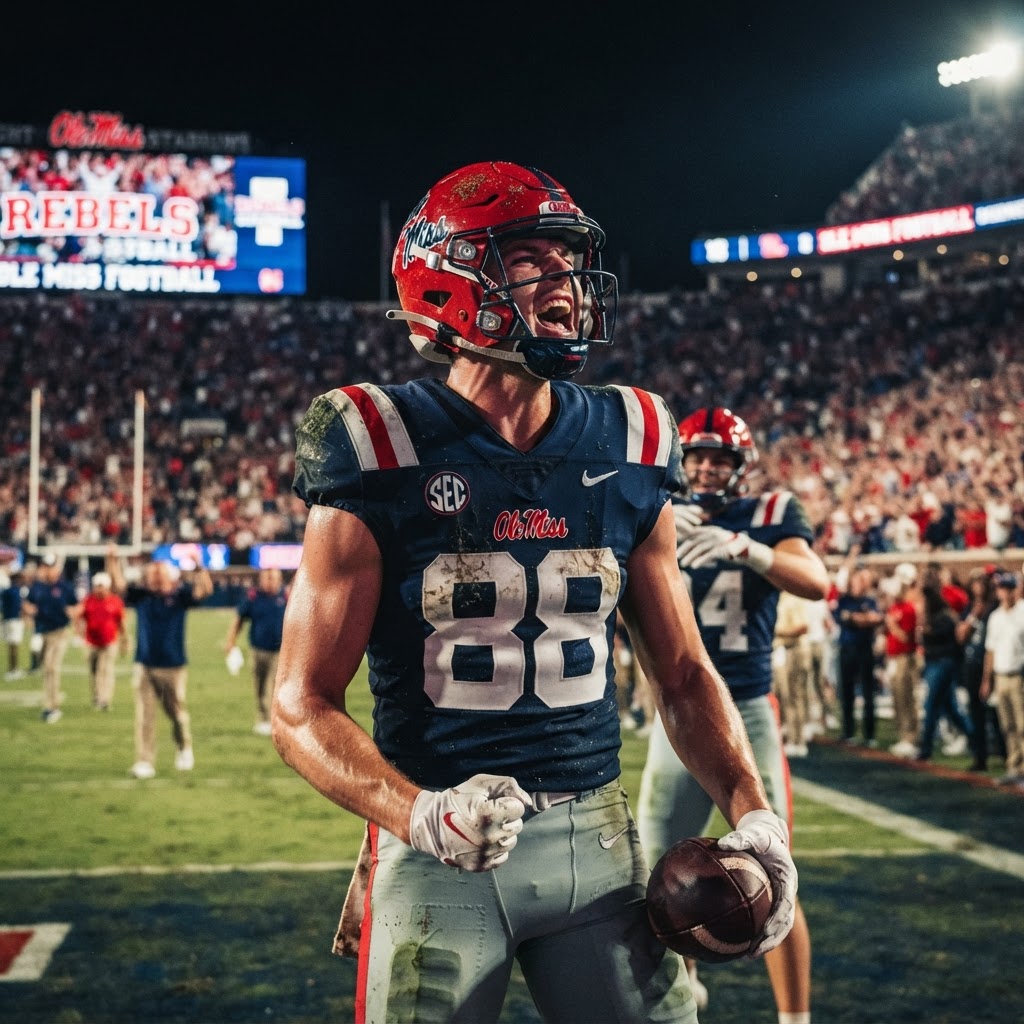
The Architect and The Anchor: Pete Golding, Trinidad Chambliss, and the New Era of Ole Miss Football
After a tumultuous transition, a historic playoff run, and a landmark legal victory over the NCAA, the Rebels are quietly building an enduring physical fortress in the post-Kiffin landscape.

It is the middle of July in the Mississippi Delta, a time of year when the heat rises off the blacktop in visible, shimmering waves and college football programs settle into the quiet rhythm of the summer dead period. But inside the Grammy Museum in Cleveland, Mississippi, on July 9, the atmosphere was anything but dormant. When Ole Miss head coach Pete Golding took the microphone for the latest stop on the "Rebel Road Trip," there was a distinct, undeniable gravity to his presence. He was no longer the interim caretaker navigating a sudden coaching defection, nor just a defensive savant holding a locker room together. He was the undisputed architect of a new era in Oxford.
As Golding fielded questions, notably projecting calm support for the NCAA's new "five-for-five" eligibility rule and its impact on roster management, a singular truth became evident: the frantic, headline-chasing theater of the previous regime has left the building. In its place is a steady, violent hum of infrastructure being laid brick by brick. The Ole Miss Rebels are moving past the Lane Kiffin era, and as fall camp looms on the horizon, they are doing so with a roster, a staff, and a terrifyingly competent quarterback all aligned under a single, physical vision.
The Gavel and The Quarterback
You cannot discuss the momentum building in Oxford without starting with the man who anchors the entire operation: Trinidad Chambliss. If Golding is the architect, Chambliss is the unquestioned on-field general. For months, a dark cloud of uncertainty hovered over the Manning Center as a prolonged legal battle with the NCAA regarding Chambliss's eligibility played out in the courts. That saga finally reached its conclusion on July 10, when the Mississippi Supreme Court categorically denied the NCAA's final appeal.
The ruling officially cleared Chambliss for his sixth year of eligibility in 2026, sending a jolt of electricity through a fanbase still buzzing from last season's triumphs. Chambliss is coming off a staggering 2025 campaign in which he accounted for 3,927 passing yards and 22 touchdowns, culminating in a Sugar Bowl victory over Georgia and a historic College Football Playoff semifinal appearance. Armed with absolute clarity regarding his status, the preseason Heisman Trophy chatter surrounding Chambliss is no longer hypothetical.
More importantly, Chambliss has become the vocal leader of a locker room eager to forge its own identity. When Kiffin, now at LSU, recently made public comments regarding his former program, it was Chambliss who publicly pushed back, drawing a line in the sand. Ole Miss is pursuing potential legal action to recover unpaid buyouts from former players who defected to Baton Rouge, but on the field, the players who stayed—and the quarterback who leads them—are singularly focused on the future.
Establishing the Chain of Command
There is a fundamentally different energy in a building when a defensive-minded head coach gets his first full offseason in charge. When Golding officially took the reins on November 30, 2025, he didn't just inherit a roster; he inherited a culture in need of a philosophical shift. He spent the spring and summer prioritizing structural foundation, bringing in John David Baker as offensive coordinator and retaining Bryan Brown to run the defense.
In the modern Southeastern Conference, momentum is too often mistaken for viral marketing and transfer-portal bravado. But authentic momentum is architectural. It is the steady, unglamorous laying of bricks in the crucible of summer heat, transforming a program from a passing offensive spectacle into an enduring, physical fortress.
This trio gives the Rebels a defined, complementary chain of command. Under Brown's direction during the 2024-25 cycle, the Ole Miss defense transformed into a wood-chipper, setting program records with 52 sacks and a staggering 120 tackles for loss. Returning stars like game-wrecker Suntarine Perkins are now augmented by a highly targeted transfer portal haul. Golding and Brown have fortified the secondary with elite talent, bringing in Joenel Aguero, Jalyn Crawford, Edwin Joseph, and Sharif Denson, while adding massive trench presence with lineman Carius Curne.
The Quarterback Crucible
While Chambliss's legal victory solidified his unquestioned status as QB1, the genius of Golding and Baker's roster construction lies in the depth assembled behind him. The Rebels boast arguably the most fascinating quarterback room in the SEC, with highly touted arms Deuce Knight and Walker Howard rounding out the depth chart.
In many programs, stockpiling this level of talent leads to transfer-portal drama. In Oxford, it is being utilized as premium fuel. The internal competition demands daily excellence. For a Golding-led program built on mental toughness and physical resilience, having multiple capable quarterbacks pushing the entrenched starter through the dog days of July is a quiet but massive advantage.
Fencing the Magnolia State
Golding's cultural overhaul isn't just about X's and O's; it's heavily rooted in a renewed, aggressive approach to local recruiting. Appearing on the "Talk Of Champions" podcast on July 9, Golding articulated his mandate with crystal clarity: "lock down the state." He passionately argued that Mississippi's elite prep talent no longer needs to cross state lines to chase national championships or NFL draft stock. The resources, the development, and the playoff pedigree are all available right in Oxford.
That philosophy is currently bearing fruit in real-time. As of July 7, Ole Miss is officially a top-three finalist for five-star 2026 running back David Gabriel Georges. The Rebels' pitch is both compelling and deeply personal, centering on reuniting Georges with his high school teammate, four-star Ole Miss quarterback commit Keegan Croucher. Croucher has been relentlessly recruiting Georges behind the scenes, embodying the peer-to-peer buy-in that Golding is cultivating. Adding Georges to a backfield that already features the punishing, explosive style of returning starter Kewan Lacy would give Baker an embarrassment of offensive riches.
The 7.5 Paradox
Despite the internal confidence, the returning production, and a defense built to terrorize opposing backfields, national skepticism lingers. On June 22, BetMGM released its preseason college football win totals, setting the Ole Miss over/under at a surprisingly modest 7.5 wins. The justification from oddsmakers rests entirely on a brutal schedule that features daunting road trips to Texas and Florida.
Inside the Manning Center, however, that 7.5 figure is viewed not as a projection, but as an insult. The Rebels have no intention of regressing after last year's CFP semifinal run. The schedule is undoubtedly a gauntlet, but Golding's entire offseason methodology has been designed to build a team that thrives in hostile environments. Flashy offenses win shootouts at home; suffocating defenses and seasoned, battle-tested quarterbacks win in Austin and Gainesville.
What Comes Next
The ultimate momentum question for Ole Miss won't be fully answered until the pads pop in August and the lights turn on in September. But the pieces Pete Golding has meticulously assembled—a legally liberated and highly motivated offensive leader in Chambliss, a coordinator pairing designed for brutal balance, and a defensive culture that embraces contact—suggest the Rebels are trending on a steep upward trajectory.
The summer months are about retention, development, and deep-rooted buy-in. By every measurable metric that actually dictates success in the brutal theater of the SEC, Ole Miss is checking the boxes. The drama of the past has been systematically replaced by the work of the present. When the real tests arrive this fall, the rest of the country may be surprised by the sheer force of what has been built in Oxford. But for those paying attention on this sweltering July afternoon, the warning signs are already there.
Published 4 months ago
Staff
Staff writer for SEC Saturday Wire covering college sports.
Process Notes & Methodology
I chose to frame the article around Pete Golding's first full offseason as head coach and the quiet, structural momentum he's building — staff alignment, quarterback room development, and cultural foundation. This fits Momentum Monday because Golding's hire is recent (Nov 2025) and this is the critical summer window before his first full fall camp.
The hook opens with the July calendar context and Golding's November 30, 2025 start date to establish that this is a program still in formation but with enough runway to have built real momentum through spring ball and summer conditioning.
The body is built around verified facts: Golding as head coach, John David Baker (OC) and Bryan Brown (DC) as his coordinator pairing, Trinidad Chambliss as QB1, and the QB depth chart including Deuce Knight and Walker Howard. I framed these as infrastructure and internal competition rather than claiming specific spring game results or transfer activity, since those fields are empty.
The closing pivots forward to fall camp as the next true test, acknowledging that summer momentum is about retention and development rather than on-field results. It sets up the transition from the Spring Ball & Recruiting 2026 window into the upcoming season without inventing specific game predictions or schedule details.
See something wrong? Fix it.
We're the first crowdsourced college football site. Submit corrections — our editors review every one.