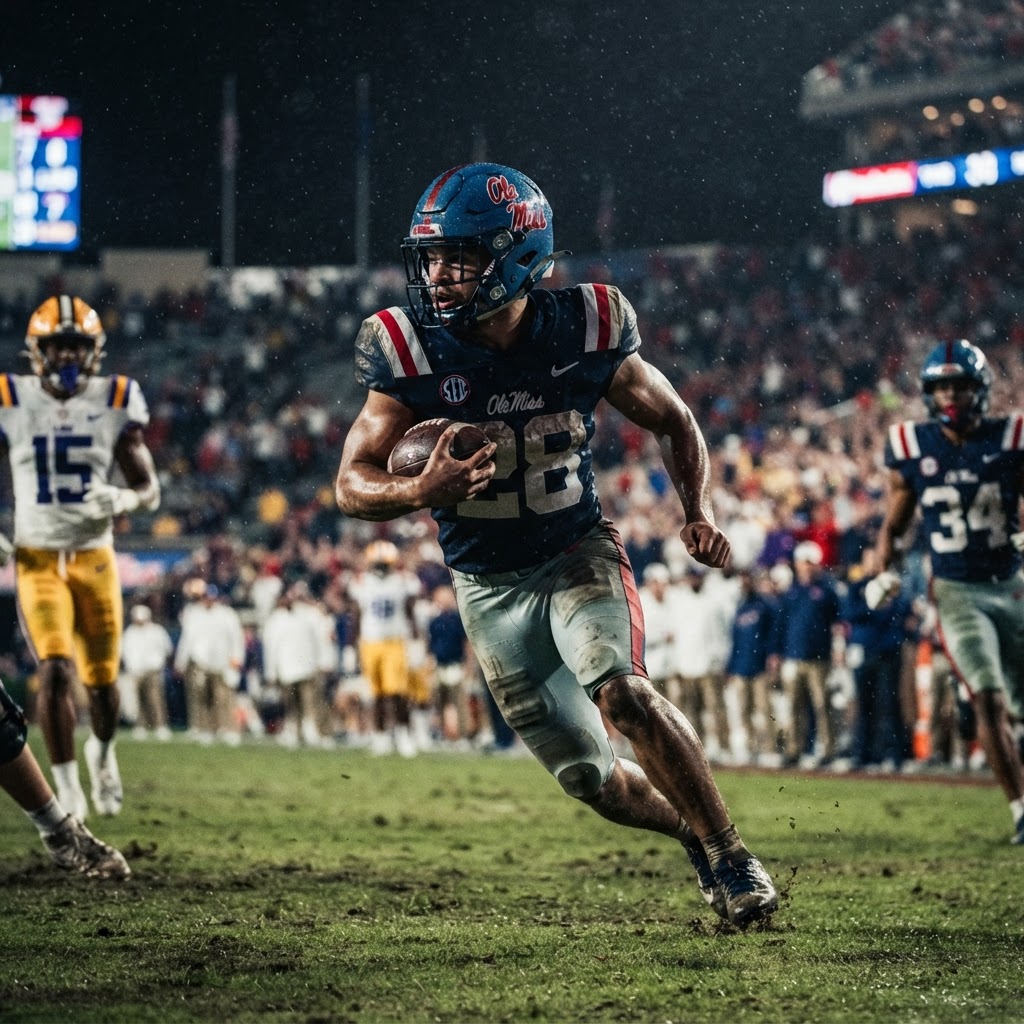
Ole Miss 2026 Outlook: Pete Golding Era Begins With Chambliss at the Helm
As the Rebels transition to a new regime, the quarterback room and defensive identity will define Year One under Golding

As the calendar turns to July and the SEC inches closer to fall camp, the Ole Miss Rebels find themselves in a position unlike any other in the conference: a full reset. Pete Golding, hired on November 30, 2025, inherited a program in transition, and now — roughly seven months into his tenure — the outlines of his first team are starting to take shape. For a fanbase starving for clarity, the Outlook Sunday question is simple but loaded: what exactly should expectations be for Year One under a coach who has never led an SEC program?
The Golding Vision Takes Root
There's no sugarcoating it: Golding stepped into a roster situation that demanded immediate and aggressive reshaping. With no key returning starters listed on the spring depth chart projection and the roster largely churned over since his arrival, the Rebels are effectively a first-year program wearing an old uniform. That's not necessarily a bad thing — it's an opportunity for Golding to install his culture and schemes without the friction of entrenched habits. But it also means the learning curve will be steep, and early-season growing pains are a near certainty.
Golding's reputation as a defensive architect is well established from his time in the SEC, and he brought along Bryan Brown to run the defense as coordinator. Brown's unit will likely be the identity anchor for this team — if Ole Miss is going to surprise anyone in 2026, it will start on that side of the ball. The offensive coordinator duties fall to John David Baker, who now must piece together a workable attack around a largely new personnel group.
Quarterback: Chambliss Is the Guy
Amid all the uncertainty, one critical piece is settled: Trinidad Chambliss is the starting quarterback. Golding and Baker have their QB1, and that stability — rare for a first-year staff in the modern transfer era — gives Ole Miss a foundation to build around offensively. Chambliss won't have a proven, veteran supporting cast around him, but he won't be looking over his shoulder, either.
The depth behind him offers intriguing insurance. Deuce Knight and Walker Howard round out the quarterback room, giving the Rebels a trio that, on paper, is as talented as any in the bottom half of the SEC. Knight brings the high-upside developmental profile, while Howard offers SEC experience and a steady presence. If Chambliss struggles or is forced out with injury, Baker has viable options — a luxury most first-year staffs don't enjoy.
Where Ole Miss Fits in the SEC Outlook
Honest power-ranking placement for the Rebels right now is tricky. In a conference loaded with established coaching staffs and roster continuity, Ole Miss is betting on schematic fresh starts and internal development over proven returning production. That profile typically lands a team somewhere in the 10th–14th range of an SEC power poll — competitive enough to steal a game or two against the middle class, but not yet equipped to challenge the top tier.
The swing factor is simple: how fast can Golding's defense become a unit that keeps the Rebels in games? If Brown can manufacture pressure and discipline early, and if Baker can design an offense that protects Chambliss while maximizing his strengths, Ole Miss could outperform a modest preseason projection. If the installation lags, it could be a long autumn in Oxford.
The Road Ahead
With spring ball behind us and fall camp approaching, the next six weeks are about refinement and readiness. Golding's staff will be finalizing the two-deep, shoring up weaknesses exposed in the spring, and preparing Chambliss for the volume of responsibility he'll carry in Week One. The 2026 season won't be judged solely on wins and losses — it'll be judged on whether the foundation Golding is pouring now hardens into something the SEC has to respect by November.
For now, the outlook is cautious but not without hope. The Golding era begins with a blank canvas and a clear QB1. How the rest of the picture fills in will define whether Year One is a rebuild or a surprise.
Published 4 months ago
Staff
Staff writer for SEC Saturday Wire covering college sports.
Process Notes & Methodology
I chose to frame Ole Miss as a first-year rebuild under Pete Golding, leaning into the clean-slate narrative since no key returning starters are listed. This fits Outlook Sunday perfectly because the core question is what to expect from a brand new regime in 2026.
The hook anchors on Golding's November 30, 2025 hire date and the seven-month timeline into July, establishing that the Rebels are early in a full reset. This immediately signals to readers that this is a transition-season outlook.
The body is built around the verified coaching staff (Golding, Brown, Baker), the confirmed QB1 Trinidad Chambliss, and the QB depth chart (Knight, Howard). I used the absence of returning starters to frame the roster as a blank canvas rather than inventing specific player names or stats.
The closing pivots to fall camp preparation and frames 2026 as a foundation-laying year judged on trajectory rather than just wins. It sets up future coverage of camp battles and early-season performance without inventing specific upcoming games.
See something wrong? Fix it.
We're the first crowdsourced college football site. Submit corrections — our editors review every one.