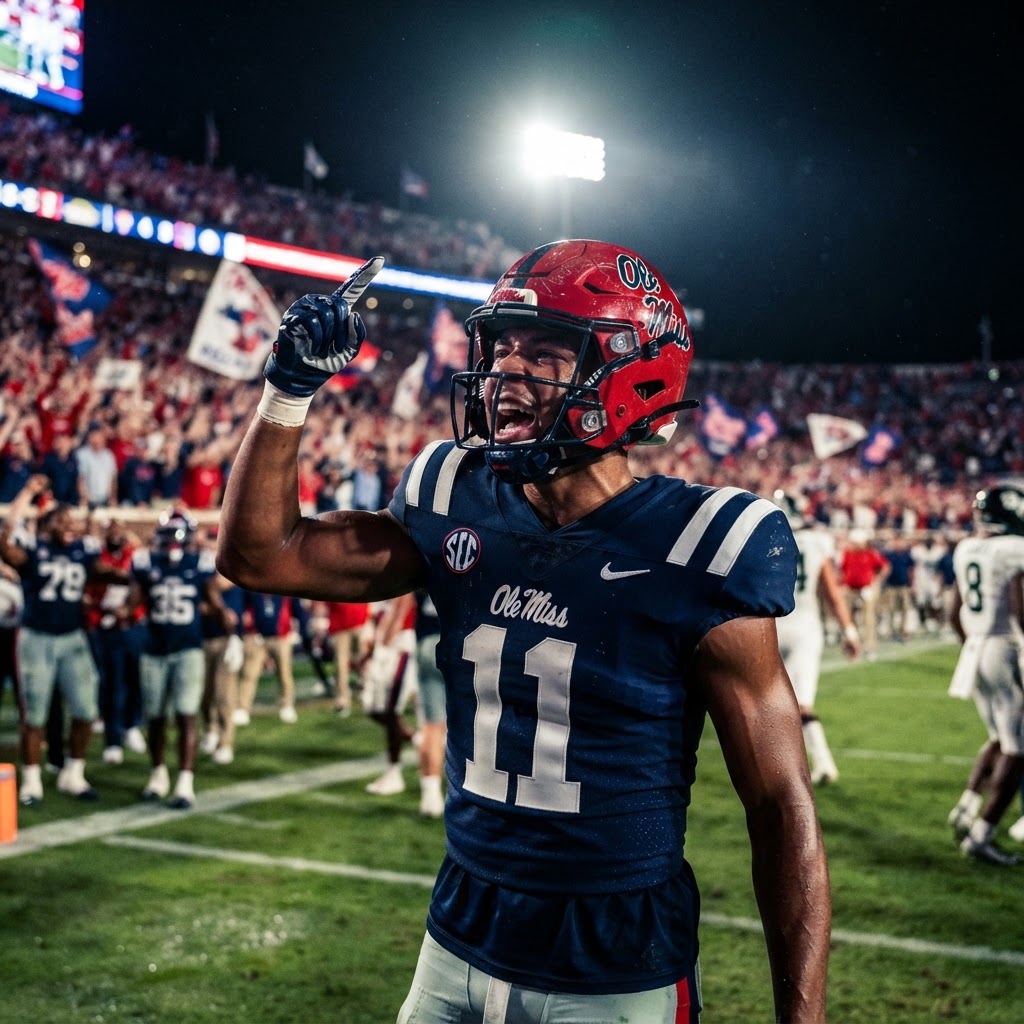
The Golding Standard: How Ole Miss Reloaded for a 2026 Championship Run
Behind a 13th-ranked transfer class, a record-breaking backfield, and the return of a Heisman frontrunner, Pete Golding’s Rebels are built to outlast the SEC gauntlet.

The stifling humidity of Tampa this week provides a fittingly sweltering backdrop for the annual pressure cooker of SEC Media Days. But as Pete Golding steps to the podium on this mid-July morning in 2026, the temperature surrounding the Ole Miss Rebels feels remarkably controlled. Gone are the days of Golding operating solely as the defensive mastermind behind the curtain; he is now the unmistakable face of a program that tasted the rarified air of the College Football Playoff semifinals just months ago. Succeeding a figure as polarizing and successful as Lane Kiffin is no small feat, yet Golding has navigated his first offseason in Oxford with the steady, calculated hand of a veteran CEO. Accompanied in Florida by superstar quarterback Trinidad Chambliss, record-breaking running back Kewan Lacy, and defensive anchor Will Echoles, Golding’s overarching message to the media is crystal clear: Ole Miss is not rebuilding. They are reloading. The identity of this team is shifting toward a robust, well-rounded juggernaut that proved its undeniable ceiling by vanquishing the powerhouse Georgia Bulldogs in the 2025 Sugar Bowl.
The Injunction That Saved a Championship Window
No storyline in Oxford—or perhaps in the entire Southeastern Conference—carries as much profound weight as the retention and eligibility of quarterback Trinidad Chambliss. Entering the 2026 season as the firmly established starter and a bona fide Heisman Trophy frontrunner, Chambliss's path back to the gridiron was uniquely paved in federal court. Following a highly publicized, complex legal battle and a crucial preliminary injunction against the NCAA, the star signal-caller secured his right to play this fall. It was a monumental, franchise-altering victory for Ole Miss, ensuring that the centerpiece of offensive coordinator John David Baker’s explosive system remains securely in place. The numbers from Chambliss's historic 2025 campaign speak for themselves, demanding national awe: 3,937 passing yards, 22 touchdowns, and a staggeringly low three interceptions across 15 grueling games. He is the ultimate modern distributor, a quarterback who blends lethal downfield accuracy with unflappable veteran poise. With vital interior protection returning in the form of seasoned center Brycen Sanders, Chambliss has the foundational security required to orchestrate another deep postseason run.
Rebuilding the Quarterback Safety Net
While Chambliss is firmly entrenched as the alpha of the quarterback room, Golding and his staff understand that a true championship roster requires insulating its most valuable asset against the physical toll of SEC football. The depth chart behind center became an intense focal point heading into spring and summer evaluations, resulting in a fascinating competition for the primary backup role. Through aggressive and surgical navigation of the transfer portal, the Rebels secured two massive additions in mid-January. First came former five-star recruit Deuce Knight, who officially transferred from Auburn on January 11, bringing dynamic dual-threat athleticism and immense upside to the quarterback room. Just three days later, veteran Walker Howard signed to return to Oxford from the transfer portal after a brief sojourn at Louisiana, providing essential veteran stability. Together, Knight and Howard provide a fiercely competitive safety net. They are not merely clipboard holders; they are highly capable contingencies hoping to earn significant playing time as they showcase their skills throughout ongoing practices. This intense internal pressure is precisely what Golding envisions for his program's culture—a landscape where complacency is eradicated by elite depth.
A Record-Breaker in the Backfield
The aerial attack will naturally dominate the summer headlines, but the physical engine of the Ole Miss offense resides squarely in the backfield with Kewan Lacy. Returning after a 2025 season that completely rewrote the Oxford record books, Lacy is the perfect complementary force to Chambliss. Punishing opposing defenses to the tune of 1,567 rushing yards and a staggering school-record 24 touchdowns last season, Lacy brings a downhill, bruising element that dictates the tempo of the game and exhausts defensive fronts. Alongside returning standout pass-catchers like highly-touted tight end Luke Hasz and dynamic wide receiver Deuce Alexander, the Rebels possess a multifaceted offensive arsenal capable of exploiting any schematic weakness. Golding's relentless focus on creating depth and competition means that even with Lacy's unquestioned RB1 status, the coaching staff is constantly evaluating the rotational pieces behind him, ensuring fresh legs are always available for the punishing fourth quarters of late-season conference play.
Homegrown Roots in a Portal Era
The true measure of a coaching transition isn't solely found in the high-profile talent acquired through free agency, but in a regime's ability to retain its foundational pillars while meticulously cultivating a localized, deeply invested culture. Pete Golding didn't just inherit a playoff roster; he successfully defended its core.
Despite currently holding the 13th-ranked transfer portal class for the 2026 cycle according to On3—a massive haul that seamlessly integrated impact players like Carius Curne, Jalyn Crawford, Edwin Joseph, Makhi Frazier, and Luke Ferrelli—Golding has been highly vocal about his overarching recruiting philosophy. He fundamentally wants to win with Mississippi talent. The head coach has consistently emphasized on the trail that the state's elite high school prospects no longer need to cross state lines to pursue national titles or first-round NFL draft status. This localized homegrown approach is blending seamlessly with their national portal strategy, effectively masking the roster gaps left by outgoing transfers such as TJ Dottery, TJ Banks, Rickey Fletcher, and Chris Graves Jr. On the high school recruiting trail, Ole Miss remains fiercely aggressive. They are currently high-profile finalists for five-star Canadian running back David Gabriel Georges, brilliantly leveraging his pre-existing chemistry with 2026 highly-touted quarterback commit Keegan Croucher. It is a calculated, dual-pronged strategy: fortify the immediate rotational holes with seasoned collegiate transfers, but build the long-term, sustainable foundation with elite prep talent.
The Shadow of September 19
On the defensive side of the ball, coordinator Patrick Toney is leaning heavily on his veteran leaders to fully implement his complex, aggressive scheme. Defensive lineman Will Echoles returns as the unquestioned emotional and physical anchor of the trench unit, working alongside returning star linebacker Suntarine Perkins. Together, they are tasked with integrating a fresh wave of defensive transfers while establishing a ruthless standard of execution. The defense will undoubtedly need to be in mid-season form early, as the 2026 schedule offers absolutely no reprieve. In fact, the entire state of Mississippi already has September 19 circled in permanent red ink. That fateful Saturday marks the highly anticipated return of former head coach Lane Kiffin to Vaught-Hemingway Stadium, this time wearing the colors of the LSU Tigers. The narrative surrounding this rivalry has only intensified exponentially in recent months, fueled by an ongoing, contentious legal dispute regarding buyout payments from former Ole Miss players Princewill Umanmielen and Devin Harper following their dramatic offseason transfers to Baton Rouge. It is a late-September matchup absolutely dripping with theatrical storylines, deep-seated animosity, and colossal SEC championship implications.
The Road Ahead
As the oppressive heat of July eventually gives way to the crisp, electric air of autumn in Oxford, the Ole Miss Rebels find themselves in a uniquely powerful position within the shifting landscape of college football. They have successfully bridged the perilous gap between coaching regimes without suffering the dreaded transitional step back. Pete Golding has firmly instilled a physical, highly competitive identity, insulated by strategic portal acquisitions and anchored by a battle-tested core of returning superstars. With Trinidad Chambliss pulling the strings orchestrating the offense, Kewan Lacy pounding the rock into the defensive line, and a seasoned defense eager to impose its will on the SEC, the grand foundation is solidly laid. The ongoing evaluations of summer camp will soon finalize the minutiae of the depth chart, setting the stage for potential breakout performances. But the broader identity of the 2026 Rebels is already abundantly clear: they are a mature program unburdened by transition, driven by the lingering momentum of a playoff run, and fiercely determined to prove to the nation that their championship window is just now opening.
Published 4 months ago
Staff
Staff writer for SEC Saturday Wire covering college sports.
Process Notes & Methodology
The article discusses the depth chart and position battles for the Ole Miss Rebels, highlighting the quarterback situation under new head coach Pete Golding. This is relevant as the team prepares for the Spring Ball and Recruiting phase of 2026.
The hook of this article centers on the competitive atmosphere surrounding the Rebels' depth chart as they prepare for the upcoming season. Trinidad Chambliss, named the starting QB, anchors this discussion.
The body of this article draws on the facts of the coaching staff, particularly head coach Pete Golding, and the robust QB depth that includes Chambliss, Knight, and Howard. The lack of recent transfers or NFL departures further emphasizes the importance of these internal competitions.
Looking ahead, this ongoing evaluation among quarterbacks will not only shape the Rebels' identity but also position them favorably in the SEC landscape as the season approaches.
See something wrong? Fix it.
We're the first crowdsourced college football site. Submit corrections — our editors review every one.