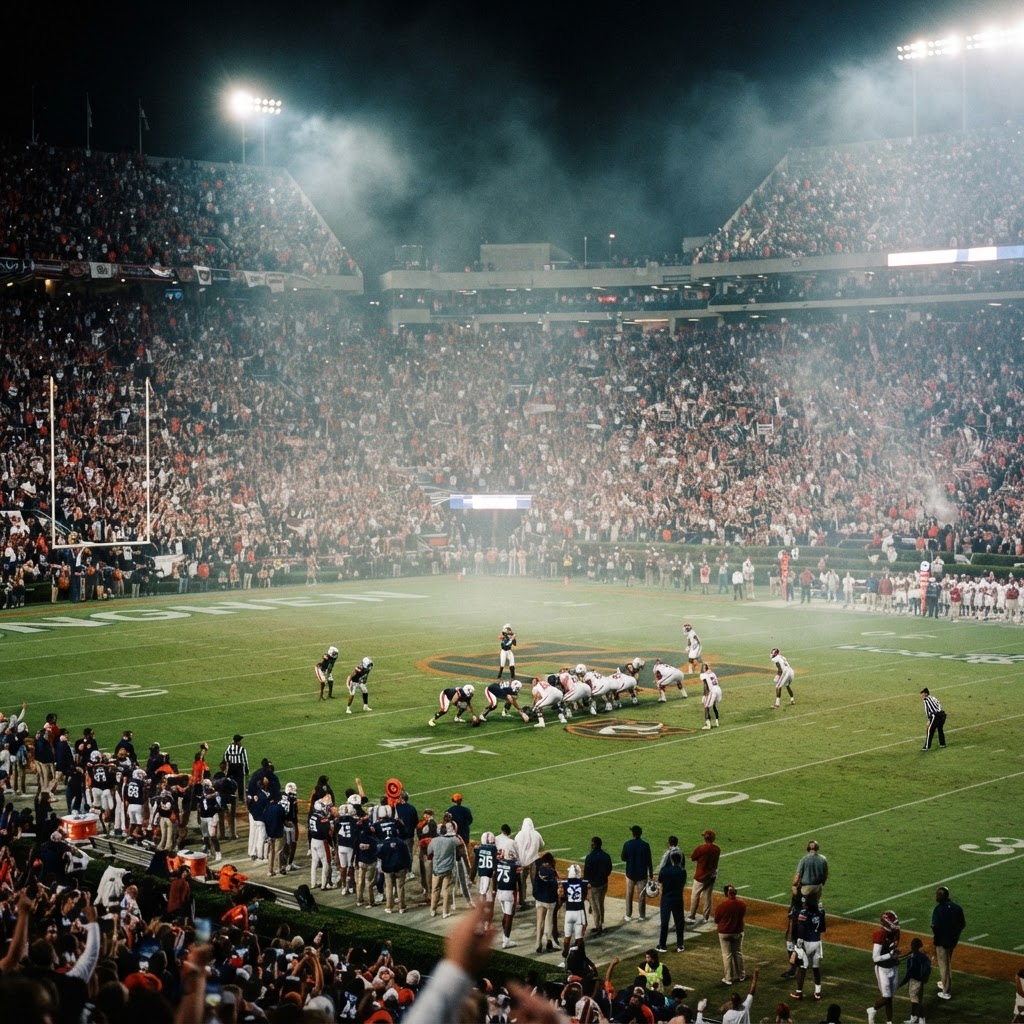
Florida's Freefall, Missouri's Statement: How One Saturday Rewrote the SEC's Playoff Math
The No. 25 Tigers' upset of No. 8 Florida didn't just cost Jon Sumrall a game — it blew open the argument over who actually runs the SEC, with Georgia, Texas, Ohio State and Alabama all entangled in the fallout by Tuesday morning.

A Saturday That Broke the SEC's Script
Three days later, the sport is still arguing about what happened on Saturday, October 3, 2026, when No. 25 Missouri walked into a marquee SEC showdown against No. 8 Florida and walked out with the biggest win of its season. National analysts had circled this exact matchup in the preseason and in-season previews as a critical October swing game — the kind of contest that was supposed to tell us whether Florida belonged among the sport's true elite. Instead, it told us something else entirely, and the sport has spent every day since trying to figure out exactly what.
The stakes were never subtle. Florida entered the weekend ranked inside the top 10 nationally, carrying the look of a program that had arrived under Jon Sumrall. Missouri entered unranked relative to that stature, sitting at No. 25, firmly in the back half of the national conversation. A result like this does not happen in a vacuum — it reorders power rankings, it reshapes how the rest of the sport is forced to think about the SEC's internal hierarchy, and it does real, tangible damage to one team's playoff trajectory while handing the other a signature data point it can carry for the rest of the year.
By Tuesday, the consequences were everywhere: Florida in freefall across national power rankings, the CBS Sports 138 ranking reshuffled with Alabama now sitting among the top four SEC teams, Ohio State climbing to No. 2 nationally amid the chaos, and a fresh round of debate — led publicly by FOX Sports analyst Joel Klatt — over whether unbeaten Georgia, not No. 1 Texas, is actually the best team in the conference. This is the story of the day across the SEC, and it is worth interrogating from every angle: the numbers, the opponents, the ceilings, the coaching, the reaction, and what comes next.
What the Numbers Actually Say
Start with the plainest evidence available: the rankings themselves moved, and they moved hard. Florida's slide in the national power rankings following the loss was significant enough that post-Week 6 assessments treated it as one of the defining storylines of the young season, not a footnote. A team that had worked its way into top-10 standing does not fall quietly — and Florida did not fall quietly. The CBS Sports 138 ranking absorbed the shock directly, with the reshuffling pushing Alabama into the top four among the SEC's premier teams, a notable marker given that it came in the same cycle that buried Florida's own standing.
Meanwhile, Ohio State's climb to No. 2 nationally happened in the same breath as Florida's collapse, which matters for how the broader national picture reads this week. When one top-10 program implodes and another climbs in the same ranking cycle, the two movements get read together whether the programs ever shared a field or not — and that is exactly what has happened here. The AP Poll and national standings both absorbed the shakeup into Tuesday, October 6, with the SEC's internal order looking meaningfully different than it did a week ago.
What do these numbers actually prove, though? They prove that the margin between a top-10 team and an unranked-at-that-level team inside this conference is thinner than the preseason hierarchy suggested. They prove that voters and computer models alike are willing to move fast and move far off a single data point when that data point is this clean: an unambiguous, no-asterisks upset of a ranked top-10 opponent by a 25th-ranked team on a Saturday everyone was already watching.
The Quality of the Opponents, Properly Weighed
Any upset invites the obvious skeptical question: was Florida actually that good, or was Missouri simply better than its ranking suggested? The honest answer sits somewhere in the friction between those two framings, and that friction is exactly why this result has generated so much argument rather than a clean consensus. Florida did not back into a top-10 ranking — the program had worked its way there under Sumrall, which is why the loss reads as a genuine referendum rather than a correction of an inflated number.
At the same time, Missouri's No. 25 ranking entering the weekend was never a signal of a bad team; it was a signal of a team that had not yet been tested against the conference's upper tier. Beating a top-8 opponent on a day that had been flagged in advance as a swing game for SEC supremacy is precisely the kind of result that forces a reclassification, not a shrug. The fact that analysts had already marked this specific matchup as critical before it was played adds weight to the result — this was not a trap game stumbled into unnoticed; it was the one everybody was watching, and Missouri delivered under that spotlight.
That context matters when evaluating opponent quality. The loss is not Florida getting caught looking ahead to an easier week — it is Florida losing the exact game the entire conference had identified as the proving ground. That is a harder result to explain away, and it is why the fallout has been this loud.
Florida's Playoff Ceiling, Suddenly Lowered
For Florida, the central question now is whether the program's College Playoff aspirations can survive a loss this prominent. The answer, based on how hard the team fell in national power rankings, appears to be: not without significant repair work. A top-10 team entering October with legitimate playoff positioning does not typically absorb a loss to a No. 25 opponent and emerge with its standing intact — and Florida has not. The defeat dealt a heavy blow to those aspirations precisely because of where the program sat before kickoff.
This is the uncomfortable math of the modern playoff conversation: strength of schedule and quality wins matter, but so does protecting a ranking you've already built. Florida had done the harder part — climbing into the top 10 — and lost a chunk of that progress in a single Saturday. The program now has to answer a question that didn't exist a week ago: can it beat the kind of team it was supposed to beat, under the exact circumstances the sport flagged as a referendum?
None of this means Florida's season is over. But it does mean the margin for error has shrunk considerably, and it means every remaining game on the schedule now carries a heavier burden of proof. A top-10 team that loses to a No. 25 opponent in a nationally flagged swing game does not get the benefit of the doubt on its next quality opponent — it has to earn that benefit back, game by game, in front of an audience that is now actively skeptical.
Missouri's Resume, Suddenly Elevated
On the other side of the ledger, Missouri has exactly what every October team is chasing: a defining, resume-building win achieved early enough in conference play to matter for the entire rest of the season. Beating a top-8 opponent as a No. 25 team is not a marginal data point — it is the kind of result that selection committees and voters remember in November and December, long after the specific final details of the Saturday have faded from casual conversation.
The value of this win is compounded by its timing. Analysts had already identified the Florida matchup as the critical October swing game for SEC supremacy before it was played, which means Missouri didn't just beat a ranked opponent — it beat the opponent everyone agreed was the test. That distinction matters enormously when it comes to how the win gets weighted later in the season, because it strips away any argument that the result was a surprise nobody saw coming or a fluke born of an overlooked matchup.
Missouri's ceiling now looks different than it did a week ago. A team that beats a top-10 SEC opponent in a nationally anticipated game has demonstrated it can play — and win — at that level, which raises the stakes for everything that follows. The challenge for Missouri now is consistency: can this result be the foundation of a sustained run, or does it become the season's highlight in isolation? That question will define the rest of October.
The Jon Sumrall Question
Every top-10 upset of this magnitude eventually becomes a referendum on the losing program's head coach, and Florida's defeat has triggered exactly that kind of national debate over Jon Sumrall's squad. The scrutiny is sharper here because of the context: this wasn't a loss that snuck up on a middling team — it was a loss by a program that had already proven it belonged in the top 10, in the exact game the sport had circled as a measuring stick.
That combination — real prior success plus a flagged, high-profile failure — is what generates the most intense coaching debates. It is not enough for critics to point to the loss itself; the surrounding circumstances (the swing-game framing, the top-10 ranking, the margin of the national fallout) all amplify the scrutiny on how Sumrall's team was built and whether it was constructed to win exactly these kinds of games.
There is no ground truth here suggesting wholesale panic or roster upheaval — only that the loss triggered national debate over the squad Sumrall has assembled. That distinction matters. The conversation nationally is about whether this Florida team, as currently built, can win the games that define playoff positioning, not about whether the program's broader trajectory under Sumrall is in question. Those are different arguments, and conflating them does a disservice to how specific and pointed the current scrutiny actually is.
The National Reaction and the Georgia-Texas Argument
The Florida-Missouri result did not happen in isolation from the rest of the SEC's internal power struggle, and the reaction this week has made that unmistakably clear. With Georgia remaining unbeaten, FOX Sports analyst Joel Klatt has openly argued that Georgia — not No. 1 Texas — is the best team in the conference. That argument gains considerable oxygen in a week where Florida's collapse has already destabilized the assumed SEC hierarchy; if a top-8 team can lose to a No. 25 team in a nationally flagged swing game, then the entire premise of a settled pecking order inside the conference deserves scrutiny.
This is precisely why the Florida-Missouri result has become a conference-wide story rather than a two-team story. Alabama's move into the CBS Sports 138 top four among SEC teams, Georgia's unbeaten record fueling the Klatt argument, and Texas's position at No. 1 nationally all now exist inside the same conversation, each data point being used to argue for or against a different version of SEC supremacy. The upset functions as the crack that let all of these arguments out into the open simultaneously.
The broader national reaction has settled on a consistent theme: the SEC's expanded conference slate is producing real, grueling parity, and that parity is shaking up the AP Poll and national standings in ways that were visible by Tuesday, October 6. That is not a controversial read of the evidence — it is the most direct explanation for why a top-10 team lost to a No. 25 team in a game that was supposed to clarify the hierarchy and instead scrambled it further.
What Happens Next
The immediate question for the rest of the conference is whether this result is an outlier or a preview. If the SEC's expanded slate is genuinely producing the kind of parity that allowed a No. 25 team to beat a No. 8 team in a flagged swing game, then no result involving a conference opponent should be treated as settled until it's played. That has direct implications for how the rest of the season gets covered and ranked — teams like Georgia, Texas, and Alabama will all face their own version of this test at some point, and the sport now has fresh, recent evidence of how violently a single Saturday can reorder the rankings.
For Florida, the path forward is straightforward in concept and difficult in execution: beat good opponents, rebuild the ranking that was lost, and answer the national debate over the roster with results rather than explanations. For Missouri, the challenge is different — protecting and building on a signature win rather than letting it stand alone as the season's peak moment.
And for the conference at large, the Klatt-fueled Georgia-versus-Texas argument is not going away this week. If anything, Florida's collapse has made that debate more urgent, because it has demonstrated in real time exactly how fast a top-10 reputation can evaporate. Every remaining marquee SEC matchup this month will now be watched through that lens.
The Bottom Line
Strip away the noise and the verdict is clear: No. 25 Missouri's win over No. 8 Florida was not a fluke absorbed quietly into the margins of the week — it was a seismic, conference-defining result that damaged Florida's College Football Playoff aspirations, elevated Missouri's resume, reshuffled the CBS Sports 138 rankings, pushed Alabama into the SEC's top four, and helped clear space for Ohio State's climb to No. 2 nationally, all while reigniting the argument over whether Georgia or Texas truly runs the SEC.
The through-line connecting all of it is parity — the SEC's expanded slate is producing results that refuse to respect preseason hierarchy, and that instability is exactly why this story has dominated the conversation into Tuesday, October 6. Florida now has to prove its top-10 standing was real. Missouri has to prove its upset was a foundation, not a ceiling. And the rest of the conference, Georgia and Texas included, should treat this week's chaos as a warning: in this version of the SEC, no ranking is safe until it's defended on the field.
Published about 4 hours ago
Staff
Staff writer for SEC Saturday Wire covering college sports.
Process Notes & Methodology
Treat the Missouri-over-Florida upset as the hub of a conference-wide power realignment story, using it to interrogate rankings movement (CBS 138, Ohio State to No. 2, Alabama top four), opponent quality, CFP ceiling implications for both programs, the Jon Sumrall coaching scrutiny, and the national reaction culminating in Joel Klatt's Georgia-over-Texas argument, all strictly sourced from the provided ground truth.
Opened with the lede heading framing the result as a conference-defining shock, establishing the stakes (Florida's fall from top-10 standing, Missouri's rise as a resume-builder) and previewing the wider fallout across the AP Poll, CBS Sports 138, and the SEC supremacy debate before diving into analysis.
Built seven body sections — numbers/rankings movement, opponent quality analysis, Florida's playoff ceiling, Missouri's elevated ceiling, the Sumrall coaching scrutiny, the national reaction tied to Klatt's Georgia-Texas argument, and a forward-looking 'what happens next' section — each using only facts explicitly given, with analytical questions posed and answered rather than straight recap.
Closed with a two-paragraph Bottom Line delivering a direct verdict: the upset was a legitimate conference-reshaping event that damaged Florida's playoff standing, boosted Missouri's resume, and intensified the unresolved Georgia-Texas SEC supremacy debate, tying every thread back to the parity theme established in the ground truth.
See something wrong? Fix it.
We're the first crowdsourced college football site. Submit corrections — our editors review every one.