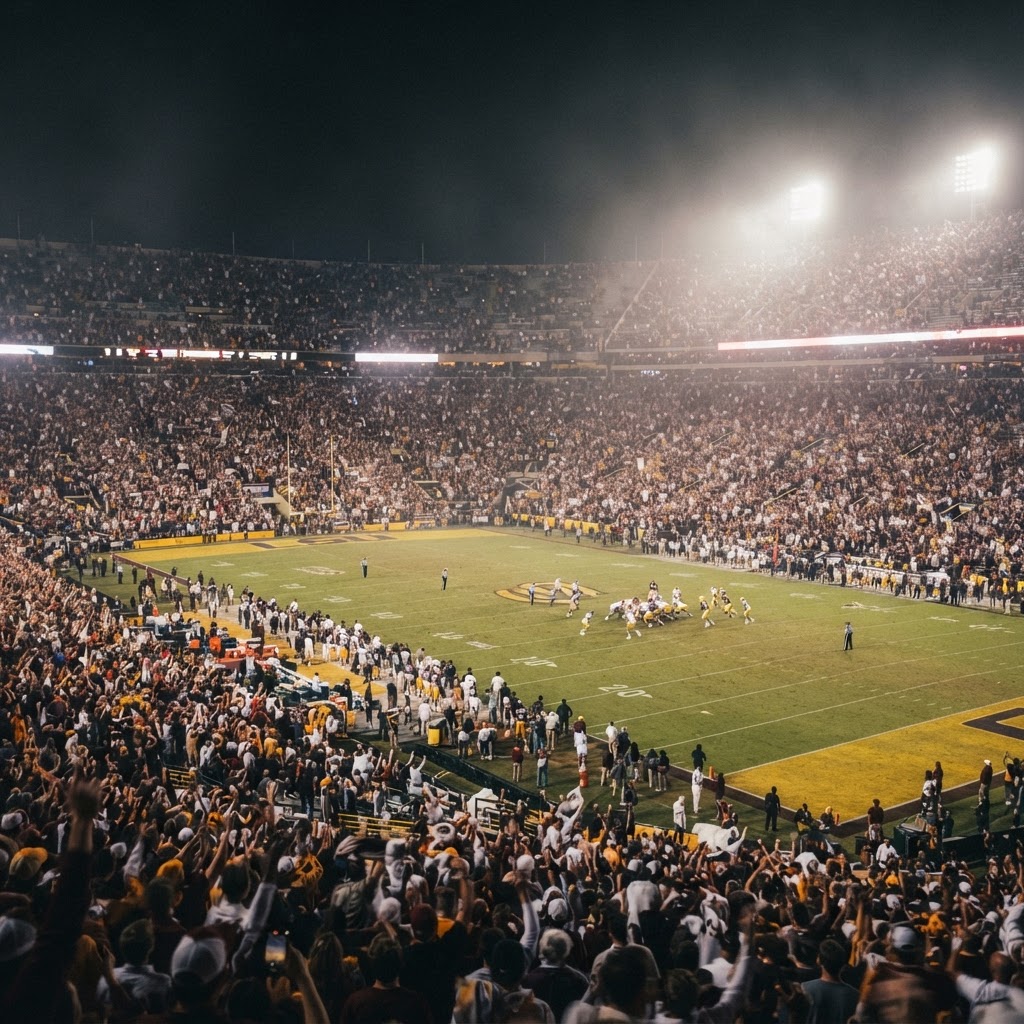
Georgia-Alabama Finally Returns to the Regular Season — And the Stakes Have Never Been Higher
A rare regular-season meeting between two top-six juggernauts arrives with a presidential guest, two of the nation's most explosive offenses, and real College Football Playoff consequences on the line

The Rivalry Nobody Gets to See Enough
There is a strange asterisk that hangs over Georgia-Alabama, one of the sport's defining rivalries of the last two decades: fans rarely get to watch it in the fall. When No. 2 Georgia travels to No. 6 Alabama this week, it marks just the fourth time these two programs have met in a regular-season game since 2007. Seven of their meetings in that stretch instead came at neutral sites, decided in SEC Championship games or on the sport's biggest national championship stages. This is not a conference filler game. This is one of the defining rivalries in modern college football, and it is happening in Tuscaloosa on a Saturday in October instead of in Atlanta or a title-game city in January.
That rarity alone would make this a massive story. But the context surrounding it elevates the matchup even further. Both teams arrive ranked in the top six of the country. Both are fielding historically prolific offenses. And both have legitimate, immediate stakes in the College Football Playoff race, with the loser facing a credibility hit that could linger across the entire postseason selection process. There is no soft landing for either side here.
Add in the spectacle layer — a presidential visit, national made-for-TV framing, and a spotlight that has turned Georgia's second-year starting quarterback into a week-long national talking point — and this single Saturday has become the epicenter of the sport. Across the SEC, nothing else this week comes close to matching its gravity.
What the Numbers Actually Say
Strip away the hype and the raw statistical profile of this game is still jaw-dropping. Georgia enters averaging 51.4 points per game, a number that places the Bulldogs among the most explosive offenses in the country. Alabama counters with 49.6 points per game of its own. These are not two defenses playing keep-away football; these are two units built to outscore anyone put in front of them, and now they are being put in front of each other.
The natural question is whether either defense can actually slow the other down, and the scoring averages suggest the honest answer is: maybe not much. When two offenses are both operating north of 49 points per contest, the expectation isn't a grind-it-out, field-position chess match — it's a shootout where red-zone execution and tempo management could decide the outcome as much as raw talent does. For a sport that has trended increasingly toward offensive explosion, this matchup might be the clearest distillation yet of where college football currently lives scoring-wise.
Georgia's numbers carry additional weight because of who is running the show. Gunner Stockton, in his second season as the Bulldogs' starting quarterback, has completed 75.5 percent of his passes with 13 touchdown throws, and he has not lost a game as a starter this season. That efficiency number is the kind of figure that validates an entire offensive infrastructure — it suggests not just big plays, but consistency, protection, and a quarterback who is not beating himself. Against a defense that will see plenty of Alabama points on the board, that efficiency may be the single most important variable in the game.
The Quality of the Opponent Is Not in Question
One of the easiest traps in sports media is inflating a matchup's importance beyond what the teams have actually earned. That is not the case here. Georgia is ranked No. 2 nationally. Alabama is ranked No. 6. Both programs arrive with resumes strong enough to be in serious Playoff position, and both are bringing top-tier scoring offenses into the building. This isn't a marquee name carried by reputation alone — the on-field quality backs up the billing.
It also matters that this game is being framed nationally alongside only one other ranked matchup of the week: No. 21 UCLA traveling to No. 13 Oregon. That Georgia-Alabama stands alone as the marquee half of that two-game showcase tells you everything about where it sits in the sport's hierarchy this week. ESPN's Football Power Index featured the showdown prominently in its predictive model for the entire Week 6 slate, a signal that the analytics community views this as one of the season's genuine measuring-stick games, not just a ratings play.
For Georgia, beating a top-six Alabama team on the road validates every bit of the No. 2 ranking and the gaudy offensive numbers. For Alabama, beating a top-two Georgia team at home does the same in reverse — it would be the kind of win that instantly reshapes how the rest of the season is viewed. There is no scenario here where either side can claim the opponent wasn't worthy of the moment.
What It Means for Each Team's Ceiling
Georgia came into this season with a roster good enough to be ranked No. 2 nationally, but Stockton's emergence has been central to the team actually playing like it. An unbeaten record as a starter paired with a 75.5 completion percentage and 13 touchdowns is the profile of a quarterback who has turned a talented roster into an offense averaging 51.4 points a game. A win at Alabama would not just preserve Georgia's record — it would be the signature result that defines the Bulldogs' Playoff ceiling for the rest of the year. Beat a top-six team of Alabama's caliber on the road, and the argument that Georgia is a true national championship contender becomes nearly impossible to dispute.
Alabama's ceiling question is just as real. The Crimson Tide are averaging 49.6 points per game themselves, nearly matching Georgia's output, which means this is not a case of one explosive team trying to slow down and manage an opponent's firepower — it's two teams fully intending to play to their strengths. A home win over the No. 2 team in the country would be the single biggest resume boost Alabama could ask for this season, instantly repositioning the Tide as a top-tier Playoff threat rather than simply a quality team hovering in the rankings.
For both programs, the downside of a loss is just as significant as the upside of a win. The Playoff format rewards resume quality, and a loss in a game this visible, against an opponent this good, is not something that quietly disappears from the conversation. Whichever team leaves Tuscaloosa with the defeat will spend the rest of the season being measured against this single result.
The Stockton Spotlight
Every marquee game needs a central character, and for this one it is unmistakably Gunner Stockton. This is being treated as his national spotlight moment — the game where a second-year starter with an unbeaten record, a 75.5 completion percentage, and 13 touchdown passes gets measured against the kind of opponent that defines a quarterback's résumé. Efficiency numbers like his don't happen by accident; they reflect a quarterback who has taken care of the football while still pushing an offense capable of 51.4 points a night.
What makes this moment different from a typical midseason spotlight is the opponent and the environment. Road games at Alabama are not neutral proving grounds — they are among the most hostile remaining tests in the sport, now amplified further by a presidential visit and full national broadcast attention. A performance that sustains his current efficiency numbers against a defense built to slow down a 49.6-point-per-game offense would answer, emphatically, whether Stockton is simply productive against lesser competition or genuinely elite against the best the conference has to offer.
There is no quarterback controversy here, no uncertainty about who is driving Georgia's offense. The only question is whether Stockton's first truly massive road test matches the body of work he has built across the season. Given the stakes attached to the outcome, there may not be a more scrutinized individual performance in the sport this week.
Why the Rest of the Country Can't Look Away
National attention on this game extends well beyond the two fan bases involved. President Donald Trump has announced plans to attend the game in Tuscaloosa, instantly turning an already enormous sporting event into one of the most talked-about spectacles of the fall sports calendar. That kind of presence does not happen for ordinary SEC matchups — it happens when a game has already established itself as appointment viewing nationally, and it only adds another layer of magnitude to Saturday.
The game's placement within the broader slate underscores the same point. It is one of only two games between ranked opponents being highlighted nationally for the weekend, standing alongside No. 21 UCLA's trip to No. 13 Oregon. Within a season broadcasting more than 230 SEC matchups across ESPN platforms, the conference and the network have clearly identified this specific game as the crown jewel of the October schedule. ESPN's FPI featuring the matchup prominently in its predictive model only reinforces how central this contest is to the week's entire national football conversation.
Put together — the rarity of the regular-season meeting, the presidential attendance, the FPI spotlight, and the historic weight of the Georgia-Alabama name — this is as close to a can't-miss event as the regular season produces. It is the kind of game that transcends typical conference coverage and becomes a full sports-media event in its own right.
What Happens Next
Whatever happens Saturday will immediately reverberate through the rest of the Playoff conversation. A Georgia win keeps the Bulldogs unbeaten under Stockton and validates the No. 2 ranking with the signature road victory that committees and pollsters remember months later. It would also deal Alabama a loss to a fellow top-six team that, fair or not, becomes the defining data point on the Crimson Tide's resume for the remainder of the season.
An Alabama win flips that script entirely. The Crimson Tide's own 49.6-point-per-game offense would have authored the result that reshapes the entire top of the sport's rankings, while Georgia would be forced to answer questions about whether its gaudy offensive numbers and Stockton's efficiency can hold up against the best competition remaining on the schedule.
Either way, the broader Playoff picture shifts immediately. With the matchup already singled out nationally alongside the UCLA-Oregon game and prominently modeled in ESPN's FPI, this result will not sit quietly. It will be cited, debated, and leaned on by committee members and analysts alike as the season moves toward its postseason reckoning.
The Bottom Line
This is as complete a collision of magnitude as the regular season offers: two top-six teams, two offenses each averaging better than 49 points per game, a quarterback entering his defining national moment, a presidential visit, and a historic rarity in a rivalry usually reserved for championship stages. Every layer of context — the FPI's prominent feature, the national highlight alongside UCLA-Oregon, the broader scale of more than 230 SEC games on ESPN platforms this year — points to the same conclusion. This is the game of the week in college football, full stop, with no close second within the conference.
What happens on the field will matter more than any of the surrounding spectacle. Gunner Stockton's unbeaten record and 75.5 completion percentage will be tested against a defense that has to defend a 49.6-point-per-game attack of its own, and the result will immediately reorder how both No. 2 Georgia and No. 6 Alabama are viewed in the national Playoff conversation. Rare games like this one don't just decide a Saturday — they tend to decide seasons.
Published 1 day ago
Staff
Staff writer for SEC Saturday Wire covering college sports.
Process Notes & Methodology
Treat the Georgia-Alabama showdown as the definitive 'Across the SEC' story of the week by leaning entirely on the provided ground truth: the historic rarity of the regular-season meeting, the matched explosive scoring averages, Stockton's efficiency/undefeated narrative, the Trump attendance angle, and the national FPI/UCLA-Oregon framing. Structure the piece as argued analysis — posing real questions (can either defense slow the other down? does the ceiling argument favor Georgia or Alabama? is Stockton's spotlight moment validated by the opponent?) and answering them strictly with the given facts, without inventing any additional stats, scores, or quotes.
The three-paragraph lede establishes the rarity of the regular-season meeting (4th since 2007, 7 prior neutral-site meetings), frames both teams' rankings and explosive offenses, and layers in the presidential visit and national spotlight to establish why this is the SEC's story of the week, setting up the deeper threads explored in the body.
The six body sections each isolate one angle required by the prompt: 'What the Numbers Actually Say' interrogates the matched scoring averages and Stockton's efficiency; 'Quality of the Opponent' leans on rankings, FPI feature, and the UCLA-Oregon comparison to prove legitimacy; 'What It Means for Ceilings' argues the Playoff stakes for both programs using only the given records/stats; 'The Stockton Spotlight' covers the coaching/roster angle through the lens of the only roster detail given (Stockton's profile and second-season status); 'Why the Rest of the Country Can't Look Away' covers national reaction via Trump's attendance and the 230+ ESPN broadcast context; 'What Happens Next' projects forward using only logical extensions of the established facts, avoiding invented outcomes.
The Bottom Line closes by restating the convergence of stakes — rankings, scoring averages, Stockton's narrative, and national framing — and delivers a clear verdict that this game is the week's defining SEC story and will reshape the Playoff conversation regardless of outcome, without speculating on an invented final score or result.
See something wrong? Fix it.
We're the first crowdsourced college football site. Submit corrections — our editors review every one.