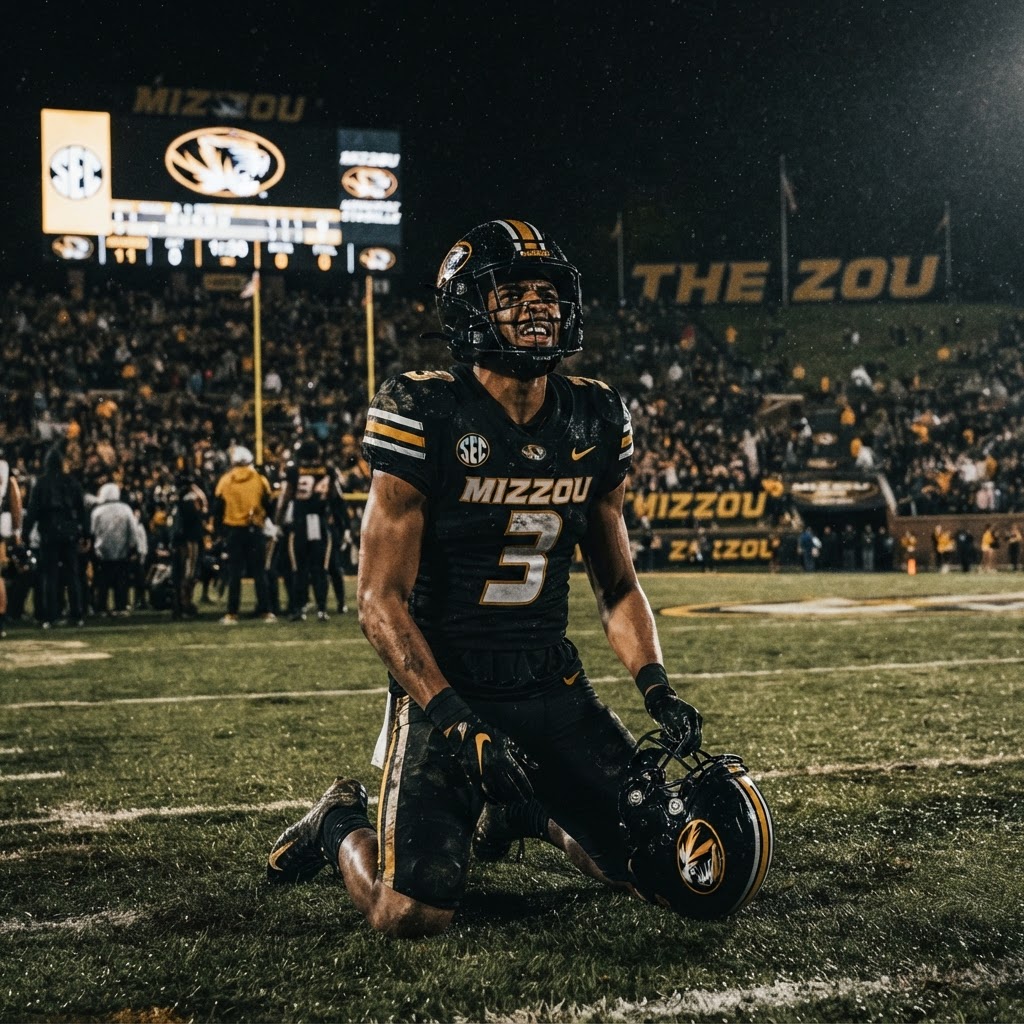
Forged in the July Furnace: Austin Simmons and Missouri’s Blueprint for an SEC Encore
As Eliah Drinkwitz returns from SEC Media Days, a retooled roster embraces the brutal crucible of Workout Wednesday to elevate the Tigers from bowl winners to championship contenders.

The Dallas Echoes and the Columbia Grind
The mid-July sun in Columbia does not merely shine; it suffocates. It bakes the practice turf at the Mizzou Athletics Training Complex into a sprawling skillet, daring anyone to step onto it. Yet, as the heat of the Missouri summer settles over the midwest, the Missouri Tigers are laser-focused on the physical demands of the rapidly approaching 2026 season. Just twenty-four hours earlier, on July 14, head coach Eliah Drinkwitz stood in the climate-controlled opulence of the Omni hotel in Dallas, headlining the program's presence at the 2026 SEC Media Days. Marking his seventh year in Columbia, armed with a contract extending through 2031, Drinkwitz projected the quiet confidence of a coach who understands that championships are won in the winter and summer, not at press conferences.
While the media in Texas analyzed depth charts and portal rankings, the true heartbeat of the Missouri program was pounding back home during a grueling iteration of Workout Wednesday. Following a 2025 campaign that culminated in a 10-3 record and a thrilling 27-24 victory over Iowa in the Music City Bowl, Drinkwitz’s focus has shifted entirely to internal standards. The mission is clear: exorcise any lingering ghosts from the disappointment of the 2025 Gator Bowl, integrate a massive influx of high-impact transfers, and forge the kind of unbreakable chemistry required to navigate the Southeastern Conference's elite.
The April Coronation of a New Signal Caller
If there was a singular focal point to Missouri’s week in Dallas, it was the formal introduction of redshirt junior Austin Simmons as the program's starting quarterback. The transition under center has been a defining storyline of the offseason. After reclassifying from the 2025 cycle and transferring from Ole Miss, Simmons arrived in Columbia with raw talent and a burden of expectation. Following a hard-fought and hyper-competitive spring practice, Simmons emerged as the clear, undisputed leader of the offense, prompting Drinkwitz to officially name him QB1 on April 2, 2026.
Drinkwitz emphasized to the media contingent that crowning Simmons early was a calculated, strategic move designed to solidify locker room leadership following the transfer of previous starter Beau Pribula. Simmons’ role this summer extends far beyond mastering the intricate playbook of offensive coordinator Chip Lindsey. It is about establishing a rhythm, a cadence, and an unspoken trust with a new-look supporting cast. The summer 7-on-7 sessions and grueling weight room circuits serve as the primary laboratory for building that vital connection before the lights turn on in August.
Forging Elite Iron in the Backfield and on the Boundary
Simmons is not marching into the SEC gauntlet alone. He is flanked by a formidable arsenal, headlined by a running back room that strikes fear into opposing coordinators. Ahmad Hardy enters the 2026 season not just as a reliable bell-cow, but as a consensus Preseason All-American widely regarded as one of the top three running backs in the country. Hardy's punishing style requires an offensive line and a perimeter blocking scheme forged in the fires of July conditioning, making these Workout Wednesdays the bedrock of Missouri's ground game.
Through the air, the Tigers are tasked with replacing significant NFL-caliber talent, but the transfer portal has provided immediate reinforcements. Former Ole Miss teammate Cayden Lee has reunited with Simmons, bringing established chemistry and a proven SEC resume to Columbia. Coming off a season where he secured 44 catches for 635 yards, Lee now boasts over 1,500 career receiving yards. Alongside Caleb Goodie, Lee is establishing the perimeter physicality necessary to separate from elite defensive backs. Every sprint, every rep, and every drop of sweat equity invested this summer is designed to synchronize this newly assembled cast.
In the modern, unforgiving ecosystem of the Southeastern Conference, a roster cannot merely be assembled; it must be annealed. The transfer portal provides the raw, disparate ore, but only the relentless crucible of a July strength and conditioning program can forge it into impenetrable armor.
Batoon’s Alchemy and the Violence of the 'Joker'
While the offense fine-tunes its timing, the Missouri defense is undergoing a fascinating schematic evolution under coordinator Corey Batoon. Tasked with maximizing the athleticism of returning edge rushers like Darris Smith and Dominick Giudice, Batoon is implementing a hybrid 'Joker' role. This specialized position is designed to disguise coverages, blur the lines between defensive end and outside linebacker, and unleash unpredictable pressure packages on opposing quarterbacks.
To execute this aggressive philosophy, the Tigers needed enforcers. Enter Robert Woodyard, an All-SEC linebacker who transferred from Auburn. Woodyard registered 67 tackles and two sacks in 2025, and he has been explicitly tasked with providing the sheer violence needed to replace the production of departed star Josiah Trotter. Behind the front seven, Missouri has aggressively addressed depth concerns that surfaced late in the 2025 campaign. The integration of high-profile secondary transfers Jahlil Florence, Malik Bryant, and Chris Graves Jr. is a daily priority. For Batoon’s defense, summer workouts are about communication as much as conditioning—ensuring that a unit comprised of varied backgrounds learns to move, breathe, and strike as one cohesive organism.
Stockpiling the Arsenal for 2026 and Beyond
The urgency of the present moment has not distracted Drinkwitz and his staff from building a sustainable powerhouse. The current Spring Ball & Recruiting 2026 period has been remarkably fruitful. Missouri’s 2026 recruiting class has surged to an impressive 14 commitments, blending national blue-chip talent with elite regional prospects. The class is anchored by four-star Florida wide receiver Jabari Brady and four-star quarterback Gavin Sidwar, ensuring the offensive pipeline remains stocked.
Crucially, the staff has also successfully defended its own backyard. Securing commitments from top local prospects like cornerback Trashundon Neal and linebacker Keenan Harris sends a powerful message across the state and the conference. When these recruits visit the facility and witness the intensity of a mid-July workout, they aren't just seeing a practice; they are witnessing the internal standard that defines the modern Missouri football program.
A Standard Measured Internally
External expectations for the Missouri Tigers are soaring. A Top 10 finish in 2023 set the benchmark, and a resilient 10-win season in 2025 proved the program's staying power. Yet, as the heat shimmers off the practice fields in Columbia, the noise of SEC Media Days feels a world away. Eliah Drinkwitz has built a culture that insulates itself from the hype, choosing instead to measure success by the agonizing, incremental gains made in the weight room when no cameras are watching.
As Austin Simmons commands the huddle, as Ahmad Hardy grinds out another sprint, and as Robert Woodyard learns the nuances of the Joker defense, the foundation of the 2026 season is solidifying. They are not merely preparing to play football; they are preparing to survive the SEC. When the leaves turn and the stadium lights ignite this fall, the Tigers will look back on the suffocating heat of July not as a punishment, but as the fiery forge that crafted their championship armor.
Published 3 months ago
Staff
Staff writer for SEC Saturday Wire covering college sports.
Process Notes & Methodology
The story centers on the team's physical transformation and the integration of new transfer talent during the summer strength program. This angle is chosen to bridge the gap between spring developments and fall expectations.
The intro hooks the reader by setting the seasonal context of mid-July and pinning the team's direction on Eliah Drinkwitz's leadership heading into his seventh season.
The body focuses on the confirmed starting quarterback, Austin Simmons, and uses the team's status regarding transfers to explain why summer conditioning is critical for this specific roster.
The closing pivot looks ahead to the upcoming season by framing the current training as the essential foundation for redemption after the 2025 season conclusion.
See something wrong? Fix it.
We're the first crowdsourced college football site. Submit corrections — our editors review every one.