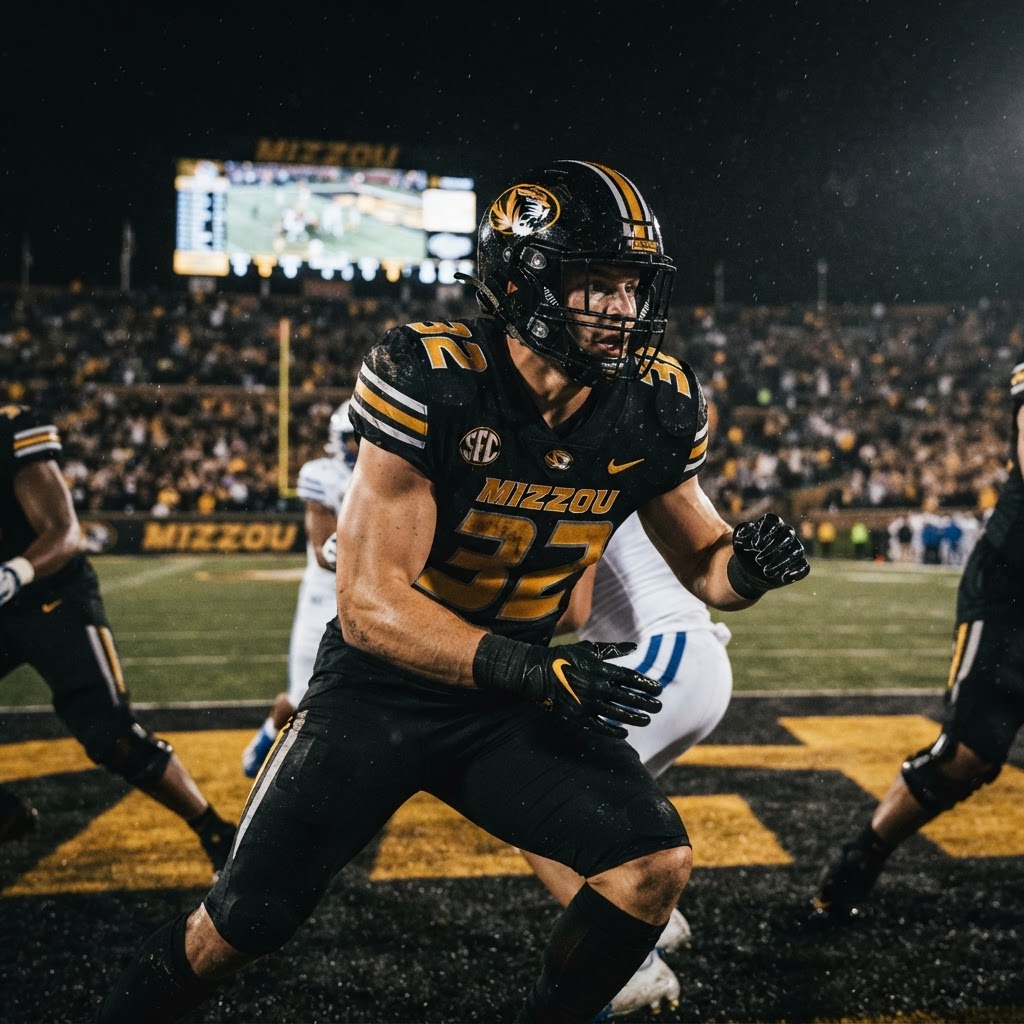
The Centennial Crucible: Missouri's $250 Million Bet on Football Immortality
As Memorial Stadium unveils a sprawling centennial expansion, Eliah Drinkwitz guides a radically reshaped roster through offseason adversity and into a punishing 2026 SEC gauntlet.

The Shadow of a Centennial Monument
The mid-July heat has settled over Columbia with its usual, suffocating weight, but an undeniable current of electricity cuts through the humidity. The cranes and scaffolding that defined the skyline for the past two years have finally receded, revealing the crown jewel of Missouri Tigers football: the newly completed, $250 million Memorial Stadium Centennial Project. As the program celebrates the 100th anniversary of Faurot Field, the architectural marvel stands as a physical manifestation of a surging program. The north end zone is now fully enclosed, a towering fortress of stone and steel that brings the stadium's capacity to roughly 65,000. It features 14 immersive field-level suites and the exclusive, 300-person Rock M Club, creating an imposing coliseum atmosphere designed to trap the roar of the crowd and unleash it upon visiting SEC foes.
For head coach Eliah Drinkwitz, this monumental infrastructure milestone perfectly mirrors the upward trajectory of his tenure. Entering his seventh season at the helm, Drinkwitz has engineered a structural stability that is exceedingly rare in the modern Southeastern Conference. Armed with a newly minted six-year, $64.5 million contract extension running through the 2031 season, Drinkwitz is now the third-longest tenured coach in the SEC. He has transformed Missouri from a scrappy underdog into a heavyweight contender. Yet, as the Tigers transition into a grueling, nine-game conference schedule that leaves absolutely zero margin for error, the $250 million question remains: Can Drinkwitz's reshaped 2026 roster match the grandeur of its new cathedral?
Unleashing the Southpaw: The Austin Simmons Era
The architectural upgrades outside the locker room are matched only by the tactical renovations within it. The 2026 offensive identity centers entirely around the electric, newly crowned starting quarterback, Austin Simmons. The left-handed Ole Miss transfer officially seized the reins of the offense on March 19, emerging victorious from a highly publicized, fiercely competitive spring camp. Simmons edged out a crowded, talented quarterback room that included veteran Nick Evers, incoming transfer Gavin Sidwar, and highly touted sophomore Matt Zollers, who flashed immense promise by throwing for 503 yards and four touchdowns as a true freshman last season.
Simmons is not merely a game manager; he is a dual-threat weapon whose arrival triggered a fundamental shift in offensive philosophy. To maximize the lefty's elite arm talent and mobility, Drinkwitz executed a masterstroke of coaching acquisitions, turning the offensive keys over to coordinator Chip Lindsey and quarterbacks coach Garrett Riley.
By installing a high-ceiling southpaw like Simmons alongside the tactical alchemy of Chip Lindsey and Garrett Riley, Missouri has aggressively broadcast its intent: the Tigers are shedding their traditional ground-and-pound shell for a dynamic, multidimensional SEC passing apparatus designed to neutralize elite defenses.
The evolution from a run-heavy attack to an aerial assault does not mean the Tigers are abandoning their physicality. Rather, the passing game is designed to force defenses into impossible geometric dilemmas, opening the field for an offense that has been meticulously curated through the transfer portal and high-level prep recruiting.
The Heartbeat of the Backfield and an Uncertain Return
Despite the anticipated aerial leap, the DNA of Drinkwitz's Missouri programs has always been tied to a dominant rushing attack. Entering 2026, the backfield is simultaneously the team's greatest proven asset and its most complex storyline. In 2025, Ahmad Hardy was nothing short of a revelation. The bruiser terrorized SEC defenses, racking up a league-leading 1,649 rushing yards and 16 touchdowns, establishing himself as the gravitational center of the Missouri offense.
However, the momentum of his breakout campaign was violently interrupted by a terrifying off-field incident in May, when Hardy sustained a gunshot wound. The severity of the situation sent shockwaves through the program, temporarily putting football into stark perspective. Miraculously, recent reports from June and early July suggest that Hardy is progressing remarkably well, with Drinkwitz publicly stating the star back is 'ahead of schedule' in his recovery. Hardy's potential availability for the 2026 season remains the most critical variable of the summer, and it will undoubtedly be the dominant talking point when Missouri takes center stage on the opening day of SEC Media Days in Tampa, Florida, on July 20.
In the event that Hardy requires extended time to recover, Missouri is not without high-caliber ammunition. The backfield remains deeply stocked with punishing runners. Jamal Roberts, who operated with lethal efficiency last season while averaging an impressive 6.1 yards per carry, is poised to shoulder the primary load. He will be joined by highly touted incoming freshman Maxwell Warner, ensuring that the Tigers' ground game retains its trademark teeth.
The Calculus of Roster Churn
Facing one of the nation's most demanding schedules—a gauntlet that features late-season, heavyweight clashes against Texas, Georgia, and Oklahoma—the Tigers have aggressively reloaded to mitigate the loss of 12 starters. The 2026 roster makeup is a fascinating case study in Drinkwitz's modern roster-building philosophy, showcasing a delicate balance of retention, targeted acquisitions, and developmental foresight.
The mathematical breakdown of the locker room tells the story of a program operating at the peak of the portal era:
- 37 key retained players from the 2025 campaign, providing vital cultural continuity.
- 30 strategic portal transfers to plug immediate positional gaps and raise the competitive floor.
- 23 high school signees developing within the system for long-term sustainability.
On the offensive side of the ball, the portal and the recruiting trail have yielded a terrifying array of playmakers. The strategic integration of former Auburn receiver Cayden Lee adds immediate SEC experience, while the recruiting class continues to swell with elite talent. Just two weeks ago, on July 1, explosive wide receiver Tre Britton officially committed to the Tigers, joining a star-studded offensive class that already features dynamic tight end Jack Brown and coveted wideout Jabari Brady. Guarded by a massive offensive line anchored by core veteran Cayden Green, Simmons will not lack for protection or perimeter weaponry.
Trench Warfare and a Secondary Rebuild
While the offense generates the headlines, defensive coordinator Corey Batoon faces the monumental task of replacing crucial NFL departures and portal exits. The most pressing challenge lies in the defensive secondary. The offseason departure of junior safety Marvin Burks Jr. to the transfer portal—taking his 131 career tackles and veteran instincts with him—left a gaping void in the back end of the defense.
Batoon and his staff moved swiftly to stop the bleeding. A massive victory came early in the offseason when rising junior safety Trajen Greco officially re-signed with the program on January 2, providing a foundational piece to anchor the defensive backfield. To further fortify the secondary, the Tigers dipped heavily into the portal, securing battle-tested reinforcements like Chris Graves Jr. and Jahlil Florence, who will be expected to contribute immediately.
Closer to the line of scrimmage, the front seven is buzzing with undeniable potential. Linebacker Nicholas Rodriguez returns to direct the defense, while returning veterans Dominick Giudice and Darris Smith provide crucial stability in the trenches. Yet, it is the addition of edge rusher Daeden Hopkins that has internal scouts whispering about generational talent. Hopkins, a freakish athlete with a relentless motor, is already being labeled as a potential first-round NFL draft pick, giving Missouri the kind of terrifying pass-rushing presence required to hunt down elite SEC quarterbacks.
Forging a New Legacy
As the countdown to the Thursday, September 3 kickoff against Arkansas-Pine Bluff accelerates, the 2026 Missouri Tigers stand at a fascinating intersection of history and modern ambition. The sprawling, $250 million edifice of the Memorial Stadium Centennial Project casts a long, proud shadow over Faurot Field, a silent demand for excellence in its 100th year.
Drinkwitz has assembled a roster built for the unique brutality of a nine-game SEC schedule. It is a roster that blends the elite, dual-threat upside of Austin Simmons with a punishing rushing attack waiting on the health of Ahmad Hardy, all supported by a defense retooled through aggressive portal acquisitions. The pieces are unequivocally in place. Now, beneath the lights of a modernized stadium and the weight of towering expectations, the Tigers must prove they can transform offseason momentum into autumn immortality.
Published 3 months ago
Staff
Staff writer for SEC Saturday Wire covering college sports.
Process Notes & Methodology
The story highlights Missouri's momentum by contrasting the internal roster development with the external physical growth of the stadium. This dual focus emphasizes a program that is expanding both its talent floor and its facility footprint.
The hook uses the current 'Spring Ball & Recruiting 2026' timeframe to establish the mood of expectation for Eliah Drinkwitz's program.
The body focuses on the integration of Austin Simmons as the QB1 and the arrival of key transfers. I also incorporated the Memorial Stadium centennial and renovation as evidence of the program's growth.
The conclusion pivots from the stadium improvements to the team's internal preparation, framing the facility upgrades as a reflection of the team's overall ambitions in the SEC.
See something wrong? Fix it.
We're the first crowdsourced college football site. Submit corrections — our editors review every one.