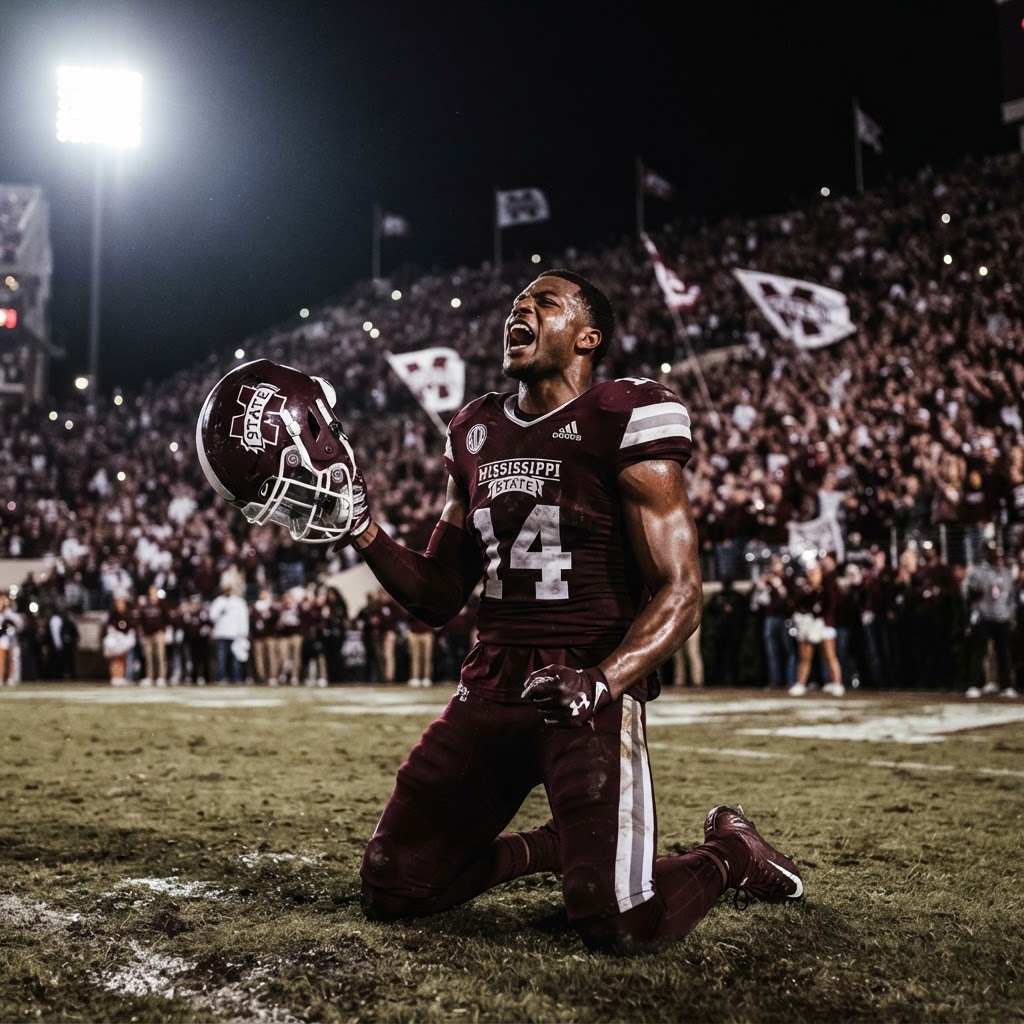
The Tampa Blueprint: How Jeff Lebby’s Retooled Bulldogs Plan to Crash the SEC Hierarchy
Armed with a 'traitsy' sophomore quarterback, a portal-infused roster, and the long-awaited return of defensive architect Zach Arnett, Mississippi State brings soaring expectations into the 2026 season.

As mid-July humidity wraps around the Deep South like a heavy blanket, the epicenter of the sport shifts temporarily to the Sun Coast. For the first time, SEC Media Days descends upon Tampa, Florida, from July 20-23, setting a new stage for the conference's annual preseason spectacle. When Mississippi State head coach Jeff Lebby takes the podium on Thursday, July 23, he will not be selling promises of a distant rebuild. Entering his third season at the helm, Lebby has moved past the growing pains of a difficult 5-8 finish in 2025. He arrives in Tampa armed with a roster built precisely to his specifications, flanked by a trio of student-athletes who represent the present and future of Bulldog football: sophomore quarterback Kamario Taylor, dynamic wide receiver Anthony Evans III, and lockdown cornerback Kelley Jones. The excuses have evaporated in the Starkville heat. Now, the expectations are soaring.
The Traitsy Prototype: Kamario Taylor Takes the Reins
The offensive identity of Mississippi State has been fundamentally rewired, and the current flowing through it belongs to Kamario Taylor. After spending the bulk of his developmental 2025 campaign learning the nuances of SEC defensive speeds, Taylor was unleashed late in the year, starting the final two games and immediately validating his immense recruiting pedigree. He provided a dazzling glimpse of his dual-threat capabilities, gashing Ole Miss for 173 rushing yards in a bitter Egg Bowl fight before turning around to throw for 241 yards against Wake Forest in the Duke's Mayo Bowl.
That late-season surge has snowballed into deafening national buzz. Following a standout performance at the Manning Passing Academy, analysts have universally labeled the sophomore as one of the most 'physically gifted' and 'traitsy' signal-callers in the country. He is the quintessential point guard for Lebby's revered 'Veer-and-Shoot' system—a scheme designed to stretch defenses horizontally before piercing them vertically.
Taylor won't be operating alone on the perimeter. He brings his top weapon to Tampa in the form of wide receiver Anthony Evans III, who anchored the receiving corps in 2025 by hauling in 67 receptions for 831 yards and four touchdowns. With Evans operating in space and Taylor orchestrating the reads, Lebby has confirmed a terrifying directive for opposing defenses: the Bulldogs are targeting a blistering 15 percent increase in offensive tempo this fall.
Forging the Shield in the Portal Marketplace
Speed, however, is a luxury afforded only by physical dominance. To keep Taylor upright and establish the punishing ground game required to survive the SEC meat grinder, Lebby and offensive coordinator Bush Hamdan orchestrated a massive, targeted overhaul of the offensive line. They turned to the transfer portal not for developmental projects, but for immediate, high-pedigree enforcers.
The reinforcements feature a trio of massive acquisitions. DJ Chester arrives from LSU, bringing immediate SEC battle-tested experience to the interior. He is joined by Miles McVay, a towering addition from North Carolina, and Ja'Elyne Matthews, who defected from Florida State to join the Starkville trenches. This collective restructuring is the foundational gamble of Lebby's third season.
In the modern SEC, offensive tempo is a lethal weapon, but without trench-level armor to sustain it, speed merely accelerates defeat. Jeff Lebby’s 15-percent acceleration relies entirely on this portal-constructed wall to keep the engine from redlining.
The success of the offense will ultimately hinge on how quickly this newly assembled offensive line can develop cohesive communication. If Chester, McVay, and Matthews can gel before the September slate intensifies, Taylor will have the pocket integrity needed to dissect secondary units.
The Architect's Homecoming: Arnett and the 3-3-5
Perhaps the most universally celebrated offseason development was the January 2026 return of Zach Arnett as defensive coordinator. Inked to a three-year contract, Arnett's homecoming is viewed as the masterstroke of Lebby's tenure—a pragmatic acknowledgment that Mississippi State's defensive DNA is inextricably linked to the aggressive, hybrid schemes Arnett previously perfected in Starkville.
Tasked with stabilizing a unit that faltered significantly in 2025, Arnett's arrival signals a welcome shift back to the 3-3-5 alignments that confuse opposing quarterbacks and manufacture pressure from unorthodox angles. It is a system built on disguised coverages, linebacker versatility, and relentless pursuit, demanding a specific blend of athleticism and football IQ.
With key returning starters like linebacker Zakari Tillman acting as the connective tissue in the middle of the field, Arnett has the necessary on-field generals to translate his complex whiteboard designs into kinetic Saturday violence. The return to the 3-3-5 isn't just a nostalgic callback; it is a tactical necessity in a conference teeming with elite quarterback play.
The No-Fly Zone and Tallahassee Injections
Arnett's scheme is notoriously reliant on cornerbacks who can survive on an island, and in redshirt junior Kelley Jones, he inherits an absolute eraser. Jones enters 2026 as a preseason All-American, and a quick glance at his 2025 metrics explains the accolades. He surrendered a minuscule 28.9 percent success rate to opposing receivers, allowing a mere 11 receptions on 38 total targets. Jones essentially established one half of the gridiron as a 'no-fly zone,' affording the front six the luxury of blitzing with reckless abandon.
To complement Jones' coverage skills, the defensive front has been heavily subsidized by an aggressive raid on the Florida State roster. Former four-star edge rusher Amaree Williams arrives from Tallahassee to inject pure, unadulterated bend and burst into a pass rush that lacked consistency last season. He is joined by fellow FSU transfer Jayson Jenkins, an interior defensive lineman who brings immediate bulk and gap-clogging power to the trenches.
The seamless integration of these portal additions into Arnett's complex, hybridized front will be the ultimate barometer of Mississippi State's defensive resurgence. If Williams and Jenkins can routinely collapse the pocket, Jones will have ample opportunities to turn errant throws into pivotal turnovers.
Securing the Borders: 'State to Starkville' Surges
Beyond the immediate portal fixes, the long-term foundation of the program is solidifying with remarkable speed. Following a late spring surge, the Bulldogs have constructed a top-15 national recruiting class for 2026. This class, currently boasting an impressive 32 commitments, is headlined by five-star local safety Bralan Womack, serving as the crown jewel of Lebby's aggressive 'State to Starkville' initiative.
The momentum on the recruiting trail refuses to stall. Just this week, on July 14, four-star safety Kennedy Green committed to the Bulldogs' 2027 class. The Georgia native cited his deep, long-standing relationship with Lebby as the primary catalyst for his decision, further bolstering a defensive backfield pipeline that has clearly become a programmatic priority under Arnett's renewed leadership.
The Tampa Horizon
As the Mississippi State contingent prepares to face the media glare in Tampa, the overarching narrative is one of quiet, dangerous confidence. The Bulldogs are currently projected by many pundits to finish in the middle of the SEC pack, a testament to the sheer depth of the newly expanded conference. Yet, internal expectations within the walls of the Leo Seal Jr. Football Complex remain sky-high.
Jeff Lebby has meticulously aligned the variables for a massive breakthrough. With tactical continuity established on offense, a retooled roster flush with elite transfer talent, and an aggressive, proven architect leading the defense, the blueprint is complete. The 2026 season offers Mississippi State an elusive opportunity: the chance to shatter modest external projections and permanently alter the hierarchy of the Southeastern Conference.
Published 3 months ago
Staff
Staff writer for SEC Saturday Wire covering college sports.
Process Notes & Methodology
The article focuses on the team's outlook by framing the transition from the 2025 struggles to the 2026 expectations. It highlights the dual narrative of Lebby's offensive system and Arnett's defensive rebuild.
I opened with the current debate regarding the team's projected win total to immediately ground the reader in the 'Outlook Sunday' theme.
The body is built around Kamario Taylor's established role as QB1, the major influx of offensive line transfers, and the critical return of Zach Arnett as defensive coordinator to address previous struggles.
The conclusion pivots to the upcoming fall season, positioning the successful integration of new portal talent as the key variable for the team's future performance.
See something wrong? Fix it.
We're the first crowdsourced college football site. Submit corrections — our editors review every one.