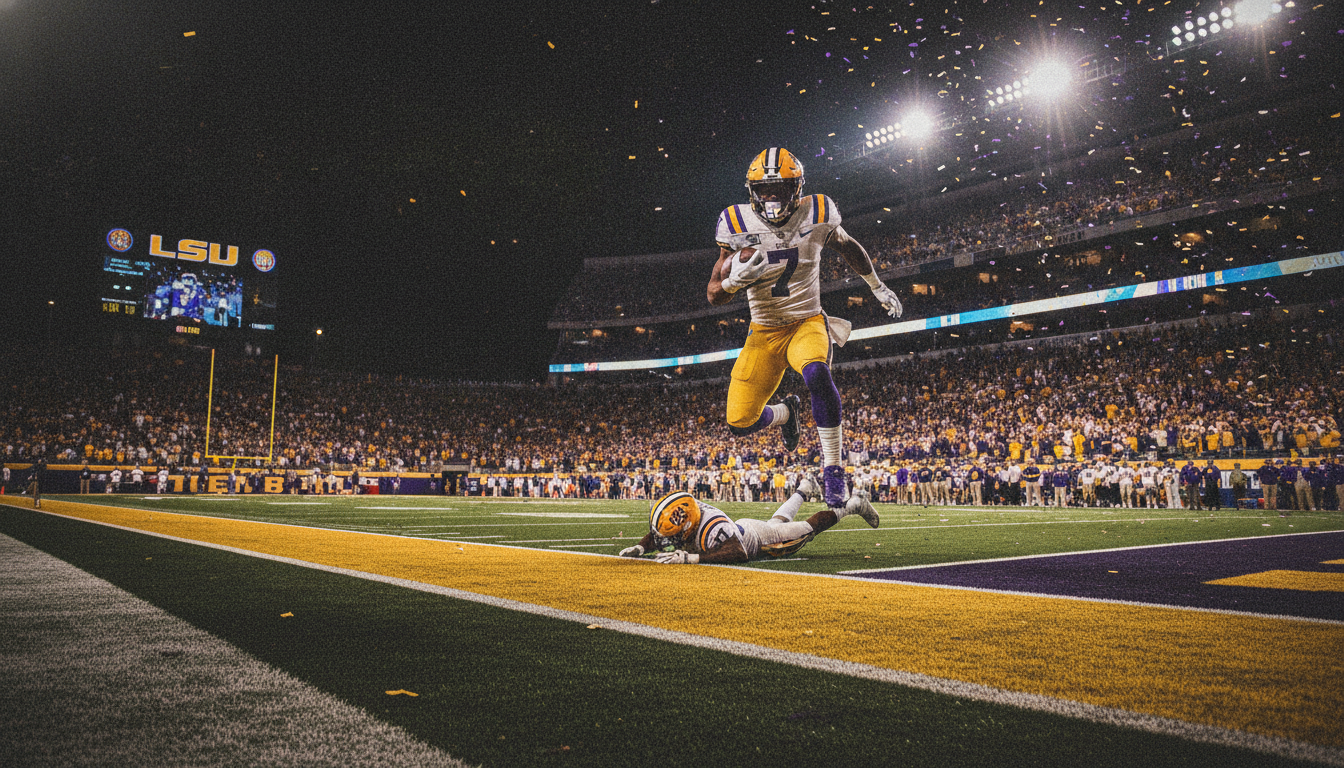
Welcome to the Storm: Inside Lane Kiffin’s Unpredictable First Season at LSU
On a pivotal Game Day Saturday, the Tigers are still a team defined by high-profile personalities, a massive question mark at quarterback, and the calculated chaos of their new head coach.

An Ominous Beginning
The sky over the stadium split open, unleashing a delay that felt more like a metaphor than a meteorological event. As LSU’s season opener against Clemson was put on hold, fans were given a little extra time to ponder the new reality in Baton Rouge. This is the Lane Kiffin era, a period that began not with a bang, but with a pause—a moment of forced reflection on a program entirely remade. The 2026 season arrived with a storm, and for a team navigating a sea of change, it felt strangely appropriate. Every Saturday since has been about figuring out which direction the wind is blowing.
The Architects of Audacity
Lane Kiffin’s arrival was the headline, but the fine print is where his vision truly takes shape. He wasted little time in finalizing a staff built for high-octane football, installing Charlie Weis Jr. as his offensive coordinator and entrusting the defense to the proven Blake Baker. This isn't just a new coaching staff; it's a new philosophy. Weis Jr. is a key component of Kiffin’s famously aggressive offensive systems, while Baker is tasked with building a defense that can withstand the weekly onslaught of SEC competition. Together, they form the brain trust behind one of the most fascinating experiments in college football. The mission is clear: install a modern, explosive identity and do it immediately.
In Baton Rouge, the Kiffin era hasn't been defined by a single play, but by the pregnant pause before the snap—a moment brimming with calculated risk and explosive potential.
The Billion-Dollar Question
Yet, for all the tactical planning in the coaching offices, the most critical question remains unanswered on the field. Who is leading this offense? As the season moves through its crucial September stretch, LSU still operates without a publicly anointed starting quarterback. This central mystery hangs over every practice, every press conference, and every offensive series. Is it a deliberate strategy by Kiffin to maintain a competitive edge, or a genuine battle that has yet to yield a clear winner? Either way, it has become the defining storyline of the early season. For a program accustomed to legendary signal-callers, the anonymity under center is a stark, and perhaps unsettling, new reality for the Tiger faithful.
Old Ghosts and New Fences
The intrigue extends beyond the current roster and staff. In a move that sent ripples across the conference, former national championship-winning coach Ed Orgeron returned to the program in May as a special assistant. His presence adds a layer of surreal continuity, a bridge to a past era of glory even as the program sprints in a new direction. Compounding the complexity of Kiffin’s rebuild were external pressures. The SEC office itself became an unlikely antagonist, blocking several potential roster additions, including tight end Dae’Quan Wright. These administrative hurdles have forced the new staff to be even more creative, navigating not just their opponents on the schedule but the rulebook itself.
Forged in the Fire
As another Saturday unfolds, the picture of LSU football in the 2026 season becomes slightly clearer, but the final image is far from complete. This is a team being forged in real-time, in the unforgiving glare of the SEC spotlight. The Kiffin experiment is volatile, unpredictable, and utterly compelling. The storms may have passed for now, but the forecast in Baton Rouge calls for turbulence, with a high chance of excitement. Every snap is a data point, every game a chapter, and the only certainty is that nothing will be boring.
Published 23 days ago
Staff
Staff writer for SEC Saturday Wire covering college sports.
Process Notes & Methodology
The central storyline is the dawn of the unpredictable Lane Kiffin era at LSU, focusing on the mix of known quantities (Kiffin's style, new staff) and significant unknowns (the starting QB). This creates a compelling narrative of a program in transition, which is highly relevant early in a new coach's first season.
The intro uses the weather delay from the season-opening Clemson game as a hook. This scene, provided in the team_context, serves as a powerful metaphor for the stop-start, uncertain beginning of Kiffin's tenure.
The body is structured around the key facts from the context: Lane Kiffin as head coach, the hiring of coordinators Charlie Weis Jr. and Blake Baker, the crucial lack of a named starting QB, and the subplots of Ed Orgeron's return and the SEC blocking roster additions.
The conclusion brings the focus back to the present (Game Day Saturday) and looks forward. It frames the ongoing season as a process of discovery where the team's true identity under Kiffin is being revealed week by week.
See something wrong? Fix it.
We're the first crowdsourced college football site. Submit corrections — our editors review every one.