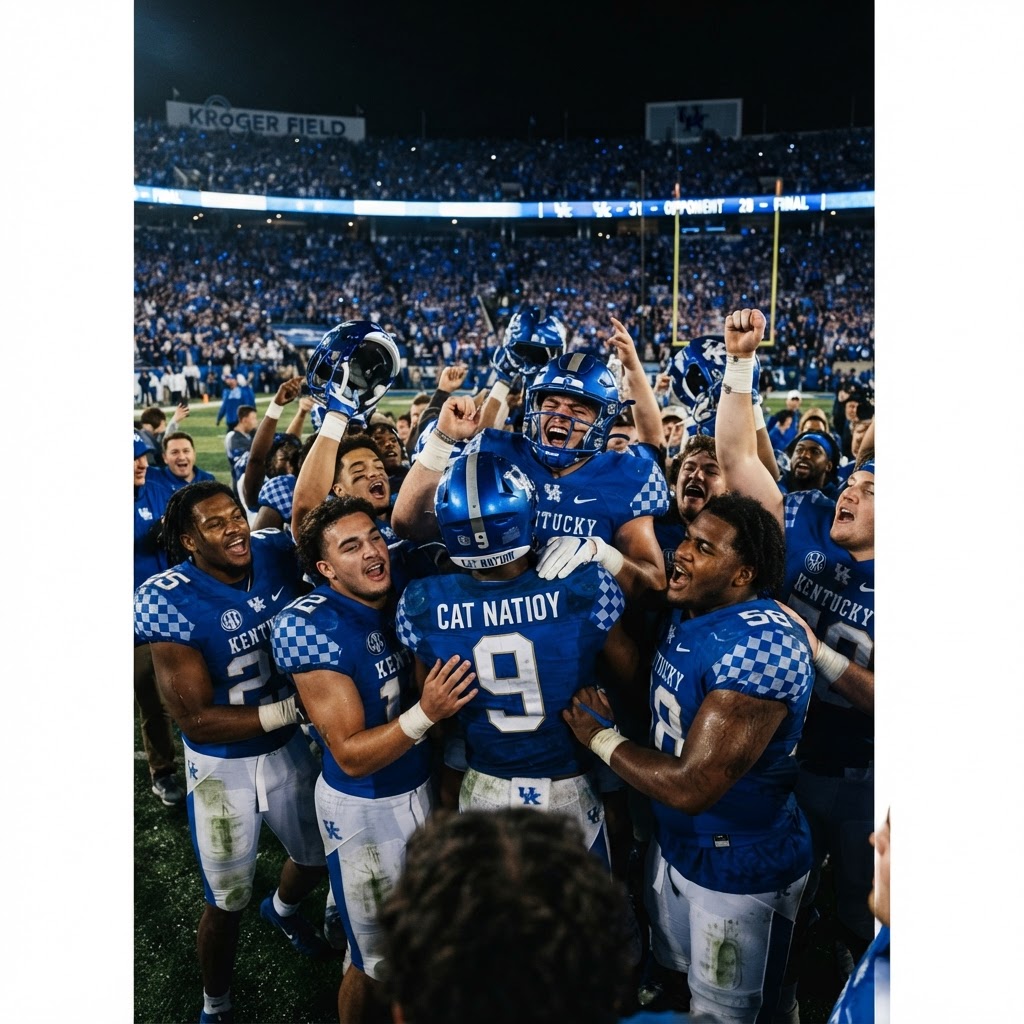
Kentucky Wins the Gamble, 35-34, in Overtime at South Carolina
Will Stein's decision to chase the win produced the defining play in a 17-point comeback.

Final: Kentucky Wildcats 35, South Carolina 34
Will Stein had one decision to make after Kenny Minchey found Henry Boyer for a 6-yard touchdown in overtime: kick the extra point and extend the game, or trust his offense to end it. Stein chose the latter. Minchey found Willie Rodriguez on the 2-point conversion, and Kentucky walked out with a 35-34 victory at South Carolina.
That final sequence was the defining moment, but it only mattered because Kentucky erased a 17-0 deficit. South Carolina controlled the early shape of the game, putting the Wildcats in comeback mode before Kentucky could establish any margin of safety. Kentucky's response turned a game that appeared to be slipping away into a one-point finish decided by a single call and two precise throws.
The decisive stretch came in overtime. Minchey's touchdown pass to Boyer gave Kentucky the lead in the extra period, but Stein did not settle for the conventional tie-and-continue approach. The aggressive call put the game on one play, and Minchey delivered to Rodriguez. Kentucky did not merely survive overtime; it ended the game on its own terms.
What Went Right
The comeback had real substance. Kentucky did not fold after falling behind 17-0. The Wildcats erased the entire deficit and put themselves in position to win, which speaks to the team's ability to stay connected through a difficult opening stretch. The comeback was the broadest positive development of the afternoon because it required the offense and the team as a whole to keep answering after South Carolina had established control.
Minchey was at his best when the game demanded clarity. His 6-yard touchdown pass to Boyer in overtime was not just a scoring play; it gave Kentucky the chance to make the most consequential decision of the game. Minchey then followed it with the successful 2-point conversion pass to Rodriguez. The available facts do not require a larger statistical claim to establish his importance: his two overtime throws directly produced the winning points.
Stein's overtime aggression was decisive. Going for two rather than kicking for a tie is the kind of choice that can define a coach's tenure in a close game. Here, the call matched the moment. Kentucky executed the play, Rodriguez finished it, and Stein's willingness to pursue the win prevented South Carolina from getting another possession.
What Went Wrong
Kentucky's start was unacceptable for a team with postseason ambitions. Falling behind 17-0 forced the Wildcats to spend the rest of the afternoon repairing damage they had created early. A comeback win is valuable, but it should not obscure the central warning: Kentucky gave South Carolina a three-score advantage and left itself almost no room for another mistake.
The margin was too thin for comfort. Kentucky ultimately won by one point and needed overtime to do it. That makes the result resilient, but it also shows how little separation the Wildcats created after recovering from the early deficit. The offense found the answer at the critical moment, yet the game remained vulnerable until the final conversion.
The game plan required a high-risk finish because Kentucky had not banked enough earlier. Stein deserves credit for making the winning call, but the need for that call was tied to the 17-0 hole. Kentucky cannot make overtime heroics the foundation of its identity. The comeback masks the poor opening more than it erases it.
Stock Up / Stock Down
- Stock up — Kenny Minchey: His overtime touchdown pass to Henry Boyer and game-winning conversion pass to Willie Rodriguez gave Kentucky the decisive execution at quarterback.
- Stock up — Will Stein: The head coach trusted an aggressive overtime decision, and the 2-point call produced the win instead of another possession.
- Stock up — Kentucky's resilience: The Wildcats answered a 17-0 deficit by completing a 17-point comeback and staying composed through overtime.
- Stock down — Kentucky's opening execution: A 17-0 deficit put the Wildcats in chase mode and made the rest of the afternoon unnecessarily difficult.
- Stock down — Kentucky's margin for error: Needing overtime and a successful 2-point conversion to win by one point leaves little evidence of sustained control.
What It Means for Not specified
Kentucky leaves South Carolina with the result that matters most: a road win, a completed 17-point comeback and a signature decision from Stein that was rewarded. Those are meaningful building blocks for a team trying to define itself under a new coach. The Wildcats showed they can absorb a damaging start without losing their discipline, and they showed that Minchey can be trusted with the ball when the game reaches its sharpest edge.
But this cannot be filed away as a flawless breakthrough. The 17-0 hole is the part Kentucky must carry into its next preparation. The Wildcats will need a cleaner opening, a larger cushion and less dependence on an overtime gamble if this win is going to become evidence of progress rather than a one-off escape. The next opponent has not been specified, so there is no responsible matchup forecast to make yet. The immediate message, however, is clear: Kentucky has earned momentum, but it has not earned permission to start slowly.
That is the tension attached to this victory. Stein's boldness delivered the finish, and Minchey's execution made it real. Now Kentucky has to prove the comeback was a foundation, not a rescue operation it will need every Saturday.
Published 15 days ago
Staff
Staff writer for SEC Saturday Wire covering college sports.
Process Notes & Methodology
Frame the game as a high-risk, high-reward Kentucky comeback in which Will Stein's overtime decision and Kenny Minchey's execution mattered more than the final margin alone.
Open on the overtime 2-point conversion, the defining moment that immediately establishes the winner, the aggressive coaching choice and the decisive players.
Anchor the review to the verified 17-0 deficit, Kentucky's 17-point comeback, Minchey's 6-yard touchdown pass to Henry Boyer, his successful conversion pass to Willie Rodriguez and Stein's decision to go for two. Treat the slow start and one-point margin as the central concerns without inventing drive-level or statistical details.
Close by balancing momentum against unfinished work: Kentucky has a meaningful win and a demonstrated capacity for resilience, but the next game must show cleaner starts and more sustained control. Because no next opponent is specified, avoid a matchup prediction.
See something wrong? Fix it.
We're the first crowdsourced college football site. Submit corrections — our editors review every one.