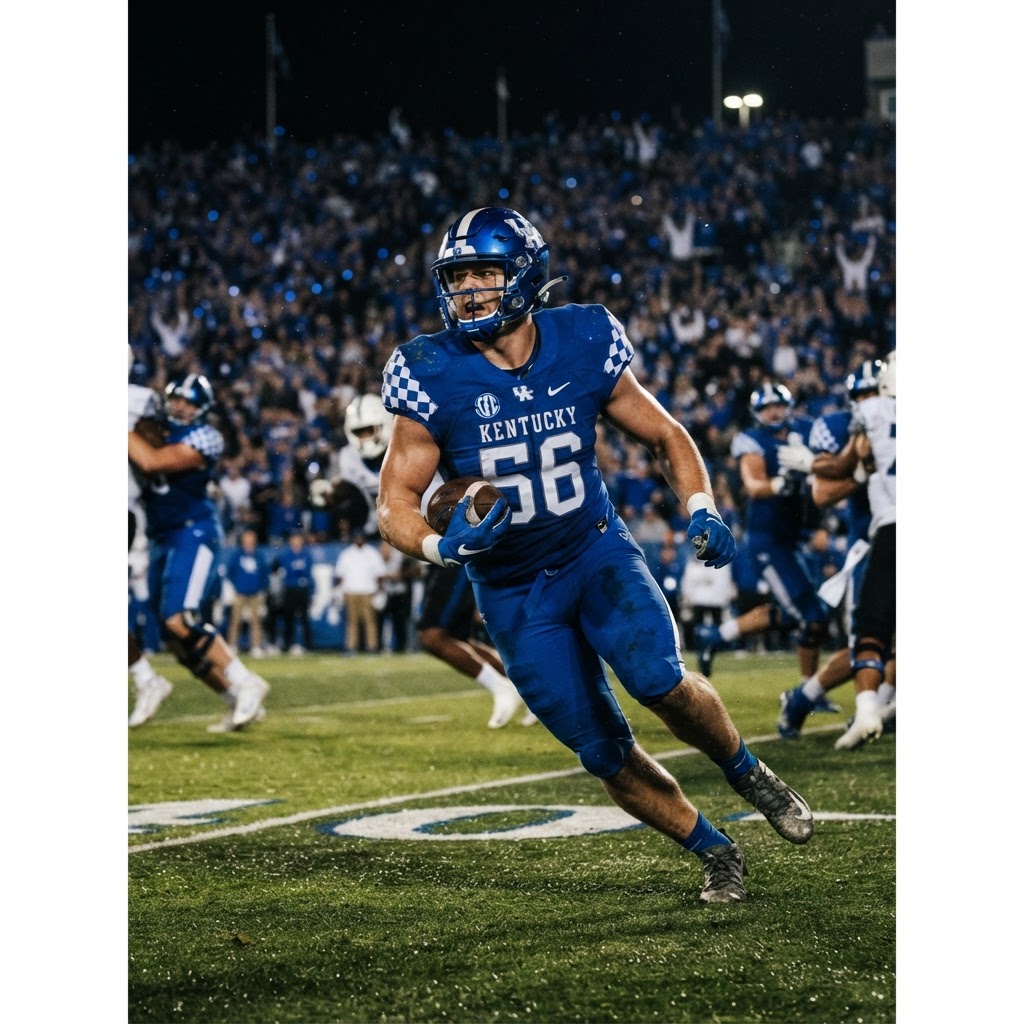
The Weight of a New Era: Inside Will Stein’s Roster Reconstruction and the July Crucible at Kentucky
With thirty new faces and a staggering schematic overhaul, the Wildcats are forging a modernized identity in the sweltering heat of summer conditioning.

In the suffocating humidity of mid-July, the Joe Craft Football Training Facility hums with a different frequency. The clanging of iron and the staccato bursts of hip-hop echoing through the weight room are standard summer soundtrack elements across the Southeastern Conference. But for the 2026 Kentucky Wildcats, these midsummer sessions represent something far more profound than routine strength maintenance. They are the physical manifestation of an aggressive cultural tear-down and rebuild.
Under the direction of 36-year-old Will Stein—now officially the youngest head coach in the SEC—the Wildcats are entirely immersed in the rigorous demands of summer strength and conditioning. The previous era of Kentucky football was defined by defensive grit and a grind-it-out mentality. Stein, however, was hired to orchestrate an offensive renaissance, an ambition that requires a complete reimagining of the program's physical foundation and schematic bandwidth before the grueling 2026 schedule begins.
The Alchemy of July Iron
The offseason focus in Lexington has centered almost exclusively on the integration of a massive roster overhaul. In the modern era of college football, roster turnover is expected, but Stein’s staff took a sledgehammer to the status quo. With nearly 30 players brought in via the transfer portal, the primary objective of these July conditioning sessions is less about individual personal records and more about expediting collective chemistry.
The transfer portal is often viewed as a mechanism for patching holes, but Will Stein has utilized it as a demolition ball—leveling a foundational identity to pour new concrete before August arrives.
The coaching staff recognizes that talent alone will not survive the SEC gauntlet. The 2026 schedule features a terrifying slate of opponents, including heavyweights Alabama, Oklahoma, and Texas A&M. Surviving that gauntlet requires the synchronized integration of portal additions like offensive linemen Lance Heard and Tegra Tshabola, who are tasked with anchoring the trenches, alongside explosive playmakers like former Oklahoma wideout Nic Anderson. In the weight room, the hierarchy of the locker room is being established one punishing rep at a time.
An Offensive Renaissance Anchored in the Portal
The focal point of Stein’s modernized offensive vision is new starting quarterback Kenny Minchey. Despite arriving in Lexington with limited collegiate snaps on his resume, Minchey has been handed the keys to the franchise. Offensive coordinator Joe Sloan has been practically attached to the young signal-caller's hip since spring ball. Sloan’s current mission is twofold: ensuring Minchey achieves absolute fluency in a complex, aggressive playbook, and overseeing the physical development necessary for Minchey to withstand the punishment of SEC edge rushers.
But a quarterback cannot operate in a vacuum. To alleviate the pressure on Minchey, the Wildcats have constructed a terrifyingly physical tandem in the backfield. Texas transfer CJ Baxter and Oklahoma transfer Javata Barnes have already established themselves as the projected primary rotation. During summer workouts, the Baxter-Barnes duo has been the talk of the facility, showcasing a blend of downhill violence and breakaway speed that embodies Sloan’s vision of a dominant, multi-dimensional rushing attack.
The Diamond's Loss is the Gridiron's Gain
While the transfer portal has dominated the offseason narrative, the most electrifying development of the mid-July stretch arrived via the traditional recruiting ranks. On Wednesday, July 15, four-star quarterback signee Matt Ponatoski officially stepped onto the turf for summer workouts, ending weeks of speculation regarding his professional future.
A standout two-sport phenom from Cincinnati, Ponatoski was selected in the 18th round of the 2026 MLB Draft by the hometown Cincinnati Reds. For a moment, the allure of professional baseball threatened to derail Kentucky's quarterback depth chart. Instead, Ponatoski opted to forgo the diamond, enrolling at Kentucky to immediately compete for the backup role behind Minchey. His arrival provides a massive boost to a quarterback room where Brennen Ward and Marshall transfer JacQai Long are fiercely battling for crucial developmental reps.
Tampa Bound: Signaling the New Blueprint
The broader college football world will get its first official glimpse into Stein’s program on Monday, July 20, when Kentucky takes the stage at the 2026 SEC Media Days in Tampa, Florida. The delegation Stein has chosen to accompany him speaks volumes about the program's shifting identity.
Joining Stein in Tampa will be quarterback Kenny Minchey, veteran safety Ty Bryant, and tight end Willie Rodriguez. The selection of Rodriguez, alongside Minchey, is a deliberate flashing neon sign indicating Stein’s offensive-centric vision. Preseason buzz inside the facility has been building rapidly around Rodriguez, who is widely anticipated to have a breakout season. In Stein’s tight-end-friendly offensive architecture, Rodriguez is being molded into a primary mismatch nightmare, moving around the formation to exploit linebackers and safeties alike.
Bateman’s High-Stakes Island Architecture
While the offense commands the headlines, the defensive side of the ball is undergoing an equally drastic transformation under defensive coordinator Jay Bateman. Gone are the days of soft zone cushions and bend-but-don't-break philosophies. Bateman is installing a hyper-aggressive scheme heavily reliant on multiple formations and zero-coverage principles.
Executing a scheme that leaves defensive backs on an island requires elite athleticism and supreme confidence, making the offseason retention of star cornerback Terhyon Nichols arguably the most critical victory of Stein’s early tenure. Nichols is the undisputed alpha of the secondary and the projected CB1 for 2026. He will be joined by high-profile portal additions, including Gardner-Webb standout Hasaan Sykes and former Florida safety Jordan Castell, alongside linebacker Elijah Barnes. For Bateman’s defense to hold water against the offensive juggernauts of the SEC, the physical readiness forged in these July conditioning sessions must translate into flawless man-to-man execution in September.
The Looming Gauntlet and the 2027 Horizon
As the sweat pools on the rubberized flooring of the weight room, the dual reality of Stein's tenure is starkly apparent. The staff must field a team capable of surviving a schedule loaded with 2025 College Football Playoff contenders, while simultaneously recruiting at a level required to build sustainable, long-term success. So far, the recruiting machinery is firing on all cylinders. Kentucky’s 2027 recruiting class is currently sitting at No. 22 nationally, boasting nine top-500 prospects, including seven four-star commitments and a top-five national quarterback prospect.
But the distant promises of 2027 will offer no shelter when the ball is kicked off this autumn. The foundation of the Will Stein era is not being built in the television studios of Tampa or the living rooms of top recruits. It is being forged right now, in the relentless, unglamorous grind of July. If the Wildcats are to shock the college football establishment and validate their massive offseason roster overhaul, the alchemy happening inside the Joe Craft facility today will be the reason why.
Published 3 months ago
Staff
Staff writer for SEC Saturday Wire covering college sports.
Process Notes & Methodology
The angle focuses on the transition under new head coach Will Stein and the physical conditioning needed for a difficult 2026 schedule. It connects the 'Workout Wednesday' theme to the logistical challenge of integrating nearly 30 new transfer players.
The intro hooks the reader with the seasonal context of mid-July and establishes Coach Will Stein as the primary figure overseeing the summer conditioning program.
The body highlights the development of QB1 Kenny Minchey under Joe Sloan and the implementation of Jay Bateman's new defensive scheme. It also references the roster overhaul necessitated by the high volume of incoming transfers.
The closing connects the current physical training to the upcoming challenging 2026 schedule, framing the summer work as a vital precursor to the season's success.
See something wrong? Fix it.
We're the first crowdsourced college football site. Submit corrections — our editors review every one.