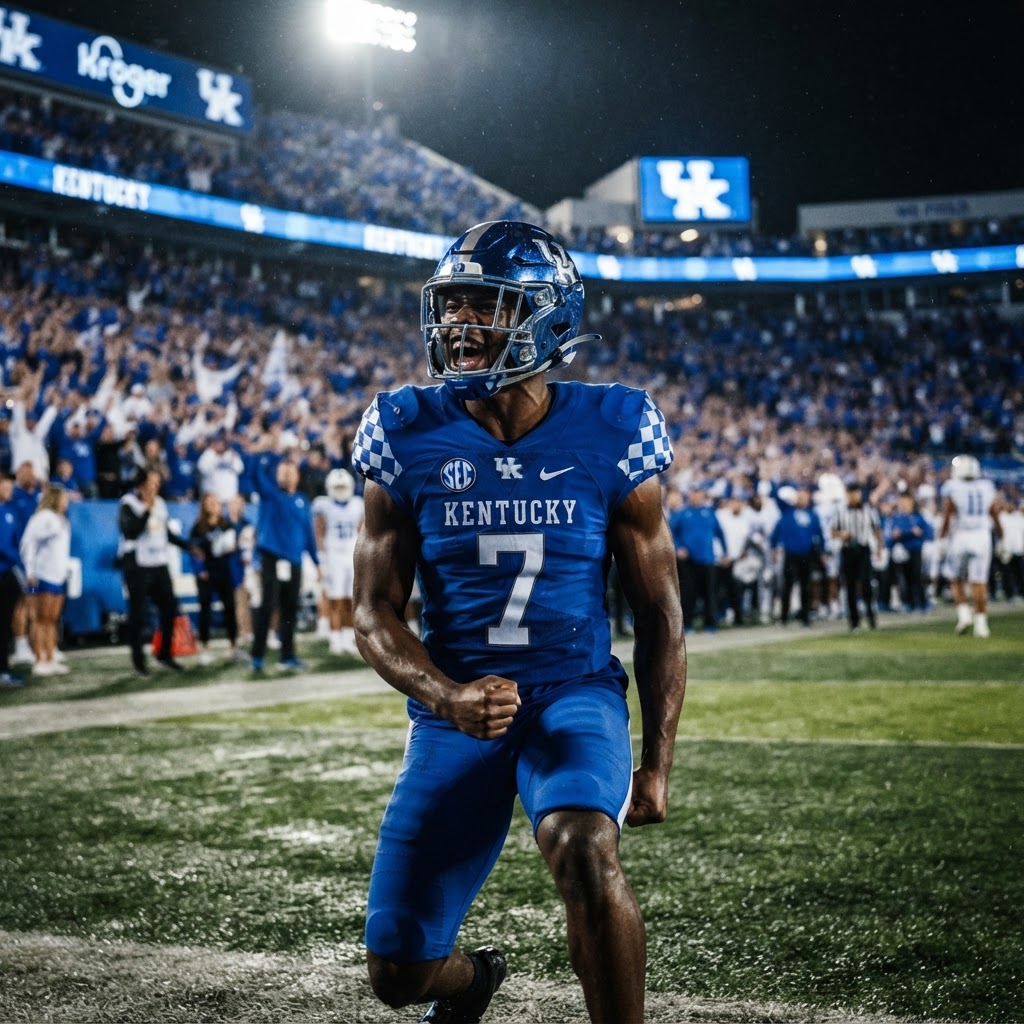
The Sunshine Mandate: How Will Stein is Engineering Kentucky’s Blueprint for the Expanded Playoff
Backed by a massive portal haul, a dynamic new quarterback, and a modernized spread-vertical assault, the Wildcats open the summer with unprecedented SEC title ambitions.

Summer in Lexington can often feel like a waiting game—a humid slog toward the distant relief of crisp autumn tailgates. But as the dog days of July stretch across the Bluegrass State, the atmosphere surrounding the Joe Craft Football Training Facility crackles with an unfamiliar, electric urgency. It is July 15, 2026. Fall camp opens in fewer than three weeks, and for the first time in recent memory, the Kentucky Wildcats are not talking about gritty rebuilding phases or mere bowl eligibility. They are talking about the expanded 12-team College Football Playoff.
The source of this palpable optimism is first-year head coach Will Stein. Nicknamed "Sunshine" for his relentlessly positive demeanor and infectious energy, Stein has spent the past seven months meticulously dismantling the program’s grinding, ground-and-pound identity, erecting in its place a sleek, modern football machine designed to light up SEC scoreboards.
The Cultural Pivot and a Statement in Dallas
When Stein descended upon SEC Media Days in Dallas yesterday, he didn't just deliver talking points—he presented a living proof of concept. In a move unprecedented for a Kentucky head coach, Stein’s delegation prominently featured an incoming transfer: quarterback Kenny Minchey. Flanked by returning safety Ty Bryant and tight end Willie Rodriguez, Minchey’s presence at the podium was a declarative statement. This is his offense now.
The shift in philosophy is stark. For the better part of a decade, Kentucky football was synonymous with methodical, clock-chewing offensive game plans—a trench-based war of attrition that often left the Wildcats mathematically outmatched against the SEC's highest-scoring juggernauts. Stein realized that survival in the modern SEC requires unadulterated verticality. To orchestrate this paradigmatic shift, Stein tapped offensive coordinator Joe Sloan. An import from LSU, Sloan arrives in Lexington carrying the gold-standard blueprint of quarterback development, having previously engineered the Heisman Trophy-winning campaign of Jayden Daniels.
Assembling the Spread-Vertical Arsenal
The execution of Sloan's high-tempo system hinges entirely on the right trigger-man, which makes January 6, 2026, the most consequential date of Kentucky's offseason. On that frigid Tuesday, Minchey officially flipped his transfer commitment from Nebraska to Kentucky, lured by the promise of Stein’s tutelage. By the time the annual Blue-White Spring Game kicked off on April 18, Minchey’s grasp of the offense was breathtaking. Operating in front of a record-setting Kroger Field crowd of over 42,000 fans, the Notre Dame transfer completed an eye-opening 72 percent of his passes.
But Minchey is not operating in a vacuum. The staff utilized the portal to assemble a bespoke arsenal of playmakers tailored perfectly to Stein's speed-in-space doctrine. UAB transfer Xavier Daisy (6-3, 210) was the first major wide receiver domino to fall on January 7, providing a massive, physical boundary target. He is joined by Oklahoma transfer Nic breakout receiver Anderson. The newly assembled backfield features the dynamic duo of CJ Baxter and fellow Sooner transfer Jovantae Barnes, the latter having reportedly shed five pounds of body fat to maximize his burst in Sloan's tempo-based scheme.
Protecting this high-octane operation is an offensive line anchored by vital portal acquisitions Lance Heard and Tegra Tshabola. The two massive tackles bring a combined 45 career starts to the trenches, providing a veteran safety net alongside key returning foundational pieces like tackle Malachi Wood.
A July Curveball in the Quarterback Room
While Minchey is the undisputed QB1, the longevity of a championship campaign requires insulated depth—a reality the staff addressed with a massive recruiting victory today. On the morning of July 15, the program verified the official enrollment of four-star quarterback Matt Ponatoski. A dual-sport prodigy from Cincinnati Moeller, Ponatoski’s arrival was far from guaranteed.
Just last weekend, the Cincinnati Reds selected him in the 18th round (No. 542 overall) of the 2026 MLB Draft. Choosing to forgo professional baseball to step onto the gridiron in Lexington, Ponatoski immediately elevates the Wildcats' quarterback room to its most talented state in decades. He projects as the primary understudy to Minchey, ensuring that Sloan's offensive engine has a premium insurance policy should the physical toll of the SEC rear its head.
Bateman’s 4-2-5 Blueprint and the Secondary Makeover
As much as the aerial revolution dominates the headlines, championships are still validated on the defensive side of the ball. Enter defensive coordinator Jay Bateman, who is currently finalizing a schematic overhaul of his own. Anticipating the elite passing attacks that dot the 2026 schedule, Bateman is transitioning the Wildcats into a versatile 4-2-5 hybrid alignment.
This architecture is explicitly designed to weaponize the secondary, primarily by maximizing the range of returning leader Ty Bryant and Florida transfer Jordan Castell. Bryant enters his senior campaign as the undisputed heartbeat of the defense, coming off a stellar season where he tied for the SEC lead with four interceptions. Paired with Castell—who emerged as a highly vocal leader during June’s player-led 7-on-7 drills—the safety tandem provides the quintessential blend of ball-hawking instinct and downhill run support.
Anchoring the middle of Bateman’s defense is aggressive portal acquisition Elijah Barnes, whose sideline-to-sideline pursuit perfectly complements the deep-third patrol of the safeties. Alongside returning veteran starters like defensive standout Terhyon Nichols, Bateman’s unit is built to create the very turnovers that Sloan’s offense is designed to convert into quick points.
Navigating a Gauntlet in the Expanded Playoff Era
Off the field, the momentum of the "Stein Era" is compounding daily. The Wildcats currently boast a top-15 national recruiting ranking for the 2026 cycle, featuring 16 total commitments, four prospects in the ESPN 300, and a trio of recent four-star additions plucked directly from the fiercely contested Georgia-Florida corridor. Yet, for all the offseason accolades and portal victories—over 30 transfers successfully integrated into the revamped depth chart—the ultimate crucible awaits on the gridiron.
The Wildcats face one of the nation's most unforgiving schedules. They host a heavyweight, prime-time clash against Alabama in Week 2 (September 12), immediately followed by a daunting road trip to Kyle Field to face Texas A&M on September 19. A mid-season home tilt against LSU on October 10 looms as a potential referendum on the program's progress.
To survive in the modern SEC, a program must choose between schematic evolution or slow irrelevance. The rapid transition from a methodical, trench-based approach to Stein’s high-flying offensive philosophy relies entirely on a precarious alchemy of portal hits and immediate chemistry. But if Minchey’s arm talent and Bateman's revamped secondary translate their summer hype to SEC Saturdays, Kentucky will shed its historical label as a spoiler and emerge as a legitimate apex predator in the expanded playoff era.
When fall camp officially opens on August 3, the theoretical will finally give way to the physical. The sweeping cultural shifts, the schematic revolutions, and the influx of premium transfer talent will be tested under the blistering Kentucky sun. But as the clock ticks down toward September, one thing is abundantly clear: Will Stein hasn't just brought fresh optimism to Lexington; he has definitively redefined the ceiling of Kentucky football. The Wildcats are no longer waiting for the future—they are sprinting toward it.
Published 3 months ago
Staff
Staff writer for SEC Saturday Wire covering college sports.
Process Notes & Methodology
The article focuses on the 'new era' storyline under head coach Will Stein. By highlighting the arrival of Kenny Minchey and the revamped coaching staff, it frames the current offseason as a period of positive transformation and momentum.
The opening hooks the reader by positioning the current date within the context of the 2026 season and immediately establishing Will Stein as the architect of the team's new direction.
The body narrative centers on the technical changes, specifically the appointment of Kenny Minchey as QB1 and the arrival of new coordinators Joe Sloan and Jay Bateman. It also incorporates key transfer portal acquisitions to show how the coaching staff is actively improving the roster depth.
The conclusion pivots toward the upcoming schedule, setting the stage for how this internal progress will be tested against a difficult slate of opponents.
See something wrong? Fix it.
We're the first crowdsourced college football site. Submit corrections — our editors review every one.