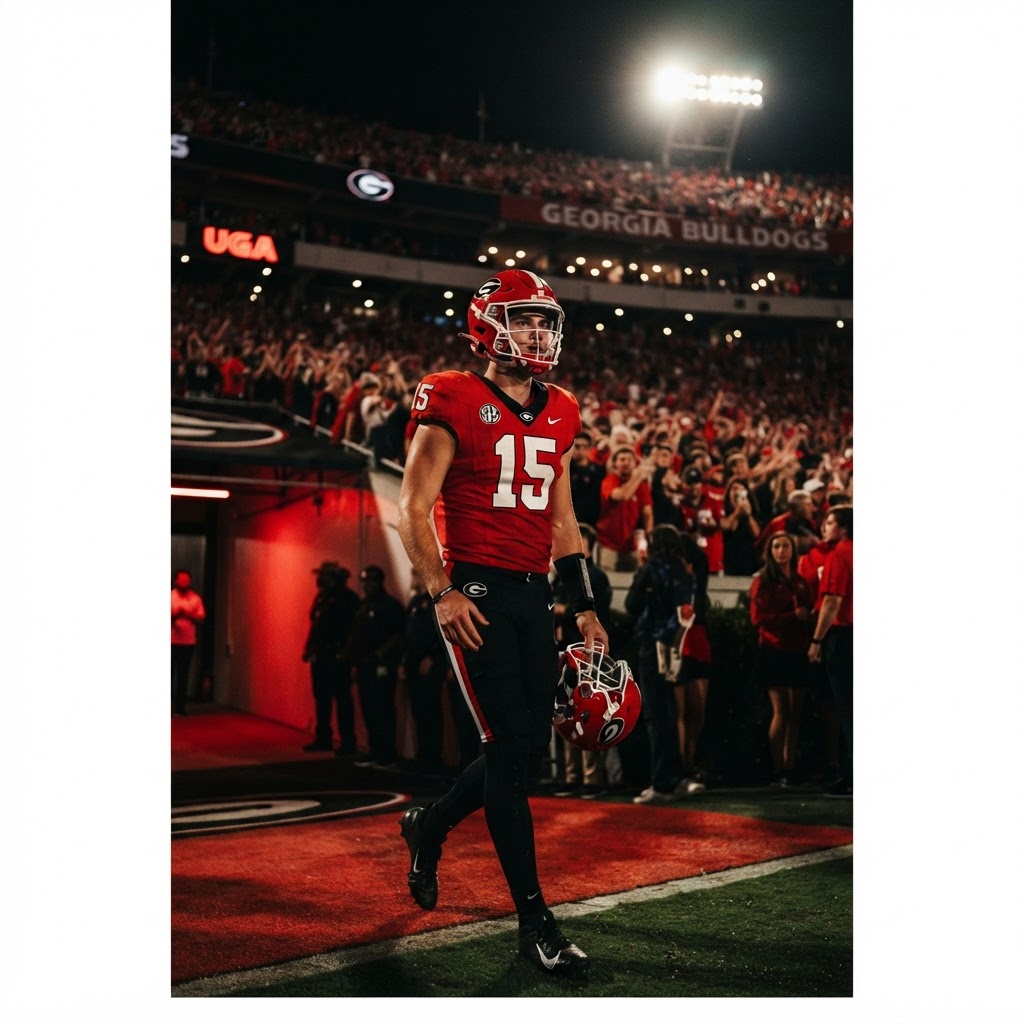
Assuming Nothing: Kirby Smart, Gunner Stockton, and Georgia’s Blueprint for a 2026 Vengeance
Following an 11-3 campaign and a bitter Sugar Bowl defeat, the Bulldogs arrived at SEC Media Days with a revamped defensive philosophy and a rugged, veteran-led offense built for college football's most unforgiving gauntlet.

The mid-July air inside the ballroom in Tampa, Florida, felt thick with a distinctly different kind of expectation. As the 2026 SEC Media Days drew to a close, the Georgia Bulldogs stepped away from the podiums and microphones having discarded the ghosts of their recent past. Gone was the suffocating, omnipresent chatter of a historic 'three-peat' that had defined their previous offseasons. In its place stood a program hardened by the sting of an 11-3 campaign in 2025—a season that culminated in a narrow, bitter Sugar Bowl defeat at the hands of Ole Miss. Now entering his 11th season in Athens, head coach Kirby Smart—recently named to the 2026 Dodd Trophy Preseason Watch List—arrived in Florida with a laser-focused mandate. The standards in Athens have not moved an inch, but the methodology for achieving them has undergone a rigorous, aggressive evolution.
The 'Assume Nothing' Mandate
To understand the psychological framing of the 2026 Georgia Bulldogs, one must look at the summer months that preceded their arrival in Tampa. Inspired by a deep-dive summer study of organizational resilience, Smart and his coaching staff introduced a new program-wide mantra: Assume Nothing. It is a philosophy born from the ashes of 2025, where assumed dominance occasionally gave way to schematic vulnerabilities. During his time at the podium, Smart spent his allotted minutes emphasizing the 'mileage' of the program rather than the years. This was a subtle but profound shift in messaging, signaling a renewed, almost primal hunger. The staff is no longer burdened by defending a dynasty; they are actively hunting a new championship. This psychological reset has permeated every level of the Butts-Mehre Heritage Hall, stripping away complacency and replacing it with a blue-collar urgency that harkens back to Smart’s earliest, most foundational days in Athens.
A 'Ford F-150' Built for a Gauntlet
At the beating heart of this championship ambition is starting quarterback Gunner Stockton. Entering his final year of collegiate eligibility, Stockton is uniquely equipped to embody the program’s new ethos. Last fall, he delivered a highly commendable 2025 campaign, throwing for 2,894 passing yards, 24 touchdowns, and merely 5 interceptions. Yet, the narrative surrounding Stockton is less about flashy aerial acrobatics and more about his profound reliability. Within the Butts-Mehre complex, the 2026 Bulldogs are intentionally positioning themselves as a more physical, 'Ford F-150' style team. In a modern college football landscape dominated by high-variance, boom-or-bust offenses, Stockton represents the ultimate steady hand. He is the rugged, dependable engine tasked with navigating a schedule that Smart accurately described in Tampa as a 'gauntlet'—a brutal slate featuring highly anticipated, high-stakes road tests against the Alabama Crimson Tide and the Texas Longhorns. Stockton’s veteran presence allows the offense to operate with a punishing, methodical rhythm, designed to wear down opponents in the fourth quarter.
Aerial Auditions and the Wide Receiver Scrutiny
While Stockton provides the foundational stability, offensive coordinator Mike Bobo faces the complex challenge of replacing significant NFL departures on the perimeter. The wide receiver room currently stands as the most scrutinized unit on the roster heading into fall camp. However, preseason buzz emanating from Athens paints a picture of quiet optimism. The emergence of dynamic vertical threats during the rigorous June camps has provided a much-needed spark for an offense searching for explosive playmakers. Bobo is expected to lean heavily on Stockton’s deep understanding of the playbook to orchestrate the passing game while these young, raw talents develop their route trees. Furthermore, the passing attack will be heavily insulated by a reinforced rushing attack. The arrival of highly touted transfer running back Dante Dowdell is expected to maintain and even elevate Georgia's physical rushing identity. Dowdell’s integration into the backfield is not merely a statistical boost; it is a schematic necessity to keep opposing safeties honest and open up the play-action deep shots that Stockton thrives on executing.
Fortifying the Deep Third
If the offense is built on veteran continuity, the defense is relying on a calculated injection of portal-tested aggression. The defining failure of the 2025 season occurred in the defensive secondary, which surrendered a staggering 310 passing yards in the Sugar Bowl loss to Ole Miss. Defensive coordinator Glenn Schumann and the defensive staff spent the past seven days of summer media availability focusing almost entirely on the integration of high-impact transfers designed to fix these perimeter leaks immediately. Enter Gentry Williams at cornerback and Khalil Barnes at safety. Williams was brought in specifically to bolster the man-coverage capabilities on the boundary, offering elite closing speed and a physical edge at the line of scrimmage. Barnes, meanwhile, adds vital deep coverage ability and positional versatility to a transitioning defensive backfield. The early returns have been overwhelmingly positive. Smart specifically noted that the secondary's performance in early summer 7-on-7 drills has shown a significant uptick in 'coverage consistency,' a metric that has become the absolute obsession of the defensive coaching staff.
Architects of the Blueprint
The strategic foundation for this 2026 rebound was quietly solidified long before the media descended upon Tampa. In an era where the Transfer Portal and NIL collectives have made roster retention a nearly impossible task, Georgia guaranteed a clear sense of continuity at the top of its hierarchy. By securing contract extensions through the 2028 season for both Bobo and Schumann, the university fortified the program's structural integrity. Smart has openly highlighted that this deeply rooted program culture—anchored by the long-term stability of his coordinators—has been the primary driver for retention. This coaching stability has paid immediate, tangible dividends on the recruiting trail. The Bulldogs have already amassed 18 verbal commitments for the 2027 recruiting class, securing a ranking of #2 nationally by major scouting services. It is a testament to the fact that while the sport changes violently around them, the developmental pipeline in Athens remains historically potent.
Restoring the Havoc Rate
Ultimately, the defensive evolution extends beyond the secondary. Schumann is utilizing the crucial summer months to ensure that overall roster development matches the program's elite historical expectations. The defensive unit has aggressively incorporated 12 early enrollees who successfully navigated the brutal 2026 spring practice cycle. The overarching goal is a resolute return to the 'Havoc Rate'—the metric of tackles for loss, forced fumbles, and interceptions that defined the Bulldogs' back-to-back national title runs. Schumann's scheme demands a relentless, aggressive pass rush to protect the newly retooled secondary, forcing opposing quarterbacks into the exact split-second errors that Williams and Barnes were recruited to exploit.
In an era defined by high-variance passing attacks and transient rosters, Georgia’s 2026 counter-revolution relies on the sheer, undeniable gravity of physical attrition, betting that a veteran quarterback and a retooled defensive backfield can outlast the chaos of the portal age.
As the calendar turns toward early August and fall camp commences at the Butts-Mehre Heritage Hall, the narrative surrounding the Georgia Bulldogs shifts from theoretical preparation to violent execution. The pieces for a national championship run are undeniably in place. With the 2026 season opener against Tennessee State looming on September 5, the mandate for Kirby Smart, Gunner Stockton, and this revamped roster is absolute. The mileage has been logged, the lessons of the Sugar Bowl have been internalized, and the gauntlet awaits. In Athens, they are assuming nothing—and preparing for everything.
Published 3 months ago
Staff
Staff writer for SEC Saturday Wire covering college sports.
Process Notes & Methodology
The angle focuses on the transition from the 2025 season into the 2026 campaign, highlighting the balance between coaching continuity and the need for roster development. It is relevant because it frames the current Spring Ball & Recruiting 2026 period as a critical preparation phase for a championship run.
The hook establishes the current timeline of the Spring Ball & Recruiting 2026 cycle and anchors the narrative in Kirby Smart's proven leadership.
The body centers on the importance of Gunner Stockton's final season and utilizes the contract extensions of coordinators Mike Bobo and Glenn Schumann to represent stability. It also integrates the transfer arrivals to explain how the coaching staff is addressing the roster depth storyline.
The closing pivots from the disappointment of the previous Sugar Bowl loss to an optimistic, forward-looking assessment of the team's ongoing development.
See something wrong? Fix it.
We're the first crowdsourced college football site. Submit corrections — our editors review every one.