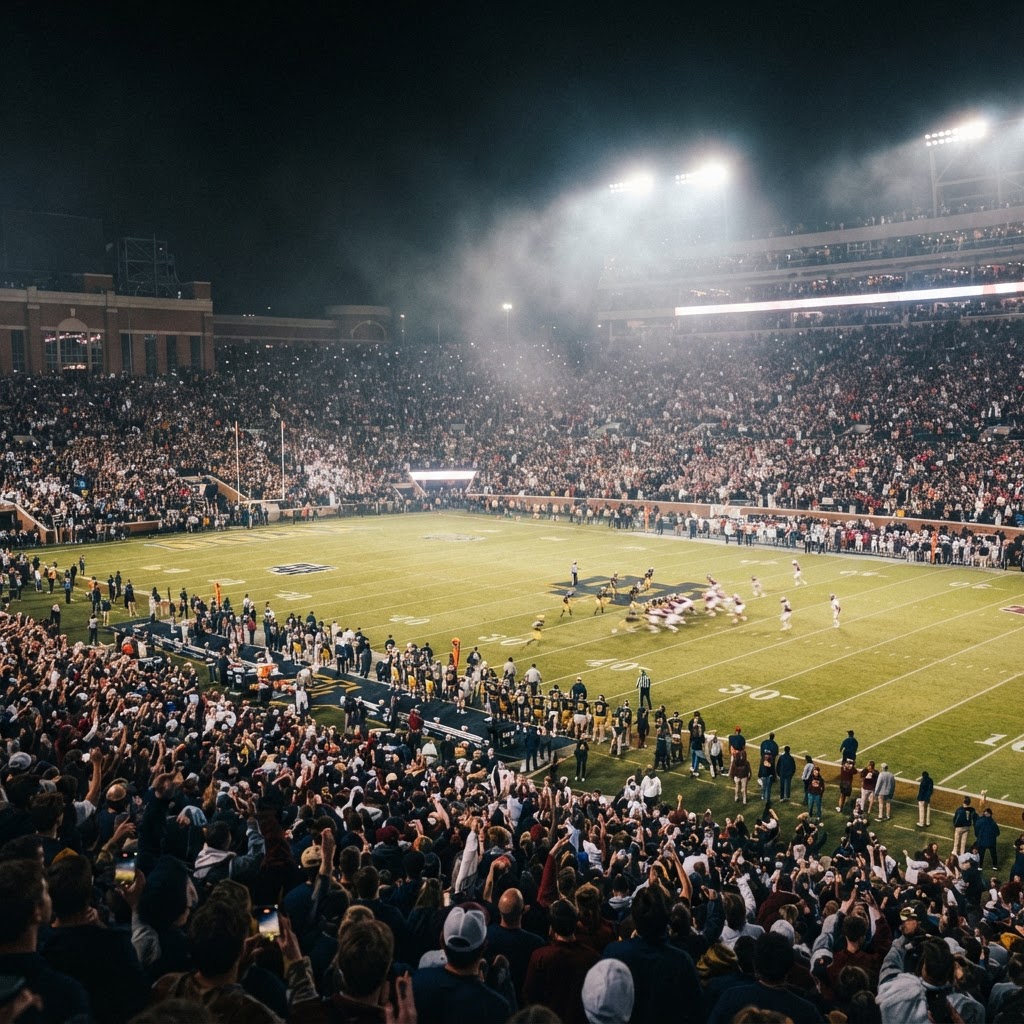
Oklahoma's Red River Stunner Flips the SEC Script — and Puts Arch Manning Under the Microscope
A 27-24 upset in Dallas knocked Texas from No. 1, handed Brent Venables his signature win, and reopened every question about Steve Sarkisian's offense and his prized quarterback.

The Rivalry Delivers a Reckoning
For three quarters and fifty-nine minutes, the Red River Rivalry looked like it might simply confirm what the rankings already said: that Texas, undefeated and perched at No. 1 in the country, was the SEC's standard-bearer. Then Tate Sandell stepped onto the turf at the Cotton Bowl in Dallas and drilled a 47-yard field goal on the final play of the game, and everything changed. Oklahoma 27, Texas 24. The scoreboard did not just end a game on Saturday, October 10, 2026 — it ended a reign.
This was not a trap game or a letdown spot dressed up as an upset. This was No. 1 in the country, unbeaten, playing its signature rivalry game, and losing to a Sooners program that had not beaten an AP No. 1 opponent since a 38-17 win over Missouri in 2007. Oklahoma had been 0-4-1 all-time specifically against No. 1-ranked Texas teams before Sandell's kick split the uprights. The history alone tells you this was not a typical rivalry result; it was a program-altering afternoon for Brent Venables and a gut-punch for Steve Sarkisian.
Four days later, on Wednesday, October 14, 2026, the fallout has not slowed down. Texas has dropped out of the top spot entirely. Georgia has climbed to No. 1 after beating No. 6 Alabama 20-17 on the same Saturday. And the national conversation has locked onto one target above all others: Arch Manning, the Texas quarterback whose three touchdown passes were nearly erased by two interceptions that directly fueled Oklahoma's scoring. This is the story of how a single Saturday in Dallas rearranged the entire College Football Playoff picture — and why the four weeks ahead will define both programs.
The Numbers That Decided Dallas
Strip away the emotion and the rivalry theater, and the box score tells a specific, damning story about margins. Texas lost by three points in a game decided on the final play. Arch Manning threw three touchdowns — a quarterback performance that, in isolation, reads like a winning day. But he also threw two interceptions, and both of those turnovers contributed directly to Oklahoma points. In a three-point game, that is not a footnote. That is the entire outcome.
Equally important, and often lost in the noise around Manning specifically, is how Oklahoma actually scored. The Sooners did not simply out-execute Texas's offense possession for possession. They generated critical points through non-offensive touchdowns — special teams and defense putting points on the board in a contest ultimately decided by three. When a game is that tight, points that don't come from your base offense are often the difference between a signature win and a near-miss, and that's precisely what happened to Texas.
Then there is Sandell's kick itself: 47 yards, final play of the game, the single cleanest piece of execution in a contest defined by chaos everywhere else. It is the detail that will appear in every Oklahoma highlight package for years, and deservedly so. But the full accounting of this result requires sitting with all three numbers at once — three touchdowns, two interceptions, and non-offensive points on the other side — because together they explain why a 27-24 final felt both razor-thin and strangely inevitable by the fourth quarter.
Measuring the Weight of the Win
How good was this win, really? The honest answer requires two separate conversations, because the opponent quality on both sides of the ball cuts in different directions. On one hand, Texas entered Dallas as the unanimous No. 1 team in the country, unbeaten, and the presumptive favorite in the SEC race. Beating that team, in that environment, with that much history working against you, is as good a résumé win as any program can manufacture in a single afternoon.
On the other hand, national commentators spent the days before and after this game pointing out that Texas's own body of work had been shakier than its ranking suggested. The Longhorns' prior wins against UTSA and Tennessee had already been flagged as uneven offensive performances before Oklahoma ever took the field. That context matters: Oklahoma didn't necessarily slay an offensive juggernaut operating at peak form. It exposed a team whose cracks were already visible to anyone watching closely in September and early October.
That nuance doesn't diminish what Oklahoma accomplished — a win is a win, and the record against No. 1 Texas teams had been winless since long before most of this roster was born. But it does complicate the instinct to treat this as simply
Published 3 days ago
Staff
Staff writer for SEC Saturday Wire covering college sports.
Process Notes & Methodology
Pipeline: across-the-sec daily Expanded — internet research + verified fact anchor Sources: - https://www.beloitdailynews.com/sports/pro-sports/here-is-the-latest-sec-sports-news-from-the-associated-press/article_167d95e9-2ff8-56b7-b31a-e107987edc08.html - https://www.si.com/college/college-football - https://www.ncaa.com/news/football/article/2026-10-10/oklahoma-stuns-no-1-texas-red-river-rivalry-thriller - https://www.ncaa.com/news/football/article/2026-10-11/georgia-rises-no-1-lsu-and-oregon-fall-latest-ap-top-25-college-football-rankings - https://www.usatoday.com/story/sports/ncaaf/2026/10/14/college-football-frauds-texas-tennessee-lsu-sec/92235080007/
See something wrong? Fix it.
We're the first crowdsourced college football site. Submit corrections — our editors review every one.