The Razor's Edge: Inside the Promising, Painful Dawn of Auburn's Alex Golesh Era
A heartbreaking 44-39 loss to Florida revealed more about Auburn's future than any victory could have, showcasing a team on the cusp of a breakthrough in its first season under a new regime.

The Echo of What Almost Was
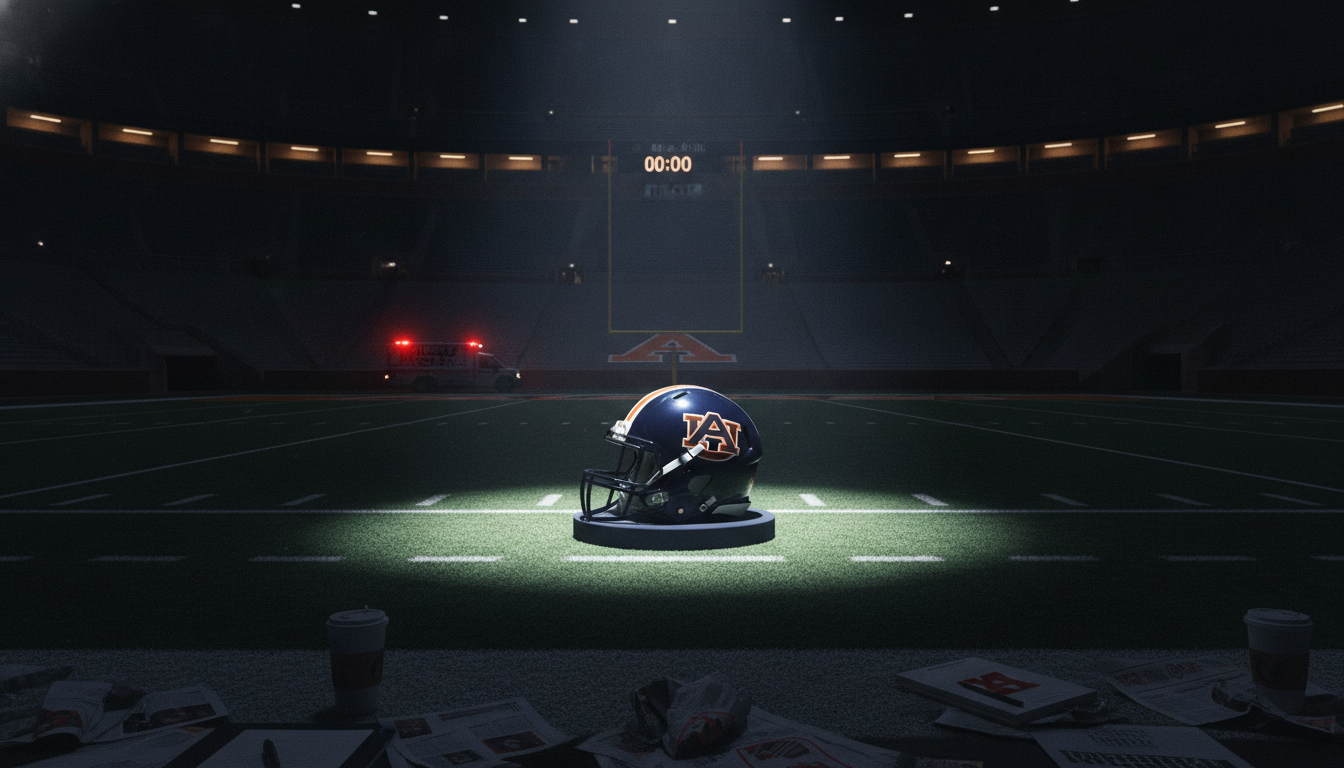
The lights at Jordan-Hare Stadium seemed to hang a little heavier in the humid Alabama air last Saturday night. The roar that had shaken the turf for four quarters subsided into a collective, hollow sigh. On the scoreboard, the final verdict was a gut punch: Florida 44, Auburn 39. For the thousands on the Plains, it was a familiar sting, a loss to a rival that felt agonizingly close. Yet, as the initial disappointment faded, a different feeling began to settle in—not one of despair, but of defiant optimism. This wasn't a collapse; it was a duel. And in that five-point margin, the future of Auburn football under its new architect, Alex Golesh, came into sharp, undeniable focus.
The Golesh Blueprint in Action
Hired in late 2025, Alex Golesh arrived at Auburn with a reputation for dynamic, high-tempo offense. The promise of a schematic revolution was the bedrock of his hiring, and through the early weeks of the Football Season 2026-2027, the installation process has been the team's central storyline. Adjusting to a new coach and a completely new system is a monumental task, often marked by disjointed play and frustrating lulls. But against a formidable Gators defense, the Tigers didn't just adjust; they attacked. Putting up 39 points in a conference slugfest is no small feat, and it serves as the most concrete evidence yet that the Golesh blueprint is not just theoretical—it’s taking hold in real-time.
This isn't about moral victories; it's about measurable progress under a new regime, where the margin for error is as thin as the final score.
Byrum Brown: Field General for a New War
At the heart of this offensive transformation is quarterback Byrum Brown. Tasked with piloting a system that demands rapid processing and decisive execution, Brown has become the on-field extension of his head coach. Against Florida, he was the engine that made the machine roar. While the final play didn't fall Auburn's way, his performance in the crucible of an SEC rivalry demonstrated a command and resilience that belies the newness of the system around him. The chemistry between a new-era coach and his quarterback is paramount, and the 39-point outburst suggests that the partnership between Golesh and Brown is rapidly evolving from a work-in-progress to a legitimate threat.
Forging an Identity on the Plains
Every team in transition searches for its identity. Is it a gritty, defensive-minded squad? A high-flying offensive juggernaut? A disciplined, mistake-free unit? The Golesh era is still in its infancy, but the identity taking shape is one of relentless, aggressive competence. The team fought. They answered scores with scores. They refused to break when Florida surged, pushing back until the final whistle. This resilience, this refusal to fold in the face of adversity, is precisely the cultural foundation Golesh aims to build. A loss is a loss in the SEC standings, but the character revealed in that battle will pay dividends long after the sting of this one game subsides.
Beyond the Box Score
The road ahead for the Tigers remains challenging, as it always does in the Southeastern Conference. There will be more tests, more moments where the game hangs on a razor's edge. But the narrative surrounding Auburn football has shifted. The question is no longer *if* the new system will work, but *how quickly* it will achieve consistent, game-winning results. The Florida game was a painful lesson in just how narrow the gap is between a tough loss and a signature win. For Alex Golesh, Byrum Brown, and the rest of the Tigers, that narrow gap is no longer an impassable chasm. It’s the final frontier they now know they have the firepower to cross.
Published about 19 hours ago
Staff
Staff writer for SEC Saturday Wire covering college sports.
Process Notes & Methodology
The central idea is to frame the narrow 44-39 loss to Florida not as a failure, but as a powerful proof of concept for new head coach Alex Golesh's system. This approach allows me to build a compelling narrative about a team on the verge of a breakthrough, turning a negative data point (a loss) into a forward-looking, optimistic story.
I opened with a scene-setting lede describing the atmosphere at Jordan-Hare Stadium right after the close loss. This strategy is anchored in the 'last_game' fact and immediately establishes the emotional stakes of the story.
The body is constructed around the three core facts provided in 'current_storylines': Alex Golesh is the new coach, the team is adjusting to his new system, and they just suffered a narrow loss. I used the 39 points scored as evidence of the new system's effectiveness and highlighted QB Byrum Brown as the leader executing that system.
The closing paragraph pivots from the specific result of the Florida game to the future implications for the rest of the Football Season 2026-2027. It frames the loss as a crucible that revealed the team's potential and sets up the narrative that they are now on the cusp of turning these close losses into wins.
See something wrong? Fix it.
We're the first crowdsourced college football site. Submit corrections — our editors review every one.