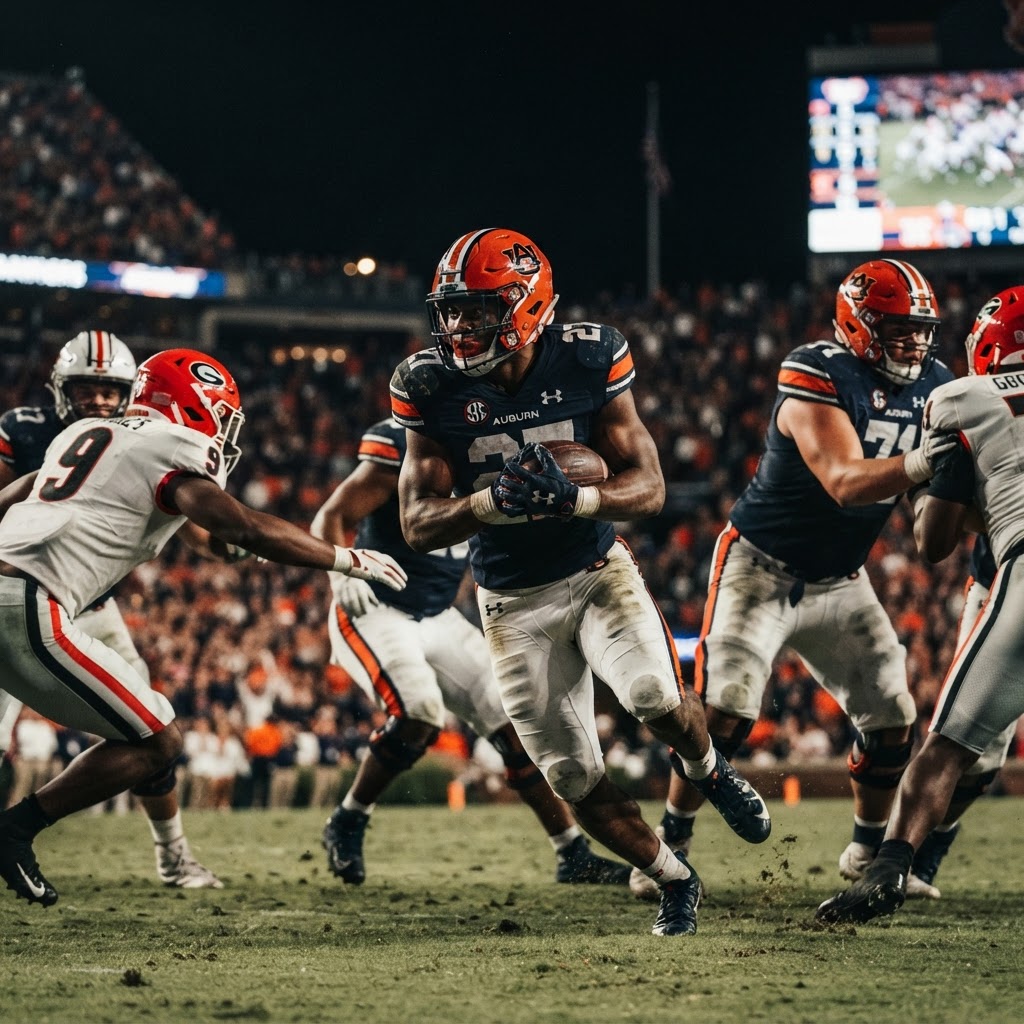
A New Era Dawns: The Golesh-Brown Connection in Auburn
Navigating the complexities of a transition season as the Tigers redefine their offensive identity.

The Atmosphere of Change on the Plains
The humid air on the Plains carries more than just the scent of cut grass this September; it carries the weight of a monumental reset. As the calendar settles into mid-September 2026, the Auburn Tigers find themselves navigating the early chapters of the Football Season 2026-2027 under the guidance of first-year head coach Alex Golesh. Every practice rep and every whistle blown in the facilities represents a deliberate move away from the past and toward a high-octane future.
The Orchestrator at the Helm
Alex Golesh, who officially assumed the mantle on January 1, 2026, has brought a palpable intensity to the program. The transition hasn't been without its growing pains, but the mandate remains clear: install a culture of efficiency and relentless competition. Golesh’s arrival marks the single most significant pivot point for a program hungry to reclaim its place in the upper echelon of the SEC.
Gordon’s Tactical Revolution
Tasked with translating Golesh's vision into points, offensive coordinator Joel Gordon is implementing a system designed to exploit space and tempo. The scheme is tailored to utilize the veteran savvy of Byrum Brown, who serves as the undisputed leader of the quarterback room. With depth provided by John Colvin and Locklan Hewlett, the room is evolving, but the focus remains entirely on Brown’s ability to distribute the ball under this new, demanding offensive structure.
The Senior Standard
In a college football landscape defined by constant fluctuation, the presence of an experienced signal-caller like Byrum Brown is an absolute luxury. Brown is not just a participant in the new system; he is an extension of Gordon on the field, bridging the gap between coaching staff intent and game-day execution. Success in the SEC often hinges on the ability of a quarterback to manage the chaos of a rebuild, and the Tigers are leaning heavily on Brown to be that stabilizing force. The chemistry developing between Brown and the offensive staff is the defining story of this early campaign.
The Analytical Lens
True progress in a head coaching transition is measured not by the scoreboard alone, but by the increasing synchronization of the scheme with the personnel’s unique physical capabilities. As the Tigers continue to sharpen their edges, the path forward is illuminated by the synergy between Golesh's philosophy and Brown's seasoned field generalship. They are currently laying the foundation for a sustainable competitive model that prioritizes internal development over quick fixes.
Looking Ahead
As the schedule progresses through the heart of the Football Season 2026-2027, the focus for Auburn will remain on refinement. With the groundwork laid by Golesh and the system taking root under Gordon, the Tigers are preparing to test their mettle in the crucible of SEC competition, keeping a steady eye on the long-term vision of a program undergoing a total, disciplined transformation.
Published 15 days ago
Staff
Staff writer for SEC Saturday Wire covering college sports.
Process Notes & Methodology
The article focuses on the transition under Alex Golesh and the reliance on Byrum Brown to lead the new offensive system. It is relevant because it frames the current 2026-2027 season as a pivotal building year for the program.
The opening uses the late September timing and the arrival of Alex Golesh to set a tone of structural change. It anchors the piece to the verified start date of Golesh’s tenure.
The body details the specific roles of Alex Golesh and Joel Gordon while highlighting the veteran presence of Byrum Brown. It emphasizes the importance of the new offensive system as the primary challenge for the 2026-2027 season.
The closing highlights the importance of internal growth and system development, setting up the expectation that the team is focused on long-term success rather than immediate, short-term results.
See something wrong? Fix it.
We're the first crowdsourced college football site. Submit corrections — our editors review every one.