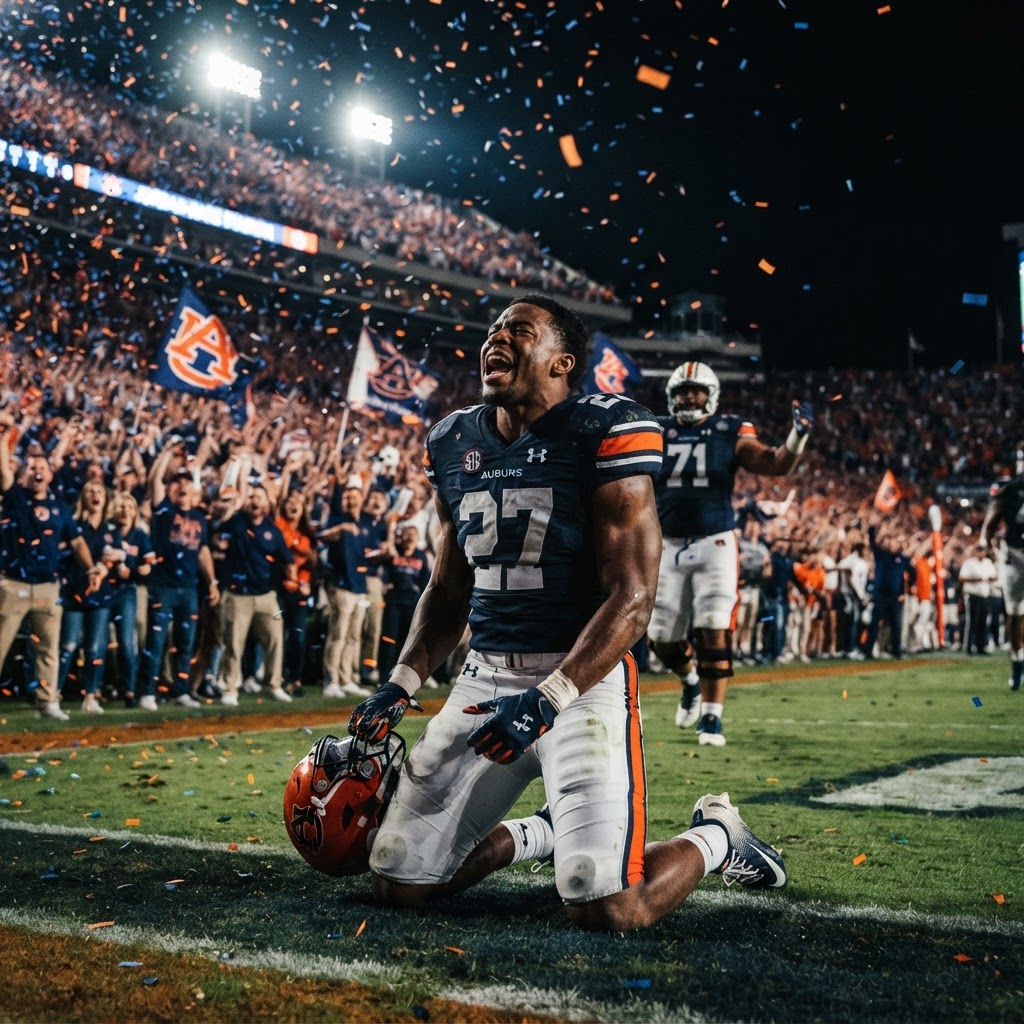
Crucible on the Plains: Alex Golesh, Byrum Brown, and Auburn's High-Stakes Rebuild
As the July heat bears down, an unprecedented transfer class is forging a new identity in the weight room, aiming to snap an eight-year bowl drought and resurrect a sleeping SEC giant.

It is July 15, 2026, and a suffocating, familiar humidity has settled over the plains of eastern Alabama. Inside the Auburn Tigers' athletic complex, however, the temperature is dictated entirely by a different kind of pressure. The rhythmic, deafening clank of iron, the sharp directives of strength coaches, and the guttural roars of exertion are the soundtrack of a program undergoing a massive, structural overhaul. Under the meticulous gaze of first-year head coach Alex Golesh, the dog days of summer have become a proving ground. The program is deep into the grind of its summer training period, and the focal point has narrowed to a singular, non-negotiable objective: forging an identity before the autumn lights turn on.
Auburn football is currently navigating the most anticipated phase of its modern calendar. Last season's 5-7 finish was a bitter pill, extending a jarring bowl game drought that dates back to 2018 and prolonging the agonizing wait for a winning season, a milestone not achieved since 2019. But the lethargy of those past campaigns has been violently exorcised from the building. The arrival of Golesh in late 2025 signaled the beginning of a total program rebuild, one defined by urgency, calculated aggression, and a complete reimagining of the roster's DNA.
The Anatomy of an Unprecedented Overhaul
To understand the sheer scale of the task Golesh and his staff have undertaken, one only needs to look at the roll call. Auburn's 2026 roster features a staggering 39 incoming players acquired via the transfer portal. It is the largest single-season transfer haul in the storied history of the program. Rather than merely patching holes, Golesh, alongside offensive coordinator Joel Gordon and defensive coordinator DJ Durkin, has essentially transplanted a new central nervous system into the team. The trenches and the secondary were the primary targets of this aggressive acquisition strategy, netting nine offensive linemen and seven defensive backs.
New arrivals like Bryson Washington, Keshaun Singleton, Da'Shawn Womack, and Stanton Ramil are sweating through these grueling Workout Wednesday sessions, tasked with internalizing the playbook while simultaneously learning the tendencies of the men spotting them on the bench press. The sheer volume of new faces makes this stage of the Spring Ball and Recruiting calendar critical. Talent has been acquired, but chemistry cannot be downloaded from the portal; it must be forged under the heavy stress of July conditioning.
The modern SEC rebuild is no longer a slow, multi-year burn; it is a flash-forged alloy of transfer portal acquisitions and immediate expectations, bound together by the sheer gravity of a franchise quarterback.
The Three-Million-Dollar Catalyst
If the 39 transfers represent the raw materials of Auburn's rebuild, the white-hot forge is new starting quarterback Byrum Brown. Brown is the undeniable crown jewel of the transfer class, a dual-threat superstar who followed Golesh from South Florida to the Plains. Armed with a reported $3 million-plus NIL deal to serve as the face of the program, Brown is not shying away from the immense expectations resting on his shoulders.
Brown famously led all FBS quarterbacks in total offensive production last season, amassing over 4,100 combined yards through the air and on the ground. But it is his presence behind closed doors that is currently generating the most optimism in Auburn. As the centerpiece of Golesh's offensive system, Brown is utilizing Workout Wednesdays to establish himself as the alpha of the locker room. Inside the strength and conditioning facility, his numbers are reported to be through the roof, shattering traditional quarterback benchmarks and demanding the respect of the nine new offensive linemen tasked with protecting him. He is not just building his own physique for a punishing nine-game SEC schedule; he is manually tying the threads of a fractured locker room together.
A Triumph of Resilience
While Brown's arrival represents the infusion of new blood, the heartbeat of the team might well belong to a familiar face who has traversed his own personal hell to be here. Fifth-year senior kicker Alex McPherson has authored the most inspiring narrative of the summer. For two years, McPherson battled a severe case of ulcerative colitis, a debilitating illness that stripped 55 pounds from his frame and drastically limited his availability in 2024 and 2025.
Today, McPherson is verified to be at 100 percent health. His recovery is nothing short of a medical and athletic marvel. Entering the 2026 campaign with a career 88 percent field goal accuracy and a flawless record of never missing a PAT, McPherson is expected to be a vital weapon for a team that anticipates playing in razor-close SEC dogfights. His resilience embodies the exact cultural toughness Golesh is demanding from the rest of the roster.
Taking the Stage in Tampa
The progress made in the weight room is about to be dragged into the national spotlight. The buzz surrounding the program is swiftly pivoting toward the upcoming SEC Media Days, scheduled for July 20-23. In a historic first, the premier media event is being held in Tampa, Florida, a poetic backdrop for the USF transplants Golesh and Brown. On July 14, Auburn officially announced its representatives for the event: Coach Golesh, quarterback Byrum Brown, the resurgent kicker Alex McPherson, and returning defensive back Champ Anthony.
The selection of these three players is deeply intentional. Brown represents the high-profile future and the portal revolution. Anthony represents the veteran returning core under DJ Durkin's defensive scheme. McPherson represents the unwavering grit and survival instinct of the Auburn spirit. Together with Golesh, they will face a media contingent eager to see if this unprecedented roster experiment can survive the rigors of the nation's premier football conference.
Atlanta Calling
Beyond the talking points in Tampa lies the brutal reality of the 2026 schedule. The Tigers are preparing for a massive stage on September 5, when they will open the season against Baylor at Mercedes-Benz Stadium in Atlanta. The 2:30 p.m. CT kickoff, broadcast nationally on ABC, will be the first live-fire test for a team built almost entirely in the span of a single offseason.
Following Baylor, Auburn must navigate a grueling nine-game SEC gauntlet. But Golesh is refusing to look past the horizon of today. His focus remains locked on the identity being shaped right now, rep by rep, in the suffocating heat of Workout Wednesdays. The momentum is already spilling over into the program's long-term health, verified by a top-10 national recruiting forecast for the 2027 class following a string of highly successful summer visits. Recruits are buying into the vision, but the current roster must validate that vision on the field.
As fall camp approaches and the dog days of summer slowly begin to wane, the 2026 Auburn Tigers stand on a precipice. The drought has been long, and the shadows of past failures still linger around the edges of the stadium. But in the weight room, where the air is thick with chalk and determination, history holds no weight. Only the iron matters. And under Alex Golesh, this team is lifting its way back into the light, ready to remind the SEC what happens when the sleeping giant on the Plains finally wakes up.
Published 3 months ago
Staff
Staff writer for SEC Saturday Wire covering college sports.
Process Notes & Methodology
The article focuses on the summer conditioning period as the catalyst for Auburn's program rebuild. It highlights the importance of this 'Workout Wednesday' phase in integrating a new-look roster.
The intro hooks the reader by anchoring the article to today's date and the current status of the program under first-year head coach Alex Golesh.
The body leverages the storyline of integrating new transfers and the central role of Byrum Brown. It also references the specific goal of ending a long-standing bowl game drought to provide stakes for the summer work.
The conclusion pivots to the upcoming nine-game SEC schedule, framing the summer workouts as the essential preparation for the challenges the team will face in the fall.
See something wrong? Fix it.
We're the first crowdsourced college football site. Submit corrections — our editors review every one.