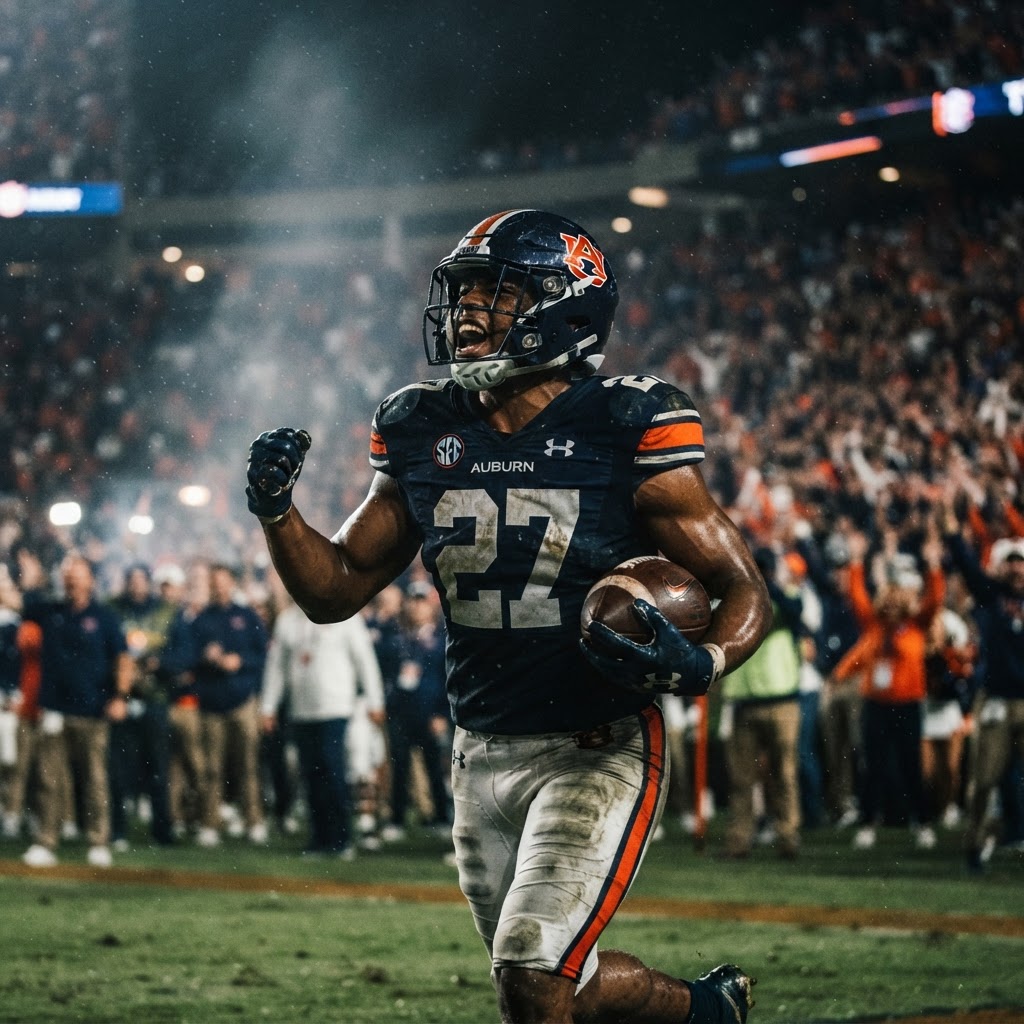
Auburn's 'Go-Fast' Renaissance: How Alex Golesh is Rebuilding the Tigers from the Portal Up
Armed with a historic dual-threat quarterback, a groundbreaking NIL strategy, and a completely retooled roster, Auburn enters 2026 looking to wipe the slate clean and shock the SEC.

The Incubation of the 'Go-Fast' Era on the Plains
July on the Plains carries a distinct, suffocating weight. The summer humidity settles over Jordan-Hare Stadium like a heavy wool blanket, a seasonal rite of passage that tests the endurance of anyone stepping onto the unforgiving turf. Yet, as the intense heat of July 2026 reaches its peak, a different kind of energy is brewing inside the Auburn football complex. The program is bracing for the official launch of the Alex Golesh era, positioned for a highly anticipated cultural and tactical shift. Appointed following a turbulent 2025 campaign, Golesh is determined to wipe the slate clean. His signature 'Go-Fast' offensive philosophy—an uptempo, hyper-aggressive system designed to exhaust opposing defenses—has dominated the regional narrative. On Tuesday, July 21, the Tigers are scheduled to take the stage at SEC Media Days in Tampa, Florida. Represented by Golesh alongside quarterback Byrum Brown, defensive back Champ Anthony, and kicker Alex McPherson, Auburn aims to send a clear message: the sluggish transitions of the past are over, and a high-octane identity is ready to be unleashed.
High Stakes, Neutral Sites, and Modern NIL Frontiers
Auburn isn’t just looking to change its on-field product; the administration is aggressively navigating the modern machinery of college football. Look no further than the massive announcement that sent shockwaves through the industry this week. On July 15, Auburn and the Aflac Kickoff Game unveiled a multimillion-dollar NIL partnership. This staggering deal, a first of its kind for a neutral-site season opener, underscores the program's aggressive business strategy as they prepare to face the Baylor Bears on September 5 at Mercedes-Benz Stadium in Atlanta. With kickoff slated for 2:30 p.m. CT on ABC, the financial and promotional stakes have never been higher for a debut game. Golesh and his staff understand that establishing a resilient, winning culture requires not just schematic brilliance, but overwhelming institutional alignment. The Aflac partnership proves that Auburn’s boosters and administration are heavily invested in ensuring the 'Go-Fast' era has the financial foundation to compete at the absolute pinnacle of the sport.
The Crown Jewel and the Architecture of Exhaustion
At the very center of this massive transformation is dual-threat quarterback Byrum Brown, widely viewed as the crown jewel of Golesh’s transfer-heavy transition class. Brown didn't just transfer to Auburn in January 2026; he followed Golesh to the Plains specifically to serve as the on-field catalyst for this complex, breakneck system. His resume is nothing short of breathtaking. Coming off a historic 2025 campaign at USF, Brown produced 3,158 passing yards and 1,008 rushing yards, cementing his name as one of only 12 players in the history of college football to achieve the 3,000/1,000 milestone in a single season. Working alongside offensive coordinator Joel Gordon, Brown is tasked with orchestrating an offense that relies on snap-count volume and sheer exhaustion. Should the physical toll of the SEC require depth, a highly competitive A-Day spring game confirmed that freshman Tristan Ti'a and Locklan Hewlett have officially emerged as the primary backups, providing a totally fresh start for a quarterback room navigating a complete rebuild.
Rebuilding the Wall and Restocking the Arsenal
While the offensive backfield possesses undeniable explosive potential, the ultimate success of the 2026 season hinges on a completely overhauled offensive line. The reality up front is stark, bordering on unprecedented: Auburn is projected to field five brand-new starters, featuring exactly zero returning starts from the 2025 roster. The staff utilized the transfer portal heavily, bringing in nine offensive line transfers—including massive additions like Stanton Ramil—who must immediately gel. To mitigate this dangerous transition phase, the offensive coaching staff will lean heavily on a dynamic backfield to establish a reliable, steadying ground game.
- Jeremiah Cobb: The talented returning sophomore is expected to carry a significant load and provide breakaway speed on the perimeter.
- Bryson Washington: The experienced Baylor transfer brings proven physicality and veteran vision, crucial for grinding out tough yards between the tackles.
If Auburn is to realize its potential as an SEC dark horse, the completely rebuilt offensive line must stabilize by September; everything in the 'Go-Fast' scheme relies on the men in the trenches finding immediate chemistry. A tempo offense that cannot block is simply a vehicle for rapid three-and-outs.
The urgency to find immediate chemistry extends to the perimeter, where the Tigers suffered massive offseason attrition. The high-profile portal departures of promising receivers Cam Coleman, Malcolm Simmons, and Perry Thompson left a glaring vacuum. That wound was salted again this week when, on July 15, three-star 2027 in-state wide receiver Cedrick Simmons flipped his commitment from Auburn to rival Alabama. Golesh, however, anticipated the depth crisis. Utilizing his deep ties to his former program, he successfully imported five wide receiver transfers from USF, remarkably securing four of their top five producers from the previous year. They already know the route trees, the tempo, and the quarterback—a massive structural advantage.
Defensive Continuity and the Heartbeat of the Roster
On the other side of the ball, the narrative shifts from total overhaul to calculated continuity. In a deeply strategic move, Golesh retained Defensive Coordinator D.J. Durkin. The Auburn defense lost significant veteran production this offseason to the NFL Draft and the transfer portal, but Durkin’s units have consistently ranked in the top 20 nationally. He is currently refining an aggressive, pressure-heavy hybrid scheme designed to dictate the pace of the game and mask transition woes with relentless backfield disruption. Returning core talents like Jared Smith, Kaleb Harris, Eric Winters, and AnQuon Fegans provide the exact brand of hard-hitting versatility required to execute Durkin's vision, alongside newly imported edge rusher Da'Shawn Womack. The secondary is further bolstered by the presence of a healthy Champ Anthony, who will carry the defensive mantle in Tampa next week.
Yet, perhaps the most inspiring storyline on the entire roster belongs to special teams. Fifth-year senior kicker Alex McPherson returns to the gridiron after a grueling, life-altering battle with ulcerative colitis in 2024. The illness caused a staggering 55-pound weight loss, threatening not just his football career, but his long-term health. His triumphant return to uniform provides an emotional anchor for a locker room full of new faces. In a season defined by transition and aggressive new philosophies, McPherson’s resilience is the physical embodiment of the grit Golesh hopes to instill in his program.
Laying the Bedrock for a Dark Horse Campaign
Despite the massive roster turnover across both units and the inevitable growing pains of the portal era, optimism surrounding the program’s baseline floor is palpable. Preseason consensus increasingly views Auburn as a dangerous dark horse in a crowded, unforgiving SEC. Regional analysts are openly predicting the program could secure its most competitive finish since 2021, provided the trench play matures quickly and the 'Go-Fast' mechanics find their rhythm before October. Furthermore, despite the recent recruiting sting at receiver, Auburn's 2027 recruiting class currently sits firmly within the national top 10, signaling supreme long-term stability with the addition of several highly coveted commits.
For Alex Golesh and the Tigers, the 2026 objective is crystal clear: establish a resilient culture, translate the high-octane intensity of spring drills into immediate on-field results in Atlanta, and lay an unbreakable foundation for the future. The humidity of July will soon give way to the crisp pressure of autumn, and when the bright lights hit Mercedes-Benz Stadium, the college football world will finally see if Auburn's great portal experiment was built to last.
Published 3 months ago
Staff
Staff writer for SEC Saturday Wire covering college sports.
Process Notes & Methodology
The angle focuses on the transition under Alex Golesh, highlighting the contrast between the total rebuild on the offensive line and the elevated expectations for the team's floor. It positions the program as a team on the rise based on recruiting momentum and offensive identity.
I used the specific timeframe of the Spring Ball & Recruiting 2026 season to frame the transition to the new coaching staff led by Alex Golesh.
I integrated the QB situation (Byrum Brown), the offensive line rebuilding narrative, the backfield strength featuring Jeremiah Cobb, and the defensive leadership under DJ Durkin to show the breadth of the current roster situation.
I closed by tying the immediate on-field outlook to the long-term success shown in the 2027 recruiting class, creating a forward-looking trajectory for Auburn fans.
See something wrong? Fix it.
We're the first crowdsourced college football site. Submit corrections — our editors review every one.