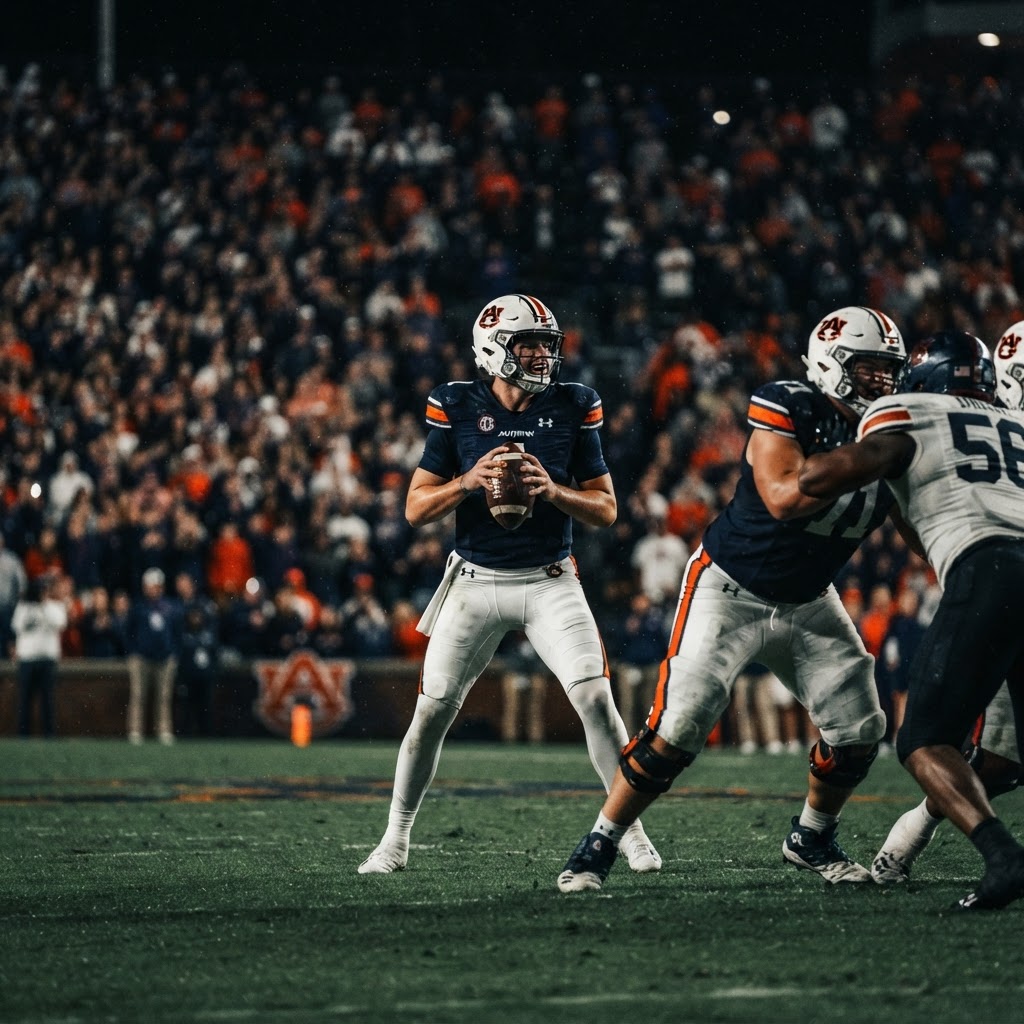
Fast-Breaks and Forged Steel: Inside Auburn's Reconstruction Under Alex Golesh
As a new era dawns on the Plains, head coach Alex Golesh and a cast of resilient transfers are turning a total roster overhaul into a high-tempo foundation.

As the oppressive, humid heat of mid-July settles over the Plains, the Auburn Tigers find themselves standing squarely at the intersection of a bitter past and a fiercely ambitious future. A disappointing 5-7 campaign in 2025 triggered a seismic overhaul in Lee County, ushering in first-year head coach Alex Golesh and initiating a profound cultural and schematic shift. The period of transition—the proverbial "honeymoon phase"—is officially over. The foundation has been poured, the blueprints have been laid bare, and the focus has now turned entirely to violent, high-tempo execution.
In a poetic twist of scheduling, the first public unveiling of this new identity will take place on July 21 in Tampa, Florida, the site of the 2026 SEC Media Days. For Golesh, it is a symbolic homecoming. Tampa is where he recently orchestrated a blistering, record-breaking offense at the University of South Florida. When he steps to the podium next week, he won't be alone in representing that Gulf Coast pedigree. He will be joined by the unquestioned centerpiece of Auburn's transformation: transfer quarterback Byrum Brown. Together, they are tasked with dragging Auburn's offense into the modern era, setting a pace that the rest of the SEC will be forced to match.
Installing the 'Fast-Break on Grass'
To understand the sheer scale of Auburn's offensive pivot, one must look at the conductor of Golesh and offensive coordinator Joel Gordon's system. Byrum Brown did not simply arrive on the Plains with a commendable resume; he arrived with historic credentials. In 2025, Brown became one of only 12 players in the history of the FBS to record 3,000 passing yards and 1,000 rushing yards in a single season.
Amassing over 4,100 yards of total offense (3,158 passing, 1,008 rushing) and 42 total touchdowns last year, Brown is the archetypal dual-threat engine required for Golesh's hyper-aggressive "Fast-Break on Grass" philosophy. The transition, however, has not been without its requisite growing pains. At the April 18 A-Day spring game, the defense routinely disrupted the timing of the new offense. Brown struggled slightly, completing just 7-of-14 passes for 85 yards and two interceptions.
Yet, out of that springtime friction emerged one of the most vital developments of Auburn's offseason: the rapid ascension of backup quarterback Tristan Ti'a. Flashing poise and precision, Ti'a generated massive internal buzz by carving up the secondary for 15-of-20 completions, 179 yards, and a touchdown.
The spring game revealed a crucial truth for Auburn: while Byrum Brown is the presumptive starter and the engine of this new tempo, Tristan Ti'a's breakout performance ensures the quarterback room possesses the competitive depth required to survive a grueling SEC schedule. The floor has been raised, forcing iron to sharpen iron on a daily basis.
Portal Plunder and the Arsenal Assembly
Operating a high-octane offense requires premium fuel, and the Auburn coaching staff recognized immediately that the roster they inherited lacked the necessary firepower. Golesh and his staff aggressively attacked the transfer portal and the high school recruiting trail, pulling off a monumental logistical feat by vaulting the Tigers' 2026 recruiting class from a dismal 93rd nationally all the way to 35th by National Signing Day. That momentum has held steady through mid-July.
The supporting cast surrounding Brown has been entirely reconstructed to maximize the quarterback's unique skill set. The backfield has been bolstered by the acquisition of Bryson Washington. The physically punishing transfer running back from Baylor adds immediate, bruising power to the rotation, bringing the 1,028 rushing yards he produced in 2024 to pair with dynamic returning leading rusher Jeremiah Cobb.
In the passing game, Auburn tapped into the Tampa connection once again, securing versatile USF tight end transfer Jonathan Echols. Signing in January, Echols brings a dependable 12.1 yards per reception to the offense, acting as a crucial safety valve and a matchup nightmare in the seams. Additional portal reinforcements, including offensive tackle Stanton Ramil and edge defender Da'Shawn Womack, signal a program prioritizing immediate, battle-tested SEC size over long-term developmental projects.
Scars and Salvation: The Leaders of the New Roster
While the schematic changes are drawing the lion's share of offseason headlines, the selections for Auburn's SEC Media Days representatives reveal the true cultural DNA of Golesh's program. Joining Golesh and Brown in Tampa will be kicker Alex McPherson and safety Champ Anthony—two players whose journeys are defined by unimaginable resilience.
McPherson's return to 100% health is arguably the most inspiring storyline in the Southeastern Conference this year. The star specialist spent the better part of the 2024 and 2025 seasons battling a severe, life-altering bout of ulcerative colitis. The disease ravaged his body, causing him to lose an astonishing 55 pounds. His physical recovery and return to elite kicking form is a testament to sheer human willpower, giving the Tigers absolute confidence in their specialist unit.
Similarly, Champ Anthony has been fully cleared for the 2026 campaign after enduring a horrific broken leg and a cascade of recurring lower-body injuries over the last two years. By selecting McPherson and Anthony as the faces of the program in Tampa, Golesh is sending a clear message to the locker room and the rest of the conference: Auburn will be defined by its grit, its refusal to fold, and its capacity to endure pain.
The Defensive Anchor Amidst the Overhaul
When an incoming head coach takes over a struggling program, the standard operating procedure is to clean house. Golesh, however, proved his pragmatism by making the crucial decision to retain defensive coordinator D.J. Durkin. While the 2025 offense sputtered, Durkin's unit remained a pillar of stability and a beacon of hope.
Under Durkin's watch, the Tigers fielded a defense that ranked 31st nationally in total defense and a highly impressive 12th in the country against the run, allowing a stingy 99.3 yards per game on the ground. Maintaining continuity on that side of the ball ensures that Golesh's new offense will have a sturdy safety net as it works through early-season growing pains. With veteran returning starters like Eric Winters, Jared Smith, and AnQuon Fegans patrolling the field, the defense expects to be the steadying force that keeps the team in dogfights against the upper echelon of the expanded SEC.
The Road to Atlanta
The talking season will officially peak next week in Tampa, but the words spoken at the podium will quickly evaporate into the suffocating humidity of an Auburn August. The Tigers are currently projected by pundits to finish in the middle-to-lower tier of the brutal, newly expanded SEC. Inside the facility, however, the veteran presence on the offensive line and the defensive front has fostered a quiet, dangerous confidence.
Auburn's 'New Era' officially kicks off on September 5, 2026, beneath the bright lights of Mercedes-Benz Stadium in Atlanta. In a fascinating twist of fate, they will face the Baylor Bears in the Aflac Kickoff Game, pitting transfer running back Bryson Washington against his former teammates right out of the gate. The time for reflection and roster building is at its end. Coach Golesh and Byrum Brown have constructed the engine; against Baylor, the college football world will finally see how fast it can run.
Published 3 months ago
Staff
Staff writer for SEC Saturday Wire covering college sports.
Process Notes & Methodology
The article focuses on the transition under Alex Golesh by highlighting the synergy between new coaching philosophies and the influx of talent. It is relevant because it frames the spring activities as the necessary building blocks for the upcoming season.
The hook establishes the current summer timeline and immediately introduces Alex Golesh as the anchor of the team's new direction.
The body content integrates the offensive transition led by Byrum Brown and Joel Gordon, while balancing it with the defensive stability provided by D.J. Durkin. It also references the spring game format to provide concrete context for the team's offseason activity.
The closing highlights the importance of roster depth and the competitive foundation built during the spring to prepare the team for the challenges ahead.
See something wrong? Fix it.
We're the first crowdsourced college football site. Submit corrections — our editors review every one.