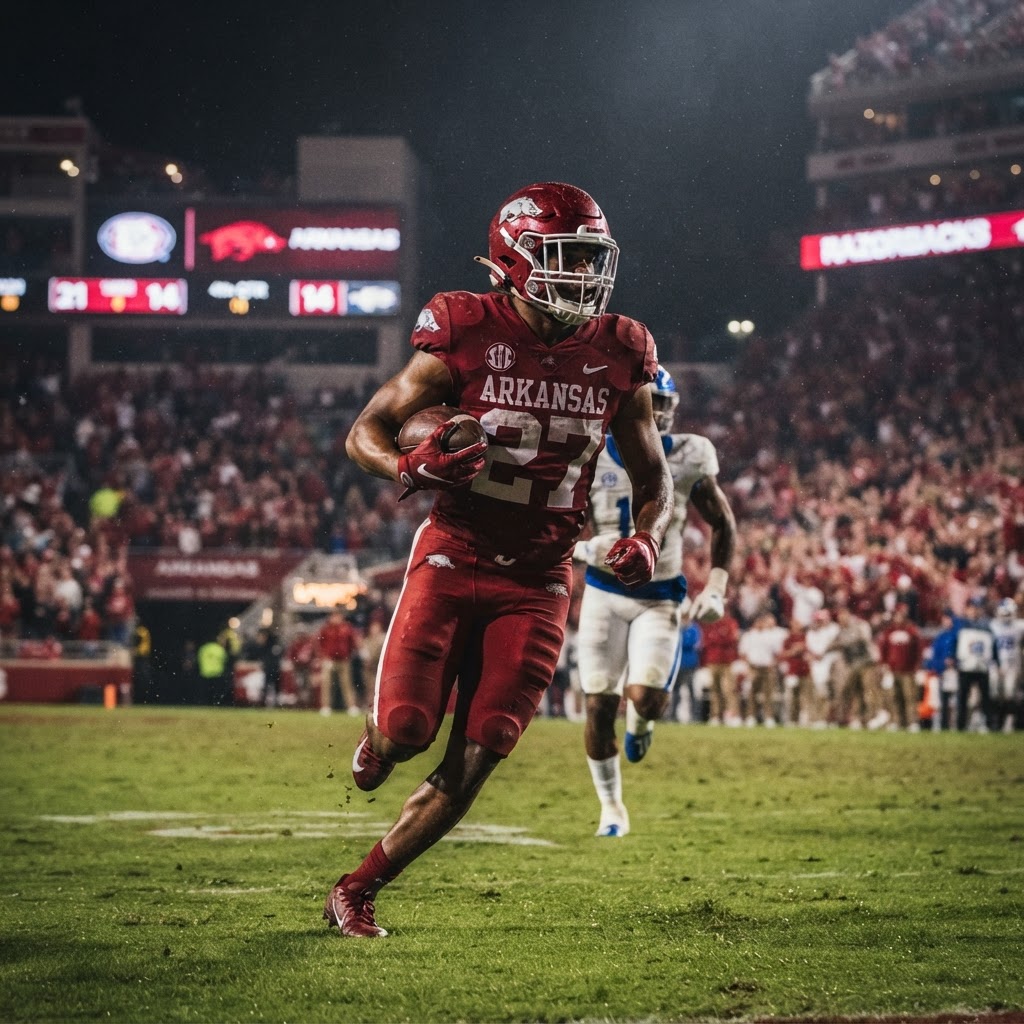
Reconstructing the Razorbacks: Ryan Silverfield's Methodical Blueprint for a New Arkansas Identity
In the wake of a grueling 2025 campaign, head coach Ryan Silverfield used the SEC Media Days spotlight to declare his starting quarterback, unveil a physical offensive vision, and lay the foundation for a cultural resurrection in Fayetteville.

The mid-July heat that bakes the asphalt across Fayetteville is a suffocating, heavy blanket, but 350 miles southwest, amidst the air-conditioned opulence of the Omni Dallas Hotel, the temperature surrounding the Arkansas Razorbacks felt decidedly different this week. Making his highly anticipated SEC Media Days debut on July 14, 2026, head coach Ryan Silverfield stepped to the podium not to make grandiose promises, but to outline a methodical, unyielding blueprint for survival. Hired on November 30, 2025, to salvage a proud program reeling from a catastrophic 2-10 campaign, Silverfield is overseeing a massive cultural and structural overhaul. The mandate is clear: the Razorbacks must become harder to break. For a fan base starved for momentum, the narrative is finally shifting from the wreckage of the past to the possibilities of the future.
The Dallas Declaration and a Culture of Sweat
Rebuilding a broken football team rarely begins with a schematic revelation; it begins in the weight room. During his podium session, Silverfield emphasized that the program's reported 100 percent participation rate in voluntary summer conditioning is the first tangible evidence of the roster's collective buy-in. It is a striking metric for a locker room that had fractured during the turbulent final weeks of 2025. This cultural reconstruction is not built on flash, but on a grueling, sweat-equity foundation. To execute Silverfield's vision, the Razorbacks have undergone a massive roster overhaul, incorporating over 40 incoming transfers to plug critical depth charts and talent gaps. The objective is to construct a unified front out of disparate parts, turning a portal-heavy roster into a cohesive unit before the autumn leaves turn.
In the unforgiving hierarchy of the SEC, rapid turnarounds are rarely born of sheer talent alone; they are forged by the mundane, unglamorous metrics of accountability, where a flawless summer conditioning attendance sheet speaks louder than any preseason projection.
Resolving the Quarterback Equation: The KJ Jackson Era
The most pressing storyline throughout the spring and early summer was the high-stakes offensive realignment and the quarterback battle required to run it. Silverfield used his time in Dallas to officially end the speculation: sophomore dual-threat KJ Jackson is the definitive starting quarterback for the 2026 season. Jackson had spent the spring locked in a dead heat with highly-touted transfer AJ Hill, whose impressive precision kept the competition tight. However, Jackson’s dynamic athletic ability and growing command of offensive coordinator Tim Cramsey’s new system ultimately separated him from the pack. Silverfield praised Jackson's mastery of the 'Power-Spread' hybrid offense—a scheme designed to blend bruising downhill running with vertical perimeter shots. Jackson's ascension brings vital stability to the most critical position on the field, allowing the offense to spend fall camp refining timing rather than evaluating auditions.
Forging the Power-Spread Trenches and Perimeter Weapons
For Jackson to succeed, the infrastructure around him had to be fortified. The 'Power-Spread' heavily relies on physical superiority at the point of attack, an area where Arkansas struggled mightily last autumn. According to the coaching staff, the offensive line has made the most significant physical strides under the new strength and conditioning program. This resurgence is anchored by the interior returning tandem of center Caden Kitler and guard Kobe Branham, the designated starters heading into fall camp. Their ability to control the A and B gaps will dictate the efficacy of the run-first foundation. On the perimeter, Jackson has developed palpable chemistry with CJ Brown, who steps up as the program's leading returning pass-catcher. To ensure the passing game possesses genuine explosive capability, the staff secured graduate transfer Davion Weatherspoon in May 2026. Weatherspoon has been confirmed as a primary vertical threat for the new-look receiving corps, offering immediate veteran savvy and a deep-ball dimension that opposing safeties must respect.
Defensive Reassembly: Stopping the Bleeding
While the offense commands the headlines, defensive coordinator Ron Roberts has been quietly executing emergency surgery on a unit that was routinely overwhelmed at the point of attack in 2025. The coaching staff aggressively utilized the post-spring transfer window to find immediate-impact players capable of matching the new staff's physical expectations. The undisputed centerpiece of this defensive rebuild is transfer defensive tackle Xadavien Sims. The buzz radiating from both Fayetteville and Dallas centered on Sims' physical transformation; staff reports officially verified that he has reached a playing weight of 315 pounds. Sims is positioned as the primary interior anchor desperately needed to plug interior gaps and improve a run defense that leaked yardage a year ago. In the secondary, the Razorbacks have found an unexpected vocal leader in incoming transfer defensive back Carter Stoutmire. Tasked with bringing reliability to a rebuilt defensive backfield, Stoutmire has drawn high praise from Silverfield for his high football IQ and his innate ability to stabilize the deep third of the field through tight coverage and pre-snap communication.
Closing the Borders: A Localized Recruiting Resurgence
The momentum generated inside the facility is beginning to manifest on the recruiting trail, providing long-term validation for Silverfield’s localized strategy. On July 12, the Razorbacks secured a massive victory with the verbal commitment of four-star offensive tackle Marcus Webb. Webb, a highly-coveted prospect from the Natural State, chose Arkansas over a host of regional heavyweights. This blue-chip acquisition signals a successful start to Silverfield's 'close the borders' recruiting initiative for the 2027 cycle. By securing elite homegrown talent, the new staff is proving that their vision for a revitalized Arkansas is already resonating deeply at home, reestablishing a protective fence around the state's top prospects.
The Imminent Crucible
With fall camp rapidly approaching in August, external expectations remain predictably tempered. Media projections currently place Arkansas in the bottom third of the expanded SEC, a byproduct of the treacherous road ahead. The 2026 schedule is universally viewed as a significant stress test, featuring brutal matchups against high-level opponents like Georgia and Texas. The campaign begins with a necessary season opener against North Alabama at Donald W. Reynolds Razorback Stadium—a game that will serve as a live-fire dress rehearsal. Immediately following that tune-up, the Razorbacks face an intriguing, first-ever historic matchup with Utah. Local analysts widely view this Week 2 clash against the Utes as the definitive litmus test for Silverfield’s cultural overhaul, providing a clear early barometer of just how far the physicality and discipline have evolved.
As the Razorbacks navigate the fleeting weeks of the 2026 summer window, the emphasis remains fiercely insulated. Silverfield continues to preach a gospel of incremental growth, ignoring the noise of preseason prognostications in favor of daily, measurable improvement. Arkansas football is still deep in the crucible, but for the first time in a long time, the hammer striking the anvil is forging something that looks undeniably resilient.
Published 3 months ago
Staff
Staff writer for SEC Saturday Wire covering college sports.
Process Notes & Methodology
The story centers on the optimism surrounding a new head coach, Ryan Silverfield, as he attempts to rebuild the program. I focused on the transition phase, highlighting the QB competition and the influx of transfer talent to illustrate the program's momentum.
The intro hooks the reader by framing the current calendar period (Spring Ball & Recruiting 2026) as a pivotal moment for Silverfield to reshape the program's identity.
I utilized the current storyline of the QB battle between KJ Jackson and AJ Hill to provide tangible stakes. I also incorporated the list of new transfers and returning starters to demonstrate how the coaching staff is balancing fresh talent with veteran leadership.
The conclusion pivots to the upcoming 2026 schedule, specifically mentioning the North Alabama and Utah games to give fans a concrete goal for the team's ongoing development.
See something wrong? Fix it.
We're the first crowdsourced college football site. Submit corrections — our editors review every one.